Taliban sweep across Afghanistan's south; take 4 more cities
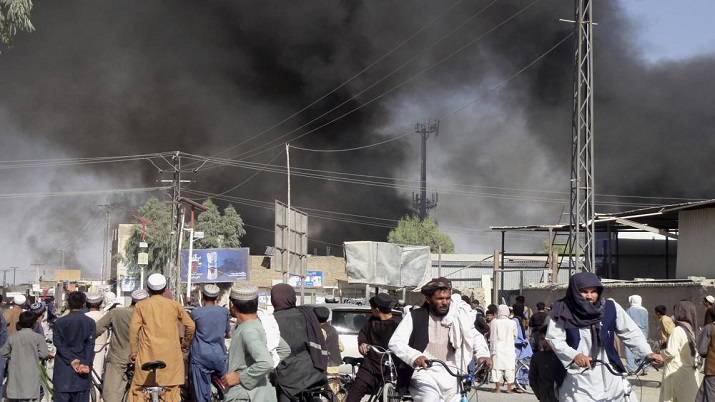
Kabul, Aug 13: The Taliban completed their sweep of the country's south on Friday as they took four more provincial capitals in a lightning offensive that is gradually encircling Kabul, just weeks before the US is set to officially end its two-decade war.
In just the last 24 hours, the country's second- and third-largest cities Herat in the west and Kandahar in the south have fallen to the insurgents as has the capital of the southern Helmand province, where American, British and NATO forces fought some of the bloodiest battles of the conflict.
The blitz through the Taliban's southern heartland means the insurgents now hold half of Afghanistan's 34 provincial capitals and control more than two-thirds of the country weeks before the US plans to withdraw its last troops. The Western-backed government in the capital, Kabul, still holds a smattering of provinces in the center and east, as well as the northern city of Mazar-i-Sharif.
While Kabul isn't directly under threat yet, the resurgent Taliban were battling government forces in Logar province, some 80 kilometers (50 miles) from the capital. The US military has estimated that Kabul could come under insurgent pressure within 30 days and that the Taliban could overrun the rest of the country within a few months. They have already taken over much of the north and west of the country.
In the south, the insurgents swept through the three provincial capitals on Friday.
Attaullah Afghan, the head of the provincial council in Helmand, said that the Taliban captured Lashkar Gah following weeks of heavy fighting and raised their white flag over governmental buildings. He said that three national army bases outside of the city remain under control of the government.
Atta Jan Haqbayan, the provincial council chief in Zabul province, said the local capital of Qalat fell and that officials were in a nearby army camp preparing to leave.
Bismillah Jan Mohammad and Qudratullah Rahimi, lawmakers from Uruzgan province, said local officials surrendered Tirin Kot. Taliban fighters paraded through a main square there, driving a Humvee and a pickup seized from Afghan security forces.
In the country's west, meanwhile, Fazil Haq Ehsan, head of the provincial council in Ghor province, said its capital, Feroz Koh, also fell to the insurgents.
With security rapidly deteriorating, the United States planned to send in 3,000 troops to help evacuate some personnel from the US Embassy in Kabul. Separately, Britain said about 600 troops would be deployed on a short-term basis to support British nationals leaving the country, and Canada is sending special forces to help evacuate its embassy.
Danish broadcaster TV2, meanwhile, quoted Foreign Minister Jeppe Kofod as saying that the country's embassy in Kabul is closing temporarily and staff are being evacuated. Germany is reducing its embassy staff in Kabul to the operationally necessary, absolute minimum, Foreign Minister Heiko Maas told reporters Friday, as he urged all German citizens to leave the country immediately.
Thousands of Afghans have fled their homes amid fears the Taliban will return the country to the sort of brutal, repressive rule it imposed when it was last in power at the turn of the millennium. At that time, the group all but eliminated women's rights and conducted public executions as it imposed an unsparing version of Islamic law. An early sign of such tactics came in Herat, where insurgents paraded two alleged looters through the streets on Friday with black makeup smeared on their faces.
There are also concerns that the fighting could plunge the country into civil war, which is what happened after the Soviets withdrew in 1989.
Peace talks in Qatar between the Taliban and the government remain stalled, though diplomats are still meeting, as the US, European and Asian nations warned that battlefield gains would not lead to political recognition.
We demand an immediate end to attacks against cities, urge a political settlement, and warn that a government imposed by force will be a pariah state, said Zalmay Khalilzad, the U.S. envoy to the talks.
But the Taliban advance continued.
Hasibullah Stanikzai, the head of the Logar provincial council, said fighting was still underway inside Puli-e Alim, with government forces holding the police headquarters and other security facilities. He spoke by phone from his office, and gunfire could be heard in the background. The Taliban, however, said they had captured the police headquarters and a nearby prison.
The onslaught represents a stunning collapse of Afghan forces after the United States spent nearly two decades and 830 billion trying to establish a functioning state. US forces toppled the Taliban in the wake of the Sept. 11, 2001, attacks, which al-Qaida planned and executed while being sheltered by the Taliban government. The fighters now advancing across the country ride on American-made Humvees and carry M-16s pilfered from Afghan forces.
Bill Roggio, a senior fellow at the Foundation for Defense of Democracies, said the Afghan army has rotted from within due to corruption and mismanagement, leaving troops in the field poorly equipped and with little motivation to fight. The Taliban, meanwhile, have spent a decade taking control of large swaths of the countryside.
That allowed them to rapidly seize key infrastructure and urban areas once President Joe Biden announced the timeline for the US withdrawal, saying he was determined to end America's longest war.
Whatever forces are left or remaining that are in the Kabul area and the provinces around them, they're going to be used for the defense of Kabul, Roggio said. Unless something dramatically changes, and I don't see how that's possible, these provinces (that have fallen) will remain under Taliban control."
A day earlier, in Herat, Taliban fighters rushed past the Great Mosque in the historic city a structure that dates to 500 BC and was once a spoil of Alexander the Great and seized government buildings.
Herat had been under militant attack for two weeks, with one wave blunted by the arrival of warlord Ismail Khan and his forces. But on Thursday afternoon, Taliban fighters broke through the city's defensive lines.
The insurgents circulated photos and a video showing Khan in their captivity as well as video footage that appeared to show two Afghan military Black Hawk helicopters provided by the U.S. that were captured in Herat.
In Kandahar, insurgents seized the governor's office and other buildings, witnesses said, adding that the governor and other officials fled the onslaught. They spoke on condition of anonymity because the defeat has yet to be acknowledged by the government, which has not commented on the latest advances.
The Taliban had earlier attacked a prison in Kandahar and freed inmates inside, officials said.
The U.N. agency for humanitarian affairs warned that civilians in southern Afghanistan faced cut-off highways and mobile phone outages. It described aid groups as being unable to determine how many people had fled as intense fighting and airstrikes continued there.
On Thursday, Nasima Niazi, a lawmaker from Helmand, said civilians likely had been wounded and killed in airstrikes. US Central Command has acknowledged carrying out several strikes in recent days, without providing details or commenting on the concerns over civilian casualties.
Pakistan, meanwhile, opened its Chaman border crossing for people who had been stranded in recent weeks. Juma Khan, the Pakistan border town's deputy commissioner, said the crossing was reopened following talks with the Taliban.
Let the Truth be known. If you read VB and like VB, please be a VB Supporter and Help us deliver the Truth to one and all.
Two injuries, one DNF, a DQ as India end messy World Relays campaign

Gaborone (Botswana) (PTI): Amoj Jacob and Ragul Kumar got injured during the men's 4x400m and 4x100 races respectively as India ended their World Athletics Relays campaign in disappointment on the second day of competitions here on Sunday.
The Indian camp had high hopes of making the 2027 World Championships in the men's 4x400m relay but the team did not finish (DNF) the race as Jacob suffered cramps and pulled out of the race after taking the baton from the first leg runner Dharamveer Choudhary. Rajesh Ramesh and Vishal TK were to run in the third and fourth legs.
Those teams which could not qualify for the 2027 Beijing World Championships by reaching the final round of each of the six relay events on Saturday were given another chance in the second qualification round on Sunday.
The top two teams in each of the two heats (in all six relay events) booked the Beijing ticket on Sunday.
India will now have to try and qualify for the World Championships through the Top Lists of the World Athletics, which is a long and tedious process.
In the men's 4x100m race, third leg runner Ragul Kumar fell down the track after failing to hand over the baton inside the exchange zone to fourth leg runner Gurindervir Singh, which clearly showed the lack of coordination among the runners.
Harsh Santosh Raut and Animesh Kujur ran the first two legs.
The Indian quartet was disqualified and Kumar was seen being taken away from the Field of Play with the help of the volunteers.
It was a comedy of errors in the case of the women's 4x100m race, which saw the baton being dropped during an exchange between first leg runner Tamanna and second runner Nithya Gandhe, though the Indians finished the race in 53.09 seconds.
Gandhe started running quite a distance, but after realising that the baton was not in her hand, she turned and ran back to pick it up.
The only silver-lining for the Indian contingent was the national record time in the mixed 4x100m relay race, though the quartet of Ragul Kumar, Nithya Gandhe, Animesh Kujur and Sneha SS finished sixth in heat number two with a time of 41.35 seconds, bettering the previous national mark of 42.30 seconds set in March in Chandigarh.
The mixed 4x400m relay quartet of Theerthesh P Shetty, Kumari Saloni, Nihal William and Rashdeep Kaur ended at fifth in heat number one with a time of 3 minutes and 19.40 seconds.
On Saturday, all the five Indian relay teams had failed to make it to the respective final rounds and thus missed out on the 2027 World Championships berths.