Tanzania's populist President John Magufuli has died at 61
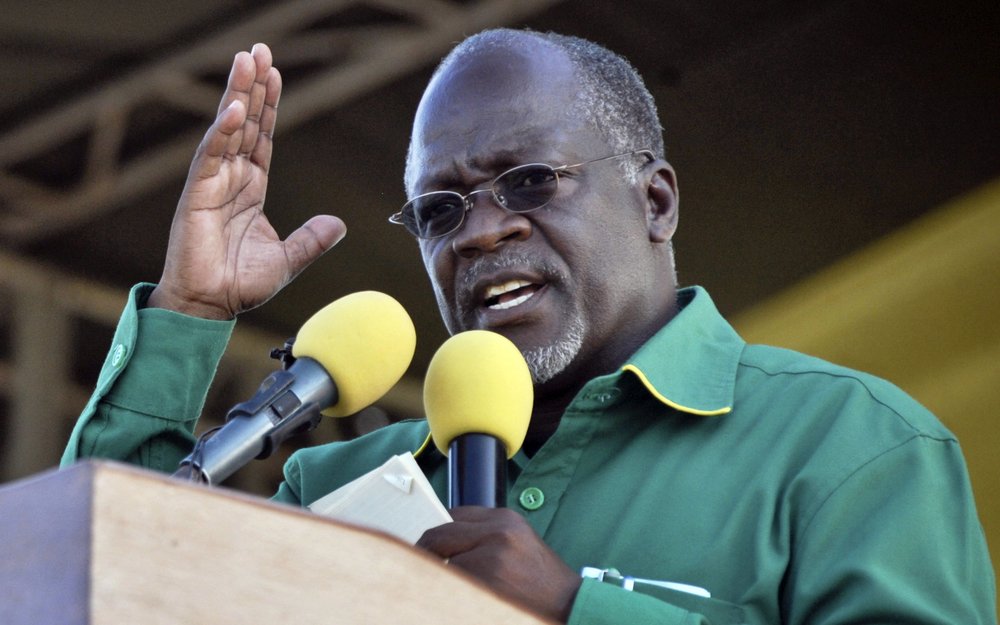
Nakuru (Kenya), Mar 18: President John Magufuli of Tanzania, a prominent COVID-19 skeptic in Africa whose populist rule often cast his East African country in a harsh international spotlight, has died.
He was 61 years old.
Magufuli's death was announced on Wednesday by Vice President Samia Suluhu, who said the president died of heart failure.
Our beloved president passed on at 6 p.m. this evening," said Suluhu on national television. All flags will be flown at half-mast for 14 days. It is sad news. The president has had this illness for the past 10 years.
The vice president said that Magufuli died at a hospital in Dar es Salaam, the Indian Ocean port that is Tanzania's largest city.
Although the vice president said the cause of Magufuli's death was heart failure, opposition politicians had earlier alleged that he was sick from COVID-19.
Magufuli had not been seen in public since the end of February and top government officials had denied that he was in ill health even as rumours swirled online that he was sick and possibly incapacitated from illness.
Magufuli was one of Africa's most prominent deniers of COVID-19. He had said last year that Tanzania had eradicated the disease through three days of national prayer. Tanzania has not reported its COVID-19 tallies of confirmed cases and deaths to African health authorities since April 2020.
But the number of deaths of people experiencing breathing problems reportedly grew and earlier this month the US embassy warned of a significant increase in the number of COVID-19 cases in Tanzania since January. Days later the presidency announced the death of John Kijazi, Magufuli's chief secretary. Soon after the death was announced of the vice president of the semi-autonomous island region of Zanzibar, whose political party had earlier reported that he had COVID-19.
Critics charged that Magufuli's dismissal of the threat from COVID-19, as well as his refusal to lock down the country as others in the region had done, may have contributed to many unknown deaths.
It is hard to gauge how most Tanzanians regarded Magufuli's COVID-19 skepticism, in a country where he remained genuinely popular among many for his seemingly frank talk against corruption even as he curtailed political freedoms and increasingly asserted an authoritarian streak. Police arrested at least one man earlier this week who was accused of spreading false information about Magufuli's health.
First elected to the presidency in 2015, Magufuli was serving a second five-year term won in 2020 elections that the opposition and some rights groups said were neither free nor fair. His main opponent in that race, Tundu Lissu, had to relocate to Belgium after the vote, fearing for his safety.
Lissu, who was among the first to raise questions about the whereabouts of Magufuli after he went missing for several days, had been shot 16 times back in 2017, an attack he blamed on government agents because of his criticism of the president.
Magufuli had become so powerful by the start of the COVID-19 outbreak that he could deny the existence of a pandemic without incurring the criticism of his predecessor and other prominent people within Tanzania. In early 2021, amid speculation that Magufuli would seek an unconstitutional third term when his mandate expired in 2025, his ruling Chama Cha Mapinduzi party was compelled to deny such a thing could happen.
John Pombe Magufuli was born on October 29, 1959, in the rural area of Chato in the country's northwest. The son of a subsistence farmer, he tended his father's cattle but was a good student, seeing classroom studies as a way out of poverty.
Magufuli earned a bachelor's degree in mathematics and chemistry at the University of Dar es Salaam in 1988. Much later, in 2009, he earned a doctorate in chemistry from the same university.
Let the Truth be known. If you read VB and like VB, please be a VB Supporter and Help us deliver the Truth to one and all.
Indian startup's 'Drishti' satellite launched aboard SpaceX rocket
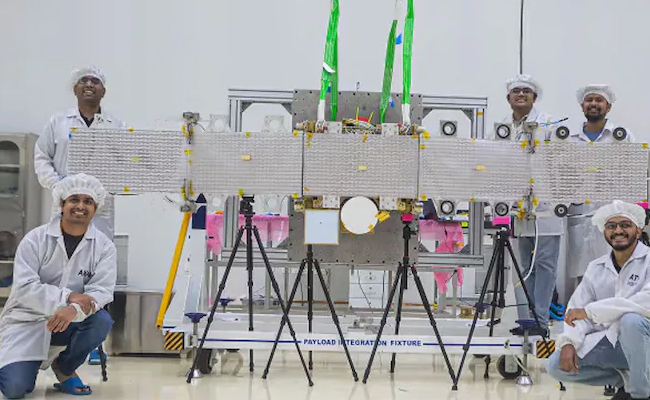
New Delhi (PTI): Bengaluru-based space start-up GalaxEye's Mission Drishti satellite was launched on Sunday aboard SpaceX's Falcon 9 rocket from California.
Mission Drishti is the world's first OptoSAR satellite, integrating electro-optical (EO) and synthetic aperture radar (SAR) sensors into a single operational platform, according to the company.
While EO sensors capture high-resolution images during sunlight and clear skies, SAR sensors provide all-weather and all-time images, using radar pulses.
In a statement, Suyash Singh, founder and CEO of GalaxEye, said, "With the satellite (Mission Drishti) now successfully in orbit, our immediate focus is on completing its commissioning. As we move through this phase, we are already witnessing strong global interest in the differentiated datasets enabled by our OptoSAR payload."
The satellite will help address long-standing limitations of conventional systems and enable more reliable and consistent data acquisition across diverse environmental conditions, the company said.
As a dual-use Earth observation satellite, the mission will support use cases across defence, agriculture, disaster management, maritime monitoring, and infrastructure planning.
The satellite is also expected to complement India's broader initiatives, including the 29 active Earth Observation satellites outlined in ISRO's recent annual report.
The launch came after five years of indigenous research and development, and extensive environmental testing and performance validation of the Mission Drishti.
In a statement, Lt Gen AK Bhatt (Retd), director general of Indian Space Association (ISpA), said, "GalaxEye has achieved what only a few global players have, which is seamlessly combining optical and SAR capabilities on a single platform to enable persistent, all-weather intelligence."
What stands out is not just the technology, but its broader impact on how downstream applications will increasingly define value in the space economy, particularly in Earth observation, where timely, decision-grade insights are critical," he added.
ISpA is the premier industry association of space and satellite companies in the country.
Union Minister Jitendra Singh also took note of the Mission Drishti launch, saying the development marked a significant milestone in India's space journey.
In a post on X, the minister said, "The successful launch of the world's first OptoSAR satellite, and the largest privately-built satellite in the country, reflects the immense potential of our young innovators driving nation-building."
GalaxEye aims to scale up Mission Drishti to a constellation of 10 satellites by 2030, developing a robust and sovereign Earth observation infrastructure for India.