Texas man executed for 2004 murder offers apology to victim's children before death
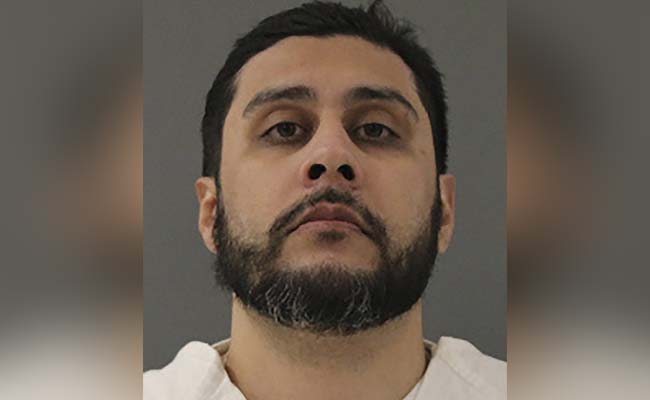
Houston: A 41-year-old man who was convicted of murdering a young mother over two decades ago was executed in Texas on Wednesday and spent his final moments apologizing to her children for the pain he had caused.
Moises Sandoval Mendoza was executed by lethal injection at the state penitentiary in Huntsville for murdering 20-year-old Rachelle O'Neil Tolleson in 2004. Court documents state that he raped Tolleson, killed her, and then burned her body and left it in a ditch. Her body was found days later.
Tolleson, mother of a five-month-old infant, had known Mendoza since high school. He pleaded guilty to the crime and petitioned to have his death sentence commuted to life imprisonment, but all legal options were ultimately exhausted. The U.S. Supreme Court denied his last appeal earlier on Wednesday.
In a statement released just before his execution, Mendoza spoke to the victim's family, stating, “To Avery… I robbed you of a mother. I’m sorry for that.” He conceded that no apology would make up for the damage he had inflicted, and he apologized to Tolleson's family.
His execution is the 13th in the United States this year. Although the means used to kill Mendoza was lethal injection, some of the most recent executions involved nitrogen gas and firing squads, tactics that have been strongly criticized by international human rights organizations. The death penalty is a point of national contention, with 23 U.S. states abolishing it and others holding moratoriums.
After the execution, Texas Attorney General Ken Paxton reaffirmed his belief in capital punishment, saying, "I will always do everything in my power to defend the law and hold criminals accountable."
Let the Truth be known. If you read VB and like VB, please be a VB Supporter and Help us deliver the Truth to one and all.
Vartha Bharati–Sankalp predictions align closely with Karnataka bypoll results
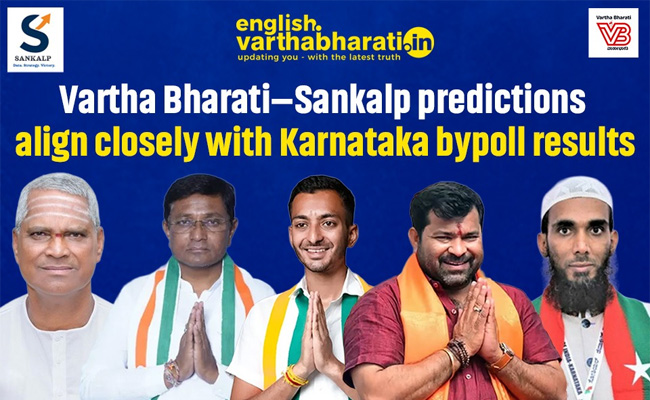
Bengaluru: The Vartha Bharati–Sankalp election analysis has shown a high level of accuracy in predicting the outcome of the recent Karnataka Assembly by-elections held in May 2026, correctly calling winners in both constituencies and closely estimating vote share trends.
The by-elections were held in Bagalkot and Davanagere South, drawing significant political attention as both seats were seen as key tests for the ruling Congress and opposition BJP.
According to the analysis, Vartha Bharati–Sankalp had made three major projections ahead of the results the winning party, vote share percentages, and margin of victory.
In both constituencies, the platform accurately predicted that the Congress would emerge victorious. The outcome matched the projections, with Congress candidates winning in Bagalkot and Davanagere South.
In terms of vote share, the predictions were largely in line with the final results. In Bagalkot, the BJP’s vote share was forecast in the range of 40 to 46 per cent, while the actual figure stood at 42.9 per cent. The Congress vote share, however, exceeded expectations, with the party securing 55.4 per cent against a projected range of 43 to 48 per cent.
The margin of victory in Bagalkot turned out to be significantly higher than anticipated. While the projection had placed the margin between 2,000 and 3,500 votes, the final margin was around 22,332 votes.
In Davanagere South, the predictions also remained largely accurate. The Congress vote share was projected between 43 and 51 per cent, and the final figure stood at 43.9 per cent. The BJP was expected to secure between 42 and 50 per cent but ended with 40.3 per cent.
The analysis had also identified the role of SDPI as a potential spoiler in the constituency. While its vote share was estimated around 6 per cent, the party eventually secured around 12 per cent of the vote.
The margin of victory in Davanagere South was predicted to be between 1,500 and 2,600 votes. The actual margin was higher at around 5,708 votes, though the contest remained relatively close as anticipated.
Overall, the performance of Vartha Bharati–Sankalp stood out for correctly identifying the winning parties in both seats and maintaining close accuracy in vote share estimates, with only limited deviations in specific cases.