The morgue at Gaza's biggest hospital is overflowing as Israeli attacks intensify
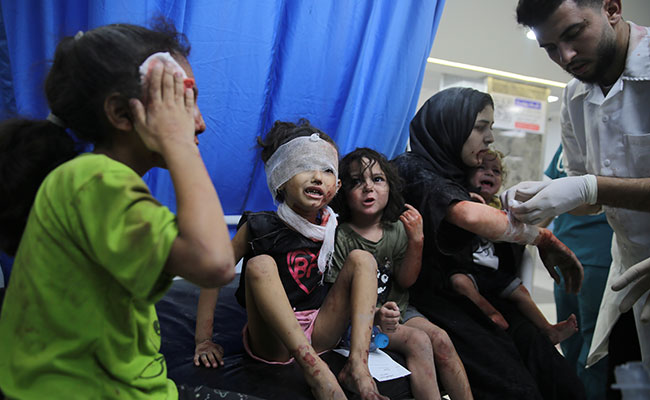
Gaza City (AP): The morgue at Gaza's biggest hospital overflowed Thursday as bodies came in faster than relatives could claim them on the sixth day of Israel's heavy aerial bombardment on the territory of 2.3 million people.
With scores of Palestinians killed each day in the Israeli onslaught after an unprecedented Hamas attack, medics in the besieged enclave said they have run out of places to put remains pulled from the latest strikes or recovered from the ruins of demolished buildings.
The morgue at Gaza City's Shifa hospital can only handle some 30 bodies at a time, and workers had to stack corpses three high outside the walk-in cooler and put dozens more, side by side, in the parking lot. Some were placed in a tent, and others were sprawled on the cement, under the sun.
"The body bags started and just kept coming and coming and now it's a graveyard," Abu Elias Shobaki, a nurse at Shifa, said of the parking lot. "I am emotionally, physically exhausted. I just have to stop myself from thinking about how much worse it will get."
Nearly a week after Hamas crossed through Israel's heavily fortified separation fence and killed over 1,200 Israelis in a brutal rampage, Israel is preparing for a possible ground invasion of Gaza for the first time in nearly a decade. A ground offensive would likely drive up the Palestinian death toll, which already has outpaced the past four bloody wars between Israel and Hamas.
The sheer volume of human remains has pushed the system to its limit in the long-blockaded territory. Gaza's hospitals are poorly supplied in normal times but now Israel has stopped the water flow from its national water company and blocked electricity, food and fuel from entering the coastal enclave.
"We are in a critical situation," said Ashraf al-Qidra, the spokesman for the Gaza Health Ministry. "Ambulances can't get to the wounded, the wounded can't get to intensive care, the dead can't get to the morgue."
Lines of white body bags soles of bare feet sticking out from one, a bloodied arm from another brought the scale and intensity of Israel's retaliation on Gaza into sharp relief. Hospital officials asked stricken family members to identify their loved ones. Some peered into the body bags, then collapsed into tears or screams.
Israel's campaign on Gaza has levelled entire neighbourhoods, killing over 1,400 people, more than 60 per cent of them women and children, according to the Gaza Health Ministry. More than 3,40,000 have been displaced 15 per cent of Gaza's population.
Israeli airstrikes on Thursday pummeled the heart of Jabaliya refugee camp, killing dozens of people including 45 members of the same extended family, Gaza's Interior Ministry said.
The Israeli military says it is striking Hamas infrastructure and aims to avoid civilian casualties a claim that Palestinians reject.
The deaths, and over 6,000 injuries, have overwhelmed Gaza's health care facilities as supplies dwindle.
"It is not possible, under any circumstances, to continue this work," said Mohammad Abu Selim, Shifa's general director. "The patients are now on the streets. The wounded are on the streets. We cannot find a bed for them."
With resources stretched thin, clinics understaffed and ambulances taking hours to get victims to medical care because airstrikes have ravaged the streets, some say it's not worth the trip.
"We know that if a case is critical, they just won't survive," said Khalil Abu Yehiya, a 28-year-old teacher whose neighbour's home was bombed in Thursday's airstrikes on the Jabaliya refugee camp.
When more heavy bombardment hit the Shati refugee camp just north of Gaza City along the Mediterranean coast, a new wave of wounded streamed into the hospital complex toddlers with bruises and bandages, men with makeshift tourniquets, young girls with blood caked on their faces. Because Shifa's intensive care unit was full, some lay in the hospital corridors, pressed up against the walls to clear aisles for staff and stretchers.
"I've been to many places and seen horrors and shelling. Not this level of insanity," said 36-year-old local photojournalist Attia Darwish as he watched the wounded pour into the hospital.
Among those killed in the strikes on the Shati refugee camp was Yasser al-Masri, whose body arrived along with those of his wife and infant daughter. Medics circulated photos of al-Masri and his daughter, covered in filth in the same body bag.
His friends shared his final Facebook post before Israel's warplanes struck.
"I only have a few hours before my phone dies because we're without electricity," he wrote. "There is no light at night except the moon. Please forgive me. I forgive all of you."
Gaza's sole power plant ran out of fuel on Wednesday. Shifa and other hospitals were desperately trying to save whatever diesel remains in their backup generators, turning off the lights in all hospital departments but the most essential intensive care, operating rooms, oxygen stations.
Abu Selima, director of Shifa, said the last of the hospital's fuel would run out in three or four days.
When that happens, "a disaster will occur within five minutes," said Naser Bolbol, head of the hospital's neonatal department, citing all the oxygen equipment keeping infants alive.
Hospital authorities said there wouldn't be electricity left to refrigerate the dead, either.
Let the Truth be known. If you read VB and like VB, please be a VB Supporter and Help us deliver the Truth to one and all.
4 workers die after being buried under coal slurry in Jharkhand's Dhanbad
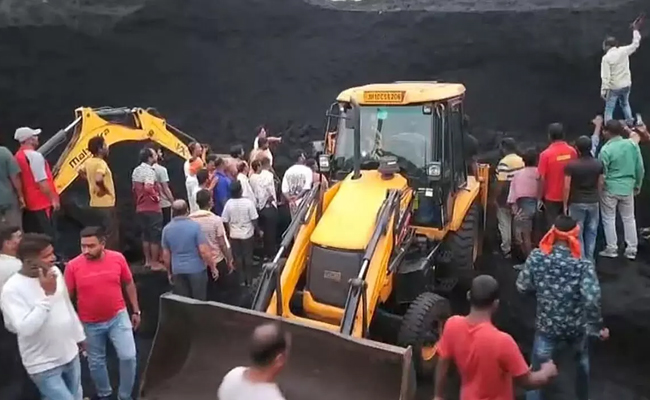
Dhanbad (Jharkhand) (PTI): At least four workers died after being buried under coal slurry in Jharkhand's Dhanbad district on Saturday, a police official said.
The incident took place at Moonidih coal washery in the command area of Bharat Coking Coal Limited (BCCL).
"Bodies of all four workers were dug out of debris during a rescue operation," Putki police station in-charge Waqar Hussain told PTI.
The incident took place when coal slurry was being loaded into trucks by workers, during which a large chunk of slurry fell and trapped several workers underneath, officials said.
The deceased have been identified as Manik Bauri, Dinesh Bauri, Deepak Bauri, and Hemlal Gope.
Meanwhile, the family members of the deceased and local villagers placed the bodies in front of the washery gate and began a protest.
They demanded compensation, jobs for dependents and action against those responsible for the incident.
Police and administration officials are trying to pacify the protesters, an official said.