They have lot of money: Donald Trump on scrapping $21 million ‘voter turnout’ fund to India

New York/Florida (PTI): President Donald Trump questioned the purpose of providing USD 21 million to India for “voter turnout” as he reiterated that the US "can hardly get in there" because of high Indian tariffs.
Trump also said "India is one of the highest taxing countries in the world".
He made these remarks after Elon Musk-led DOGE’s (Department of Government Efficiency) disclosed that USAID contributed USD 21 million to Election Commission for boosting voter turnout.
On February 16, The Department of Government Efficiency (DOGE), led by billionaire SpaceX CEO Musk, listed items on which the “US taxpayer dollars were going to be spent” and the list included “USD 21M for voter turnout in India.”
DOGE noted that all of the items have been cancelled.
The list also included USD 29 million to "strengthening political landscape in Bangladesh”, USD 20 million for "fiscal federalism" and USD 19 million for "biodiversity conversation" in Nepal as well as USD 47 million for "improving learning outcomes in Asia”.
While signing executive orders on Tuesday at Mar-a-Lago, Trump said,"...And USD 21 million for voter turnout in India. Why are we giving USD 21 million to India? They got a lot of money there. One of the highest taxing countries in the world in terms of us. We can hardly get in there because their tariffs are so high.”
On Tuesday, he signed executive orders, including a memorandum requiring 'radical transparency regarding wasteful spending of taxpayer dollars by the federal government.'
Trump said he has a "lot of respect for India. I have a lot of respect for the Prime Minister,” and noted that Prime Minister Narendra Modi had visited the White House last week.
“But we're giving USD 21 million for voter turnout. It's voter turnout in India. What about like voter turnout here?”
Hours before Prime Minister Modi had a bilateral meeting with Trump in the White House on February 13, the US President had announced reciprocal tariffs.
Under the plan, the Trump administration “will work strenuously to counter non-reciprocal trading arrangements with trading partners by determining the equivalent of a reciprocal tariff with respect to each foreign trading partner.”
During a joint press conference with Modi, Trump, responding to a question on reciprocal tariffs on India, had said "India has been, to us, just about the highest tariffed nation anywhere in the world. They’ve been very strong on tariffs, and I don't blame them, necessarily, but it's a different way of doing business. It's very hard to sell into India because they have trade barriers, very strong tariffs.
The DOGE has been put in charge of overseeing workforce reduction across the government, and as part of that, Musk announced that he would shut down USAID, which is responsible for humanitarian efforts around the globe.
According to USAID officials on February 7, all USAID humanitarian work worldwide had been stopped, reported ABC News.
The agency's website was shut down before Musk's announcement. Later, a Trump-nominated judge announced a temporary restraining order that prevents the president and DOGE from placing 2,200 employees on administrative leave.
Let the Truth be known. If you read VB and like VB, please be a VB Supporter and Help us deliver the Truth to one and all.
EAM Jaishankar meets Jamaican PM, gifts over 10 BHISHM Cubes
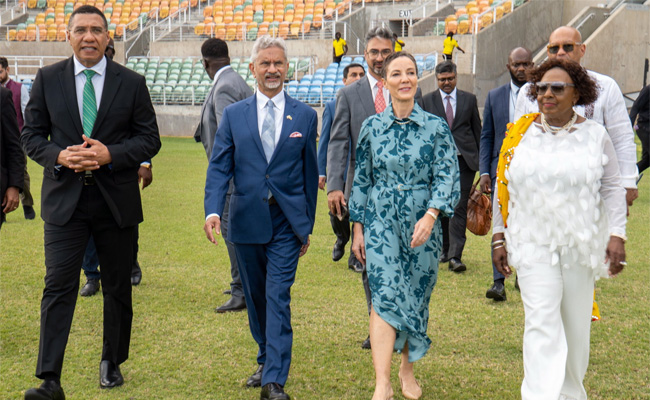
Kingston (PTI): External Affairs Minister S Jaishankar on Monday met Jamaican Prime Minister Andrew Holness and discussed ways to further deepen "political, economic and people-to-people cooperation."
Jaishankar also conveyed greetings from Prime Minister Narendra Modi to Holness.
"Pleased to call on Prime Minister @AndrewHolnessJM in Kingston. Conveyed the greetings of PM @narendramodi," Jaishankar posted on X.
"Discussed deepening our political, economic and people-to-people cooperation. Value his commitment towards further strengthening India-Jamaica relations," the post further read.
Also, the external affairs minister handed over 10 BHISHM (Bharat Health Initiative for Sahyog Hita & Maitri) Cubes as a gift to Jamaica.
"Formally handed over 10 BHISHM Cubes as a gift from India to Jamaica, in the presence of PM @AndrewHolnessJM, Health Minister @christufton and FM @kaminajsmith," Jaishankar posted on X.
"The BHISHM Cube mobile hospital system, designed for rapid deployment, will help Jamaica during disasters and emergencies. The gift of these cubes is a statement of friendship, a commitment to disaster preparedness, and an outcome of innovation," the post said.
Jaishankar arrived in Kingston on Saturday evening, marking the first leg of his nine-day tour of Jamaica, Suriname, and Trinidad and Tobago, aimed at further strengthening India's strategic and cultural ties with the Caribbean nations.
Earlier in the day, he interacted with the Indian diaspora and discussed India's ongoing transformation in infrastructure, human development and technology-driven governance and entrepreneurship with them.
He also highlighted the cricket bond between both countries as India gifted a scoreboard to Jamaica.
A scoreboard was dedicated at Sabina Park in Kingston. It is the home of the Jamaica cricket team and is the only Test cricket ground in the Caribbean island nation.
The minister expressed hope that the new scoreboard would witness many memorable innings, including those symbolising the enduring friendship between the two countries.
Cricket has long been a strong cultural bridge between India and Jamaica, which is part of the West Indies cricket team.
Jamaican players, including Chris Gayle, Courtney Walsh and Michael Holding, have played a major role in shaping the legacy of West Indies cricket in the international arena, contributing to its dominance in earlier decades and its continued global appeal.