Thousands mourn top Iranian military commanders, scientists killed in Israeli strikes
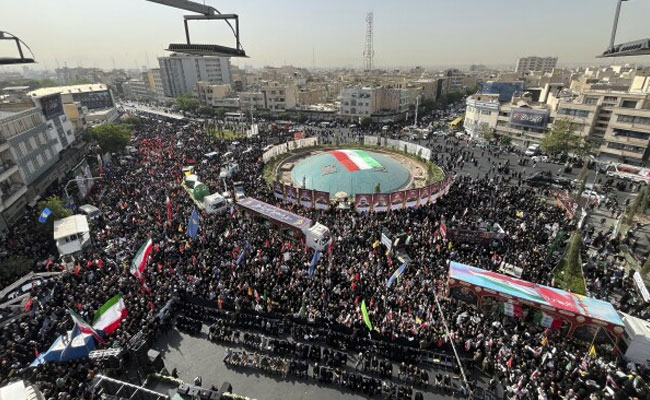
Dubai (AP): Thousands of mourners lined the streets of downtown Tehran on Saturday for the funeral of the head of the Revolutionary Guard and other top commanders and nuclear scientists killed during a 12-day war with Israel.
The caskets of Guard's chief Gen. Hossein Salami, the head of the Guard's ballistic missile program, Gen Amir Ali Hajizadeh and others were driven on trucks along the capital's Azadi Street as people in the crowds chanted: “Death to America” and “Death to Israel.”
Salami and Hajizadeh were both killed on the first day of the war, June 13, as Israel launched a war it said meant to destroy Iran's nuclear program, specifically targeting military commanders, scientists and nuclear facilities.
There was no immediate sign of Iran's Supreme Leader, Ayatollah Ali Khamenei, in the state broadcast of the funeral. Khamenei, who has not made a public appearance since before the outbreak of the war, has in past funerals held prayers for fallen commanders over their caskets before the open ceremonies, later aired on state television.
Iranian Foreign Minister Abbas Araghchi was on hand, and state television reported that Gen Esmail Qaani, who heads the foreign wing of the Revolutionary Guard, the Quds Force, and Gen. Ali Shamkhani were also among the mourners.
Shamkhani, an adviser to Khamenei who was wounded in the first round of Israel's attack and hospitalized, was shown in a civilian suit leaning on a cane in an image distributed on state television's Telegram channel.
Iran's Revolutionary Guard was created after its 1979 Islamic Revolution. Since it was established, it has evolved from a paramilitary, domestic security force to a transnational force that has come to the aid of Tehran's allies in the Middle East, from Syria and Lebanon to Iraq. It operates in parallel to the country's existing armed forces and controls Iran's arsenal of ballistic missiles, which it has used to attack Israel twice during the Israel-Hamas war in the Gaza Strip.
Over 12 days before a ceasefire was declared on Tuesday, Israel claimed it killed around 30 Iranian commanders and 11 nuclear scientists, while hitting eight nuclear-related facilities and more than 720 military infrastructure sites. More than 1,000 people were killed, including at least 417 civilians, according to the Washington-based Human Rights Activists group.
Iran fired more than 550 ballistic missiles at Israel, most of which were intercepted, but those that got through caused damage in many areas and killed 28 people.
Saturday's ceremonies were the first public funerals for top commanders since the ceasefire, and Iranian state television reported that they were for 60 people in total, including four women and four children.
Authorities closed government offices to allow public servants to attend the ceremonies.
Iran has always insisted its nuclear programme is only for peaceful purposes. But Israel views it as an existential threat and said its military campaign was necessary to prevent Iran from building an atomic weapon.
Khamenei's last public appearance was June 11, two days before hostilities with Israel broke out, when he met with Iranian parliamentarians.
On Thursday, however, he released a pre-recorded video, in his first message since the end of the war, filled with warnings and threats directed toward the United States and Israel, the Islamic Republic's longtime adversaries.
The 86-year-old downplayed US strikes on three Iranian nuclear sites as having not achieved “anything significant” and claimed victory over Israel.
The head of the United Nations nuclear watchdog agency, Rafael Grossi, has characterized the damage done by American bunker-buster bombs to Iran's Fordo nuclear site, which was built into a mountain, as “very, very, very considerable.”
Let the Truth be known. If you read VB and like VB, please be a VB Supporter and Help us deliver the Truth to one and all.
Two injuries, one DNF, a DQ as India end messy World Relays campaign
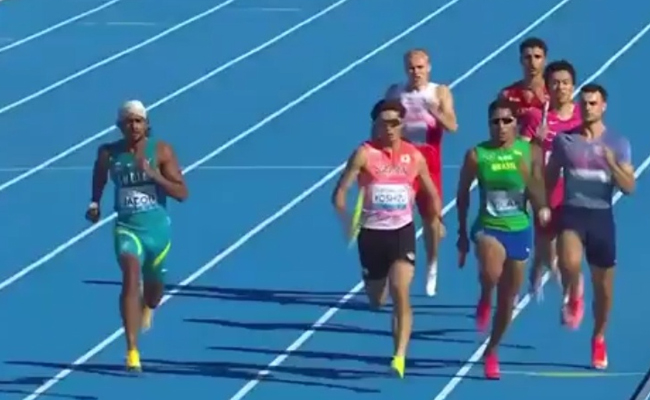
Gaborone (Botswana) (PTI): Amoj Jacob and Ragul Kumar got injured during the men's 4x400m and 4x100 races respectively as India ended their World Athletics Relays campaign in disappointment on the second day of competitions here on Sunday.
The Indian camp had high hopes of making the 2027 World Championships in the men's 4x400m relay but the team did not finish (DNF) the race as Jacob suffered cramps and pulled out of the race after taking the baton from the first leg runner Dharamveer Choudhary. Rajesh Ramesh and Vishal TK were to run in the third and fourth legs.
Those teams which could not qualify for the 2027 Beijing World Championships by reaching the final round of each of the six relay events on Saturday were given another chance in the second qualification round on Sunday.
The top two teams in each of the two heats (in all six relay events) booked the Beijing ticket on Sunday.
India will now have to try and qualify for the World Championships through the Top Lists of the World Athletics, which is a long and tedious process.
In the men's 4x100m race, third leg runner Ragul Kumar fell down the track after failing to hand over the baton inside the exchange zone to fourth leg runner Gurindervir Singh, which clearly showed the lack of coordination among the runners.
Harsh Santosh Raut and Animesh Kujur ran the first two legs.
The Indian quartet was disqualified and Kumar was seen being taken away from the Field of Play with the help of the volunteers.
It was a comedy of errors in the case of the women's 4x100m race, which saw the baton being dropped during an exchange between first leg runner Tamanna and second runner Nithya Gandhe, though the Indians finished the race in 53.09 seconds.
Gandhe started running quite a distance, but after realising that the baton was not in her hand, she turned and ran back to pick it up.
The only silver-lining for the Indian contingent was the national record time in the mixed 4x100m relay race, though the quartet of Ragul Kumar, Nithya Gandhe, Animesh Kujur and Sneha SS finished sixth in heat number two with a time of 41.35 seconds, bettering the previous national mark of 42.30 seconds set in March in Chandigarh.
The mixed 4x400m relay quartet of Theerthesh P Shetty, Kumari Saloni, Nihal William and Rashdeep Kaur ended at fifth in heat number one with a time of 3 minutes and 19.40 seconds.
On Saturday, all the five Indian relay teams had failed to make it to the respective final rounds and thus missed out on the 2027 World Championships berths.