Thousands of bodies lie buried in rubble in Gaza; Families dig to retrieve them, often by hand
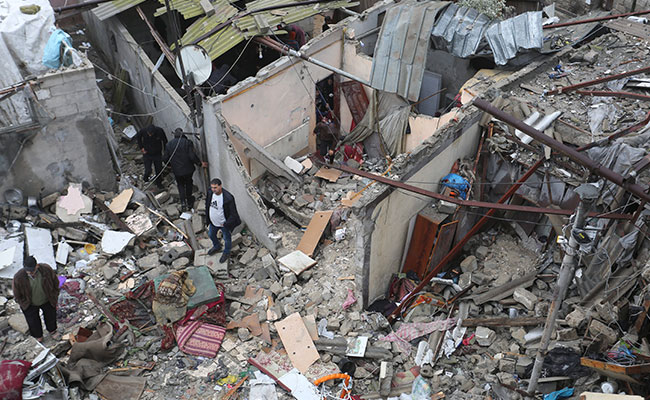
Deir Al-Balah (Gaza Strip) (AP): The wreckage goes on for block after devastated block. The smell is sickening. Every day, hundreds of people claw through tons of rubble with shovels and iron bars and their bare hands.
They are looking for the bodies of their children. Their parents. Their neighbors. All of them killed in Israeli missile strikes. The corpses are there, somewhere in the endless acres of destruction.
More than five weeks into Israel's war against Hamas, some streets are now more like graveyards. Officials in Gaza say they don't have the equipment, manpower or fuel to search properly for the living, let alone the dead.
Omar al-Darawi and his neighbors have spent weeks searching the ruins of a pair of four-story houses in central Gaza. Forty-five people lived in the homes; 32 were killed. In the first days after the attack, 27 bodies were recovered.
The five still missing were al-Darawi's cousins.
They include Amani, a 37-year-old stay-at-home mom who died with her husband and their four children. There's Aliaa, 28, who was taking care of her aging parents. There's another Amani, who died with her 14-year-old daughter. Her husband and their five sons survived.
"The situation has become worse every day," said the 23-year-old, who was once a college journalism student. The smell has become unbearable.
"We can't stop," he said. "We just want to find and bury them" before their bodies are lost in the rubble forever.
The Health Ministry in Gaza says the attacks have killed more than 11,200 people, two-thirds of them women and children. The U.N. humanitarian affairs office estimates that about 2,700 people, including 1,500 children, are missing and believed buried in the ruins.
The missing have added layers of pain to Gaza's families, who are overwhelmingly Muslim. Islam calls for the dead to be buried quickly within 24 hours if possible with the shrouded bodies turned to face the holy city of Mecca. Traditionally, the body is washed by family members with soap and scented water, and prayers for forgiveness are said at the gravesite.
The search is particularly difficult in northern Gaza, including Gaza City, where Israeli ground forces are battling Hamas. Hundreds of thousands of people have fled southward, terrified by the combat and pushed by Israeli warnings to evacuate. But even in the south, continued Israeli airstrikes and shelling mean nowhere is safe in the tiny territory.
The Palestinian Civil Defense department, Gaza's primary search-and-rescue force, has had more than two dozen workers killed and over 100 injured since the war began, said Mahmoud Bassal, the department spokesman.
More than half of its vehicles are now either without fuel or have been damaged by strikes, he said.
In central Gaza, outside the northern combat zone, the area's civil defense director has no working heavy equipment at all, including bulldozers and cranes.
"We actually don't have fuel to keep the sole bulldozer we have operating," said Rami Ali al-Aidei.
At least five large bulldozers are needed just to search a series of collapsed high-rise buildings in the coastal town of Deir al-Balah, he said.
This means that bodies, and the desperate people searching for them, are not the focus.
"We're prioritizing areas where we think we will find survivors," said Bassal.
As a result, the search for bodies often falls to relatives, or to volunteers like Bilal Abu Sama, a former freelance journalist.
He ticks off a handful of Deir al-Balah's victims: 10 corpses still lost in what is left of the al-Salam Mosque; two dozen bodies missing in a destroyed home; 10 missing in another mosque attack.
"Will those bodies remain under the rubble until the war ends? OK, when will the war end?" said Abu Sama, 30, describing how families dig through the wreckage without any tools. "The bodies will be decomposed. Many of them have already decomposed."
On Tuesday, 28 days after an airstrike flattened his home, Izzel-Din al-Moghari found his cousin's body.
Twenty-four people from his extended family lived in the home, in the Bureij refugee camp. All but three were killed.
Eight are still missing.
A civil defense bulldozer came three days after the strike to clear the road, then left quickly for another collapsed building. The bulldozer came again Tuesday and helped find al-Moghari's cousin.
After finding his cousin, al-Moghari went back into the wreckage in search of his father and other relatives.
"I am stunned," he said. "What we lived through is indescribable."
Gaza has become a place where many families are denied even the comfort of a funeral.
Al-Darawi, the man searching for his cousins, understands that.
"Those who found their dead are lucky," he said.
Let the Truth be known. If you read VB and like VB, please be a VB Supporter and Help us deliver the Truth to one and all.
Punjab CM Mann calls twin blasts 'minor', blames BJP for creating atmosphere of fear

Chandigarh (PTI): Terming the twin blasts in Amritsar and Jalandhar "minor", Punjab Chief Minister Bhagwant Mann on Wednesday targeted the BJP and said this was how the party was preparing for the upcoming assembly elections in the state.
Two blasts occurred on Tuesday night, one outside the Border Security Force's Punjab Frontier headquarters in Jalandhar at around 8 pm and another near the army cantonment area in Khasa, Amritsar, at around 11 pm.
The BJP wants to create an atmosphere of fear, Mann told reporters, adding that the party wanted to scare people into getting their votes. "BJP is a communal party. The assembly elections are over in West Bengal, and they (BJP) have said that now it is Punjab's turn, which indicates that these minor blasts are part of their preparation for the Punjab assembly elections," the chief minister said, adding that investigations are underway.
Mann further alleged that the BJP always sought to gain votes by inciting violence and intimidating the public.
"I urge the BJP to cease such tactics. Punjab is a peaceful state. We are the people who always seek the welfare of the world," Mann said while speaking to reporters in Anandpur Sahib after starting his four-day 'Shukrana Yatra' for the implementation of the anti-sacrilege law.
He claimed that the BJP had a penchant for stirring up trouble in states where it is contesting elections.
Noting the significance of the newly enacted anti-sacrilege law -- the Jaagat Jot Sri Guru Granth Sahib Satkar Amendment Act, 2026 -- Mann stated that it counteracts the BJP's efforts to provoke conflict between communities.
"With the anti-sacrilege law in place, no one will engage in sacrilegious acts at their behest," he said, further alleging that the law contradicts the BJP's agenda.
Mann expressed concern regarding the BJP's tactics, saying, "The BJP claims it is ready for Punjab. Are they trying to scare people with these minor blasts to secure votes? Punjab has already experienced dark times in the past."
"This is the BJP's style of working. In every state where it contests elections, it instigates riots, carries out minor blasts, and divides people based on religion and caste. This demonstrates their preparation for Punjab," he further alleged.
Mann also noted that Punjab often plays a significant role whenever the country faces a crisis. He emphasised that peace, along with law and order, will be maintained at all costs.
Later, in a statement, Mann alleged that the bomb blasts in Amritsar and Jalandhar were part of a deliberate strategy to destabilise the state after the passage of the anti-sacrilege law.
Drawing parallels with West Bengal, Mann alleged that the BJP "thrives on creating communal tension, panic and unrest in poll-bound states to polarise voters," but asserted that peace-loving Punjabis would never allow the saffron party to destroy the hard-earned harmony of Punjab for electoral gains.
He further alleged that the BJP was trying to create "unrest" in Punjab on the pattern of West Bengal ahead of elections, but the people of Punjab are politically aware and united against such conspiracies.
"Violence, divisiveness and communal tension are the patent of the BJP and an integral part of the saffron party's politics. BJP is trying to incite violence and fear in Punjab on the pattern of Bengal to win the ensuing polls. However, BJP's nefarious designs will never succeed in Punjab because anything can germinate on the fertile land of Punjab, but seeds of hatred can never grow here," the chief minister claimed.
Condemning the blasts in the state, Mann alleged such incidents reflected the BJP's "brand of politics", aimed at spreading terror and panic to polarise society and garner votes. "This divisive politics is being pursued by the BJP in every poll-bound state for electoral gains," he alleged.
Mann said those responsible for the blasts would soon be exposed and brought to justice. "All those involved in this heinous crime against humanity will be brought to book and put behind bars very soon. Strict punishment will be ensured for these people because the Punjab Government has zero tolerance for any activity that threatens the peace, safety and integrity of Punjab," he said.
In response to a question about the West Bengal assembly elections, Mann mentioned Mamata Banerjee's complaints regarding the looting of the electoral mandate. "The Election Commission is also facing accusations. It should clarify its stance, ensuring it is not one-sided," Mann added.