Tipu Sultan's silver-mounted gun fetches 60,000 pounds at UK auction
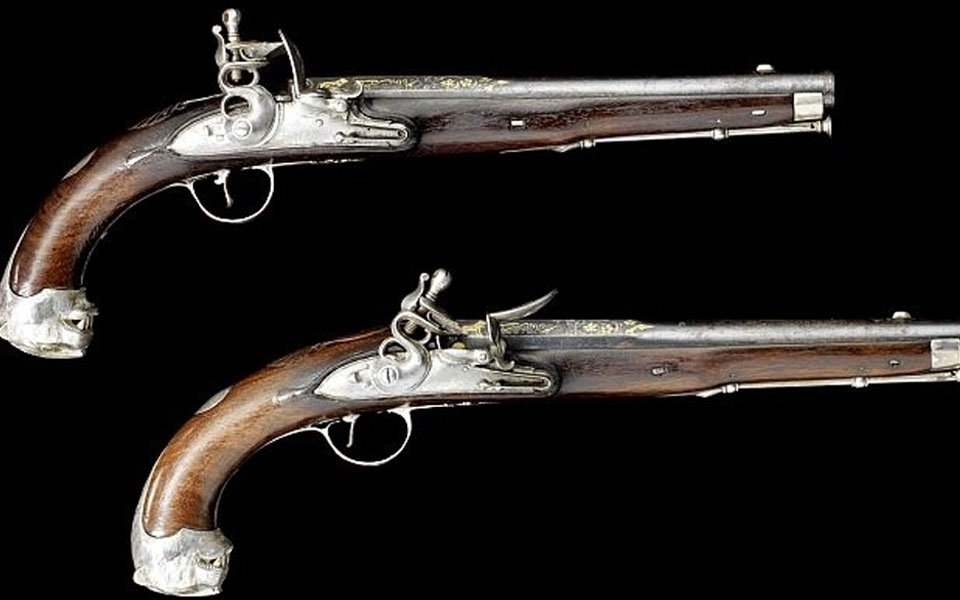
London: A collection of rare artefacts discovered by a couple after years of lying wrapped up in their attic in the English county of Berkshire and evaluated as items from Tipu Sultan's armoury was auctioned for around 107,000 pounds.
The highlight lot, a silver-mounted 20-bore flintlock gun and bayonet from the personal armoury of the last ruler of Mysore, proved hugely popular as it attracted 14 bids before going under the hammer for 60,000 pounds.
"Unlike other Tipu Sultan guns this one exhibits clear signs of having been badly damaged in its past...rather than being taken directly from the rack after the fall of Seringapatam it appears to have been collected from the battlefield," the lot description notes.
The other highlight lot, a gold-encrusted sword and suspension belt ensemble believed to be one of Tipu Sultan's personal swords, attracted as many as 58 bids before being sold to the winning bidder for 18,500 pounds.
The two centrepieces formed part of a collection of eight items brought back by Major Thomas Hart of the East India Company after the Tiger of Mysore's defeat at Seringapatam in 1799.
Alongside the arms, an intricately designed Betel Nut Casket (17,500 pounds) and a Gold East India Company Seal ring (2,800 pounds) belonging to Major Hart, believed to have passed down generations before landing in the hands of the current owners, were among the other big sellers of Tuesday's sale.
Berkshire-based Antony Cribb Ltd auctioneers, who specialise in arms and armoury related sales, had announced the auction following the "exciting discovery" earlier this year and said that majority of the buyer interest had come from Indians based in India.
The Indian High Commission in London was made aware of the artefacts by the India Pride Project, a worldwide volunteer network set up to track "India's stolen heritage", and attempted to convince the auction house to consider voluntarily restoring the items to India.
The India Pride Project, which was instrumental in the restitution of a 12th century Buddha statue stolen from Nalanda in Bihar last year via the Indian High Commission in London, said it would continue lobbying for such artefacts to find their way back to India.
"You haven't really decolonised a nation, unless you've given back what's theirs," said Anuraag Saxena, founder of the India Pride Project.
However, the auction house insisted that no laws were being broken and also confirmed that the beneficiary family had decided to make a sizeable donation to a school in India from the money generated from the auction.
"The family is not motivated by money and sincerely hope these items find their way back to India, maybe to a museum, for future generations to have access to it," said Antony Cribb of the auction house.
The latest cache of Tipu Sultan related artefacts, which included three further swords from the ruler's armoury and a lacquered leather shield, was described as special because of its rare discovery under one roof after nearly 220 years.
The items bore the trademark tiger and tiger stripes associated with the Tiger of Mysore as proof of their provenance. The lots came to light in January this year when the couple who made the discovery of this innocuous family heirloom contacted Antony Cribb Ltd about a sword they had in their attic.
After an evaluation, a gold "Haider" symbol found on the sword confirmed that the sword belonged Haider Ali Khan Tipu Sultan's father. The three other swords bearing similar gold markings were found soon after, along with the other items.
Let the Truth be known. If you read VB and like VB, please be a VB Supporter and Help us deliver the Truth to one and all.
Ladakh a living land of dharma for centuries: Amit Shah
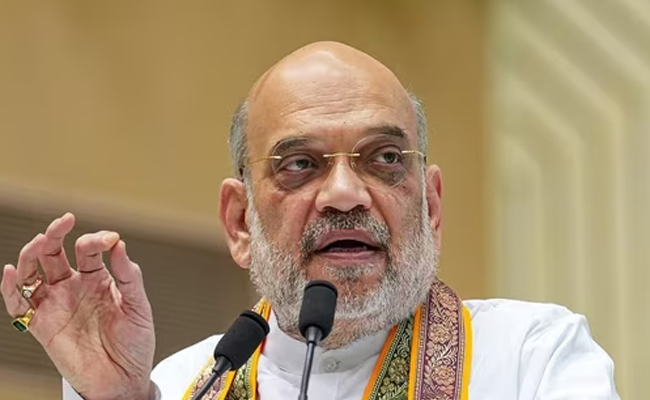
Leh/Jammu (PTI): Union Home Minister Amit Shah on Friday described the return of sacred relics of Lord Buddha to Ladakh after 75 years as a "historic reunion" and said that the Union Territory has remained a "living land of dharma", preserving and nurturing Buddhist knowledge for centuries.
Stressing the relevance of Buddha's teachings in modern times, Shah said the message of peace, compassion and the middle path was even more important today than it was 2,500 years ago.
"Ladakh has been a living land of dharma for centuries. When the Dalai Lama comes here, he says this land is not merely a geographical land but a living laboratory of Buddhist culture and compassion," Shah said, speaking after the inauguration of the sacred holy relics exposition of Tathagata Buddha and the 2569th Buddha Purnima celebrations at Jivetsal in Leh during his two-day visit to Ladakh.
Calling Ladakh a land of compassion, he said this land has preserved and nurtured knowledge. "Whenever Buddhism faced crises, this land worked to protect the teachings of Buddha. And when peace returned, it helped to expand and carry forward that preserved wisdom," he added.
"Unless one internalises knowledge and makes it a part of oneself, liberation is not possible. Knowledge is incomplete without spiritual practice, while spiritual practice without knowledge is blind. Therefore, the union of spiritual practice and knowledge is the right path. Even after all this, if there is no moral discipline, one cannot lead a truly wise life. The basis of a life of wisdom is moral discipline," he said.
Shah said it was through Ladakh and adjoining routes that the teachings of Tathagata Buddha, which originated in India, spread to China and several other countries.
"The message that emerged from the land of Ladakh has become a guiding force for many people around the world to take their lives forward. The presence of these sacred relics in Ladakh reminds us that India's civilisation has, for thousands of years, given the message of peace and coexistence," he said.
He said that in a diverse region like Ladakh and Kargil, this message becomes even more relevant. "This heritage still tells us today that amidst conflict and unrest, only the path of peace and compassion can provide solutions."
He said the return of the relics on Buddha Purnima had enhanced the significance of the festival for the people of Ladakh.
"These sacred relics have come to Ladakh after 75 years. It is as if Buddha himself is present here today," Shah said, adding that followers of Buddhism and people of other faiths in Ladakh and Kargil would draw spiritual energy from the relics.
Highlighting Ladakh's role in the spread of Buddhism, Shah said Kashmir was once an ancient centre of Buddhist studies, Mahayana philosophy and Buddhist art, from where Ladakh first came into close contact with Buddhism.
He said Emperor Ashoka's envoys laid the foundation of Buddhist influence in Ladakh through Kashmir and Gandhara, while Mahayana Buddhism expanded in the region during the Kushan period between the first and third centuries CE.
The Silk Route linking Kashmir, Leh, Yarkand, Khotan and Tibet became a channel not only for trade but also for ideas, monks, manuscripts and artistic traditions, Shah said.
He added that later, Tibetan influence between the seventh and tenth centuries further enriched Ladakh through Mahayana and Vajrayana traditions.
Stressing the relevance of Buddha's teachings in modern times, Shah said the message of peace, compassion and the middle path was even more important today than it was 2,500 years ago.
"Amid conflict and unrest, only the path of peace and compassion can provide solutions," he said.
Shah also appealed to the Ladakh administration to ensure complete arrangements so that followers of all faiths, especially Buddhists, could visit and pay obeisance to the relics.
#WATCH लेह, लद्दाख: केंद्रीय गृह मंत्री अमित शाह ने कहा, "जब दलाई लामा यहां आते हैं तो वे कहते हैं कि यह भूमि केवल भौगोलिक भूमि नहीं है। यह भूमि बौद्ध संस्कृति और करुणा की जीवंत प्रयोगशाला है। इस भूमि पर ज्ञान का संरक्षण हुआ है... भारत की सभ्यता हजारों वर्षों से शांति का संदेश… https://t.co/2nwG0w2CE6 pic.twitter.com/W13itRBqeX
— ANI_HindiNews (@AHindinews) May 1, 2026