Train signal melts, fire alarm goes off in theatre as heatwave roasts UK
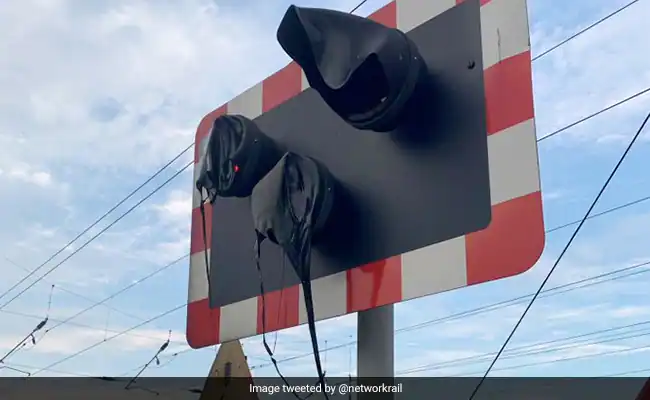
Train services faced major disruption across Britain on Wednesday as wildfire triggered by extreme temperature melted signalling equipment and damaged the tracks. Photos posted online by Network Rail and other operators show a level crossing damaged between King's Cross and Peterborough.
Videos from across the country surfaced all over social media showing what damage the record temperature has caused. One of these videos shows houses in a village outside East of London damaged by a massive fire, while another one shows forest burning on the side of a highway.

A woman using a portable fan while commuting in London. (Reuters)
The record breaking temperature also caused the fire alarm in one of the theatres going off because of the heat. A video from the Globe Theatre shows staff members scrambling for cover as the sprinkler system discharges water in the building.
"When global warming sets off your thatched roof's anti-Puritan/cannonfire sprinklers," actor George Fouracres said on Twitter while posting the video from the theatre.
When global warming sets off your thatched roof’s anti-Puritan/cannonfire sprinklers pic.twitter.com/cEKerw0w6N
— George Fouracres (@GeorgeFouracres) July 19, 2022
The record-breaking heat has also led to a surge in fire case, with London's firefighting authority declaring a major incident in the British capital on Tuesday.
The London Fire Brigade said it had deployed dozens of fire engines to several fires in and around the city, including thirty to a grass fire in east London. Television footage showed one blaze engulfing several homes.
Meanwhile, train cancellations across the country created a harrowing situation for commuters who were seen sleeping on suitcases and benches at London's Kings Cross on Wednesday morning.
The authorities running train operations have been issuing warning commuters to "not come to the station". People have also been advised to avoid unnecessary travel.
Courtesy: www.ndtv.com
Let the Truth be known. If you read VB and like VB, please be a VB Supporter and Help us deliver the Truth to one and all.
Delhi: Teenager slashes boy for refusing money for drugs; held

New Delhi (PTI): A 16-year-old boy has been apprehended for allegedly attacking a teenager with a paper cutter near the Red Fort area last month after the victim refused to give him money for drugs, an official said on Tuesday.
The juvenile, who had been absconding after the incident, was also found to be involved in another attempt to murder case registered at Jama Masjid police station, they said.
The case came to light on April 5 when police received information from LNJP Hospital about a 17-year-old boy, a resident of Nangloi, who had been admitted with serious injuries.
The victim had sustained sharp wounds on his neck and abdomen and was unfit to give a statement, the police said.
Preliminary inquiry revealed that the victim quarrelled with an unidentified boy at Parade Ground near the Red Fort, following which he was attacked. A case under relevant sections of the BNS was registered.
A team was constituted to trace the accused, which analysed CCTV footage from the area and identified a suspect seen fleeing the spot. The boy was later identified with the help of local intelligence as a vagabond frequenting the Chandni Chowk area, police said.
Despite multiple raids in Delhi and adjoining areas, the accused remained untraceable. Subsequently, his mobile number was tracked, and technical surveillance led police to Haridwar in Uttarakhand.
On April 29, the police team conducted a raid in a village in Haridwar and apprehended the juvenile after sustained efforts, an officer said.
During questioning, the accused disclosed that he had been living in the Chandni Chowk area for the past two years and was addicted to drugs. On the night of April 4, he allegedly got into an argument with the victim after the latter refused to give him money and slapped him. Enraged, he attacked the boy with a paper cutter, inflicting multiple injuries.
The police said the accused later attacked another person near the Jama Masjid Metro Station on the same night before fleeing to Haridwar.
He also disposed of the weapon and clothes by throwing them from a moving train to evade arrest, they said.
Further investigation is underway, they added.