Trump agrees to pause tariffs on Mexico, but import taxes still in place for Canada, China
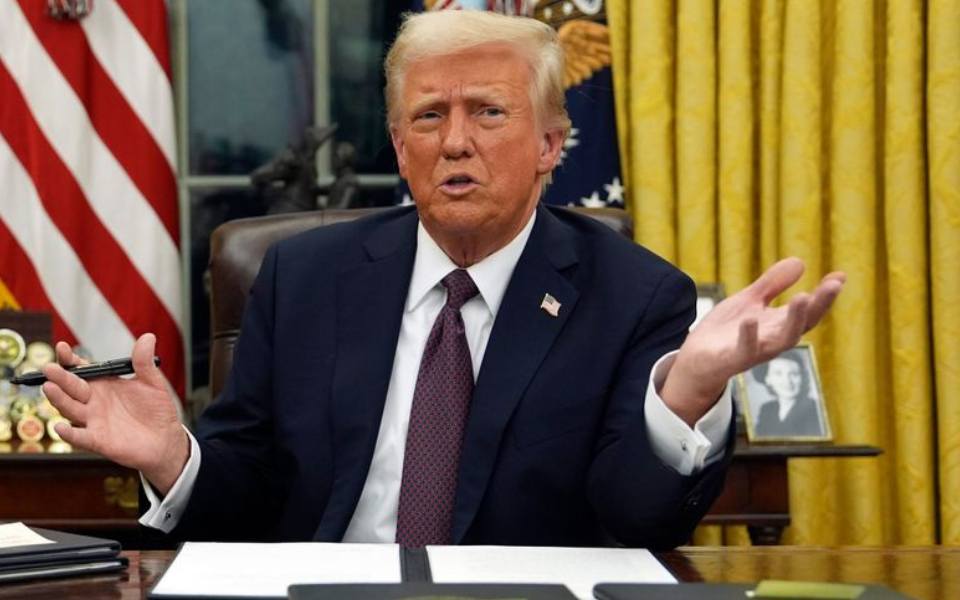
Washington, Feb 3 (AP): US President Donald Trump held off Monday on his tariff threats against Mexico for one month of further negotiations after Mexican President Claudia Sheinbaum agreed to send 10,000 members of her country's national guard to the border to address drug trafficking.
Trump's tariffs against Canada and China were still slated to go into effect Tuesday, but uncertainty remained about the durability of any deals and whether the tariffs were a harbinger of a broader trade war, as Trump has promised more import taxes to come.
The US and Mexican leaders announced the pause after what Trump described on social media as a “very friendly conversation,” and he said he looked forward to the upcoming talks.
Trump said the talks would be headed by Secretary of State Marco Rubio, Secretary of Treasury Scott Bessent and Secretary of Commerce Howard Lutnick and high-level representatives of Mexico.
“I look forward to participating in those negotiations, with President Sheinbaum, as we attempt to achieve a deal' between our two Countries,” the president said.
As a condition ahead of the talks, Sheinbaum laid out changes in border policies, and Trump confirmed Mexico's deployment of troops.
“Mexico will reinforce the northern border with 10,000 members of the National Guard immediately, to stop drug trafficking from Mexico to the United States, in particular fentanyl," Sheinbaum posted on X. “The United States commits to work to stop the trafficking of high-powered weapons to Mexico."
Trump posted earlier on social media that he spoke Monday morning with Canadian Prime Minister Justin Trudeau and would speak with him again at 3 pm. Both Canada and Mexico had plans to levy their own tariffs in response to US actions, but Mexico is holding off for the moment.
Trump used his social media post to repeat his complaints that Canada has been uncooperative, despite decades of friendship and partnerships that range from World War II to the response to the 9/11 terrorist attacks.
“Canada doesn't even allow US Banks to open or do business there,” Trump posted. “What's that all about? Many such things, but it's also a DRUG WAR, and hundreds of thousands of people have died in the US from drugs pouring through the Borders of Mexico and Canada.”
Financial markets, businesses and consumers are trying to prepare for the possibility of the new tariffs. Stock markets opened with a modest sell-off, suggesting some hope that the import taxes that could push up inflation and disrupt global trade and growth would be short-lived.
But the outlook reflected a deep uncertainty about a Republican president who has talked with adoration about tariffs, even saying the US government made a mistake in 1913 by switching to income taxes as its primary revenue source.
Trump said Sunday that the tariffs would lift if Canada and Mexico did more to crack down on illegal immigration and fentanyl smuggling, though there are no clear benchmarks. Trump also said the US can no longer run a trade imbalance with its two largest trade partners.
Mexico is facing a 25% tariff, while Canada would be charged 25% on its imports to the United States and 10% on its energy products. China faces a 10% additional tariff due to its role in the making and selling of fentanyl, the White House said.
Kevin Hassett, director of the White House National Economic Council, said Monday that it was misleading to characterize the showdown as a trade war despite the planned retaliations and risk of escalation.
“Read the executive order where President Trump was absolutely, 100% clear that this is not a trade war,” Hassett said. “This is a drug war."
But even if the orders are focused on illegal drugs, Trump's own remarks have often been more about his perceived sense that foreign countries are ripping off the United States by running trade surpluses. On Sunday, Trump said that tariffs would be coming soon on countries in the European Union. He has discussed tariffs as both a diplomatic tool on national security issues, a way to raise revenues and a vehicle for renegotiating existing trade pacts.
Multiple economists outside the administration have warned that the tariffs would push up prices and hamper growth, with Trump himself saying there would be some short term pain after having campaigned last year on the promise that he could tame inflation.
Let the Truth be known. If you read VB and like VB, please be a VB Supporter and Help us deliver the Truth to one and all.
Rupee falls 20 paise to 95.43 against US dollar in early trade

Mumbai (PTI): The rupee depreciated 20 paise to 95.43 against US dollar in early trade on Tuesday as market sentiments remained fragile after renewed military exchanges between US and Iranian forces in the Gulf region.
Forex traders said investor anxiety due to instability in the Gulf is causing massive capital flight into safe-haven assets, with the US dollar acting as the primary beneficiary.
Moreover, Brent oil prices is hovering near USD 113 per barrel, maintaining pressure on oil-importing economies like India.
At the interbank foreign exchange market the rupee opened at 95.30 then lost ground to touch 95.43 against the US dollar, in initial trade, registering a fall of 20 paise over its previous close.
Rupee fell 39 paise to close at an all-time low of 95.23 against the US dollar on Monday.
"With oil boiling rupee on Monday fell to a closing low of 95.0875 and this morning the opening was still lower as it becomes more and more vulnerable when dollar index rises due to safe-haven buying and oil prices rise due to the continuous fighting in the Gulf Region," Anil Kumar Bhansali, Head of Treasury and Executive Director, Finrex Treasury Advisors LLP, said.
The higher oil prices will keep rupee sold off against the dollar as oil companies and FPIs intensify dollar buying, Bhansali added.
Meanwhile, the dollar index, which gauges the greenback's strength against a basket of six currencies, was trading at 98.51, up 0.15 per cent.
Brent crude, the global oil benchmark, was trading lower by 1.07 per cent at USD 113.22 per barrel in futures trade.
"Market sentiments remained fragile after renewed military exchanges between US and Iranian forces when Iranian forces launched fresh attacks in the Gulf as both sides sought to assert control over the strategic waterway," Bhansali said.
On the domestic equity market front, Sensex declined 361.62 points to 76,907.78 in early trade, while the Nifty dropped 134.90 points to 23,980.60.
Foreign Institutional Investors purchased equities worth Rs 2,835.62 crore on Monday, according to exchange data.