Trump and Netanyahu hold talks as US president warns 'no guarantees' fragile peace in Gaza will hold
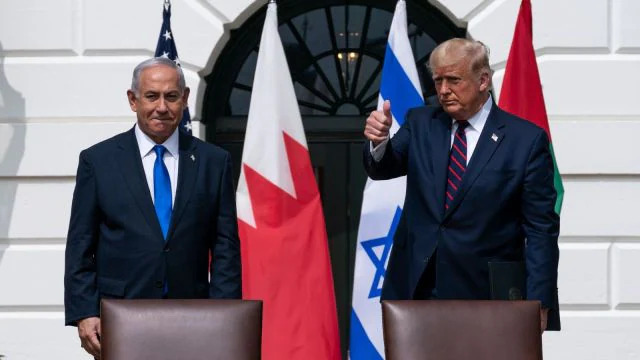
Washington (AP): President Donald Trump and Benjamin Netanyahu are set to meet on Tuesday as the Israeli prime minister faces competing pressure from his right-wing coalition to end a temporary truce against Hamas in Gaza and from war-weary Israelis who want the remaining hostages home and the 15-month conflict to end.
Trump is guarded about the long-term prospects for the truce, even as he takes credit for pressuring Hamas and Israel into the hostage and ceasefire agreement that went into effect the day before he returned to office last month.
“I have no guarantees that the peace is going to hold," Trump told reporters.
The leaders' talks are expected to touch on a long-sought Israel-Saudi Arabia normalization deal and concerns about Iran's nuclear program, but hammering out the second phase of the hostage deal will be at the top of the agenda.
Netanyahu's arrival in Washington for the first foreign leader visit of Trump's second term comes as the prime minister's popular support is lagging. Netanyahu is in the middle of weekslong testimony in an ongoing corruption trial that centres on allegations he exchanged favours with media moguls and wealthy associates. He has decried the accusations and said he is the victim of a “witch hunt.”
Being seen with Trump, who is popular in Israel, could help distract the public from the trial and boost Netanyahu's standing.
It's Netanyahu's first travel outside Israel since the International Criminal Court issued arrest warrants in November for him, his former defense minister and Hamas' slain military chief, accusing them of crimes against humanity during the war in Gaza. The US does not recognize the ICC's authority over its citizens or territory.
Netanyahu said in statement that the meeting with Witkoff and US National Security Adviser Michael Waltz was “positive and friendly.”
The Israeli leader said he would send a delegation to Qatar to continue indirect talks with Hamas that are being mediated by the Gulf Arab country, the first confirmation that those negotiations would continue. Netanyahu also said he would convene his security Cabinet to discuss Israel's demands for the next phase of the ceasefire when he returns to Israel at the end of the week.
Since returning to office, Trump has called for relocating Palestinians from Gaza to neighbouring Egypt and Jordan, even as Egyptian President Abdel Fattah el-Sissi and Jordanian King Abdullah II have rejected it. Saudi Arabia, the United Arab Emirates, Qatar, the Palestinian Authority and the Arab League have joined Egypt and Jordan in rejecting plans to move Palestinians out of their territories in Gaza and the occupied West Bank.
Yet Trump insists he can persuade Egypt and Jordan to come around to accept displaced Palestinians because of the significant aid that the U.S. provides Cairo and Amman. Hard-line right-wing members of Netanyahu's government have embraced the call to move displaced Palestinians out of Gaza.
Shibley Telhami, the Anwar Sadat Professor for Peace and Development at the University of Maryland, said the push by Trump to move Palestinians out of Gaza is helpful to Netanyahu. But he added that it undercuts Trump and Netanyahu's desire to land a normalization deal with Saudi Arabia.
The Saudis, the biggest Arab power in the Middle East, have said they would only agree to such a deal if the war ends and there is a credible pathway to a Palestinian state in Gaza and the West Bank.
“This push by Trump doesn't square with the idea of a Palestinian state as we know it,” Telhami said. “It's hard to see the Saudis going along with it.”
Netanyahu on Monday met with Trump's pick to serve as ambassador to Israel, former Arkansas Gov. Mike Huckabee, and evangelical leaders. Huckabee has long rejected a Palestinian state in territory previously seized by Israel.
The prime minister is also expected to press Trump to take decisive action on Iran. Tehran has faced a series of military setbacks, including Israeli forces significantly degrading Hamas in Gaza and Hezbollah militants in Lebanon as well as an operation that decimated Iran's air defences. The moment, Netanyahu believes, has created a window to decisively address Tehran's nuclear programme.
“This is one of the most important and critical meetings between an American president and an Israeli prime minister,” said Eytan Gilboa, an expert on U.S.-Israel relations at Bar-Ilan University near the Israeli city of Tel Aviv. “What's at stake here is not just bilateral relations between Israel and the United States but the reshaping of the Middle East.”
Let the Truth be known. If you read VB and like VB, please be a VB Supporter and Help us deliver the Truth to one and all.
Rupee falls 20 paise to 95.43 against US dollar in early trade

Mumbai (PTI): The rupee depreciated 20 paise to 95.43 against US dollar in early trade on Tuesday as market sentiments remained fragile after renewed military exchanges between US and Iranian forces in the Gulf region.
Forex traders said investor anxiety due to instability in the Gulf is causing massive capital flight into safe-haven assets, with the US dollar acting as the primary beneficiary.
Moreover, Brent oil prices is hovering near USD 113 per barrel, maintaining pressure on oil-importing economies like India.
At the interbank foreign exchange market the rupee opened at 95.30 then lost ground to touch 95.43 against the US dollar, in initial trade, registering a fall of 20 paise over its previous close.
Rupee fell 39 paise to close at an all-time low of 95.23 against the US dollar on Monday.
"With oil boiling rupee on Monday fell to a closing low of 95.0875 and this morning the opening was still lower as it becomes more and more vulnerable when dollar index rises due to safe-haven buying and oil prices rise due to the continuous fighting in the Gulf Region," Anil Kumar Bhansali, Head of Treasury and Executive Director, Finrex Treasury Advisors LLP, said.
The higher oil prices will keep rupee sold off against the dollar as oil companies and FPIs intensify dollar buying, Bhansali added.
Meanwhile, the dollar index, which gauges the greenback's strength against a basket of six currencies, was trading at 98.51, up 0.15 per cent.
Brent crude, the global oil benchmark, was trading lower by 1.07 per cent at USD 113.22 per barrel in futures trade.
"Market sentiments remained fragile after renewed military exchanges between US and Iranian forces when Iranian forces launched fresh attacks in the Gulf as both sides sought to assert control over the strategic waterway," Bhansali said.
On the domestic equity market front, Sensex declined 361.62 points to 76,907.78 in early trade, while the Nifty dropped 134.90 points to 23,980.60.
Foreign Institutional Investors purchased equities worth Rs 2,835.62 crore on Monday, according to exchange data.