Trump asks EU to impose up to 100% tariffs on India, China for buying Russian crude oil: Report
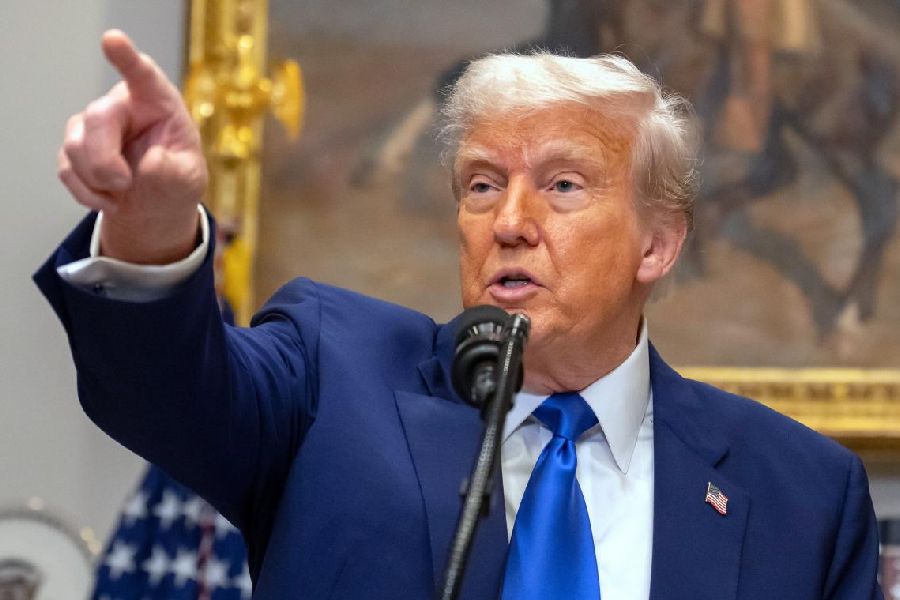
New Delhi: US President Donald Trump has asked the European Union (EU) to impose tariffs of up to 100 per cent on India and China as part of a joint effort to increase pressure on Russia to end the war in Ukraine, the Financial Times reported on Wednesday.
The report came shortly after Trump and Prime Minister Narendra Modi exchanged positive outlook about the India-US relations and referred to ongoing efforts to seal a trade deal.
The president made the extraordinary demand after dialling into a meeting on Tuesday between senior US and EU officials gathered in Washington to discuss ways to heighten the economic cost of the war for Moscow, the report said, citing unnamed officials.
The FT quoted a US official as saying that Washington was prepared to "mirror" any tariffs on China and India imposed by the EU.
The relations between New Delhi and Washington are on a major downturn after Trump doubled tariffs on Indian goods to a whopping 50 per cent including a 25 per cent additional duties for India's purchase of Russian crude oil.
India described the US action as "unfair, unjustified and unreasonable".
However, the exchanges between Modi and Trump on social media indicated some efforts to reset the ties.
In the last few days, several Trump administration officials including White House trade advisor Peter Navarro have used offensive language to criticise India for its procurement of Russian crude oil.
India's big oil lobby has turned the largest democracy in the world into a "massive refining hub and oil money laundromat for the Kremlin", Navarro said recently.
Defending its purchase of Russian crude oil, India has been maintaining that its energy procurement is driven by national interest and market dynamics.
India turned to purchasing Russian oil sold at a discount after Western countries imposed sanctions on Moscow and shunned its supplies over its invasion of Ukraine in February, 2022.
Consequently, from a mere 1.7 per cent share in total oil imports in 2019-20, Russia's share increased to 35.1 per cent in 2024-25, and it is now the biggest oil supplier to India.
The FT's report came amid renewed push by Trump to end the Ukraine conflict.
The US president held summit talks with Russian President Vladimir Putin in Alaska last month to explore ways to end the conflict.
Let the Truth be known. If you read VB and like VB, please be a VB Supporter and Help us deliver the Truth to one and all.
NCW chief condemns rape-murder of 4-year-old girl in Pune, calls for swift action
New Delhi (PTI): National Commission for Women (NCW) Chairperson Vijaya Rahatkar has condemned the alleged rape and murder of a four-year-old girl in Maharashtra's Pune, calling it "deeply distressing" and a "blot on humanity".
The girl was allegedly raped and killed by a 65-year-old labourer, who has a criminal record, in Bhor tehsil of Pune on Friday. The accused allegedly lured the child to a cattle enclosure on the pretext of giving her food. After raping her, he killed her by hitting her with a stone, according to police.
The accused has been arrested.
In a post on X on Saturday, Rahatkar said the incident in the Nasrapur area in Pune was heartbreaking and has shaken society.
"The brutal torture and murder of a four-year-old innocent girl in Nasrapur (Bhor, Pune) is deeply painful, heartbreaking, and shocking. It is a blot on humanity," she said.
She said Pune Rural police has arrested the accused and noted that Maharashtra Chief Minister Devendra Fadnavis and Deputy Chief Minister Sunetra Pawar have assured strict action in the case.
Rahatkar said the NCW has taken cognisance of the matter and written to the National Commission for Protection of Child Rights (NCPCR), requesting the body to ensure necessary and prompt action.
It has also been recommended that the case be pursued under stringent provisions of the Protection of Children from Sexual Offences (POCSO) Act and be closely monitored from the filing of the chargesheet to proceedings in a fast-track special court to ensure time-bound justice, she added.
Ensuring justice for the victim and stringent punishment for the accused is a collective responsibility, the NCW chairperson underlined.
In a post on X, the NCW said it has taken suo motu cognisance of the extremely "heinous" incident.
"This heinous crime causes profound pain and outrage, and it highlights serious concerns regarding the safety of young girls," it said.
Strongly condemning this grave "inhuman act", the NCW said such crimes constitute a serious violation of children's rights and raise questions about society's security system.