Trump doubles planned tariffs on Canadian steel, aluminum to 50% as trade war intensifies
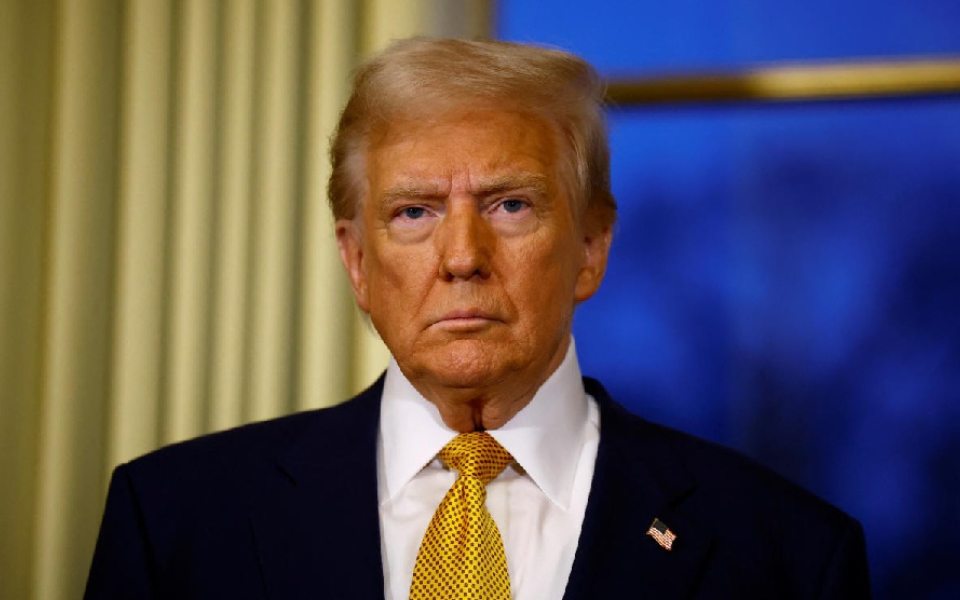
Washington, Mar 11 (AP): President Donald Trump said Tuesday that he will double his planned tariffs on steel and aluminum from 25% to 50% for Canada, escalating a trade war with the United States' northern neighbour and showing an indifference to recent stock market turmoil and rising recession risks.
Trump said on social media that the increase of the tariffs set to take effect on Wednesday is a response to the price increases that the provincial government of Ontario put on electricity sold to the United States.
“I have instructed my Secretary of Commerce to add an ADDITIONAL 25% Tariff, to 50%, on all STEEL and ALUMINUM COMING INTO THE UNITED STATES FROM CANADA, ONE OF THE HIGHEST TARIFFING NATIONS ANYWHERE IN THE WORLD,” Trump posted Tuesday on Truth Social.
After a brutal stock market selloff on Monday and further jitters Tuesday, Trump faces increased pressure to show he has a legitimate plan to grow the economy instead of perhaps pushing it into a recession. But so far the president is doubling down on the tariffs he talked up repeatedly during the 2024 campaign and throwing a once stable economy into utter turmoil as investors expected him to lead with deregulation and tax cuts instead of colossal tax hikes.
The US president has given a variety of explanations for his antagonism of Canada, saying that his separate 25% tariffs are about fentanyl smuggling and voicing objections to Canada putting high taxes on dairy imports that penalise US farmers. But he continued to call for Canada to become part of the United States as a solution, a form of taunting that has infuriated Canadian leaders.
“The only thing that makes sense is for Canada to become our cherished Fifty First State," Trump posted on Tuesday. "This would make all Tariffs, and everything else, totally disappear.”
Ontario Premier Doug Ford, after responding to Trump by raising electricity prices, said Tuesday on MSNBC that the US people and its business leaders needed to speak up against the “chaos” caused by Trump's launching of a trade war.
“If we go into a recession it's self made by one person. It's called President Trump's recession,” Ford said. “It shouldn't be this way. We should be booming, both countries.”
The US president condemned the use of electricity “as a bargaining chip and threat,” saying in a separate social media post on Tuesday that Canada "will pay a financial price for this so big that it will be read about in History Books for many years to come!”
Trump was set to deliver a Tuesday afternoon address to the Business Roundtable, a trade association of CEOs that during the 2024 campaign he wooed with the promise of lower corporate tax rates for domestic manufacturers. But his tariffs on Canada, Mexico, China, steel, aluminum — with plans for more to possibly come on Europe, Brazil, South Korea, pharmaceutical drugs, copper, lumber and computer chips — would amount to a massive tax hike.
The stock market's vote of no confidence over the past two weeks puts the president in a bind between his enthusiasm for taxing imports and his brand as a politician who understands business based on his own experiences in real estate, media and marketing.
Harvard University economist Larry Summers, a former treasury secretary for the Clinton administration, on Monday put the odds of a recession at 50-50.
“All the emphasis on tariffs and all the ambiguity and uncertainty has both chilled demand and caused prices to go up,” Summers posted on X. “We are getting the worst of both worlds - concerns about inflation and an economic downturn and more uncertainty about the future and that slows everything.”
The investment bank Goldman Sachs revised down its growth forecast for this year to 1.7% from 2.2% previously. It modestly increased its recession probability to 20% “because the White House has the option to pull back policy changes if downside risks begin to look more serious.”
Trump has tried to assure the public that his tariffs would cause a bit of a “transition” to the economy, with the taxes prodding more companies to begin the years-long process of relocating factories to the United States to avoid the tariffs. But he set off alarms in an interview broadcast on Sunday in which he didn't rule out a possible recession.
“I hate to predict things like that,” Trump said on Fox News Channel's “Sunday Morning Futures." "There is a period of transition, because what we're doing is very big. We're bringing wealth back to America. That's a big thing. And there are always periods of — it takes a little time. It takes a little time. But I don't — I think it should be great for us. I mean, I think it should be great."
The promise of great things ahead did not eliminate anxiety, with the S&P 500 stock index tumbling 2.7% on Monday in an unmistakable Trump slump that has erased the market gains that greeted his victory in November 2024. The S&P 500 index fell roughly 0.4% in Tuesday morning trading.
Trump has long relied on the stock market as an economic and political gauge to follow, only to seemingly ignore it as he remains determined so far to impose tariffs. When he won the election last year, he proclaimed that he wanted his term to be considered to have started Nov 6, 2024 on Election Day, rather than his January 20, 2025 inauguration, so that he could be credited for post-election stock market gains.
Trump also repeatedly warned of an economic freefall if he lost the election.
“If I don't win you will have a 1929 style depression. Enjoy it,” Trump said at an August rally in Pennsylvania.
The White House is no longer treating stocks as a reliable economic indicator. After the markets closed on Monday, the White House highlighted that the tariffs were prompting companies such as Honda, Volkswagen and Volvo to consider new investments in US factories.
It issued a statement that Trump's combination of tariffs, deregulations and increased energy production had led industry leaders to promise to “create thousands of new jobs.”
The significance of thousands of additional jobs was unclear, as the US economy added 2.2 million jobs last year alone, according to the Bureau of Labour Statistics.
Let the Truth be known. If you read VB and like VB, please be a VB Supporter and Help us deliver the Truth to one and all.
Maharashtra sets up state vaccination task force to strengthen immunisation programme

Mumbai (PTI): The Maharashtra government has set up a State Vaccination Task Force to strengthen the regular immunisation programme and review the progress of related campaigns, a health department official said on Monday.
The State Vaccination Task Force will comprise at least 29 members and will be headed by the administrative head of the health department, he informed.
The government has also constituted separate district-level and municipal vaccination task forces to improve implementation and address challenges at the grassroots level, he said.
Municipal task forces, chaired by respective civic commissioners, have been constituted in view of the vast urban population in Maharashtra and the role of civic bodies in implementing different health programmes.
The district-level task forces will function under the chairmanship of collectors.
"Complete immunisation of children at the appropriate age is an extremely simple, cost-effective and highly effective measure to reduce child mortality and the prevalence of diseases among kids. Immunisation is a powerful tool for reducing illness in children," maintained the official.
To ensure full vaccination of all children, the state government implements various campaigns from time to time as per the central government guidelines, he pointed out.
"Active participation and cooperation of other relevant government departments are essential (in making these campaigns successful)," according to the official.
The state-level body will review the regular immunisation programme, associated campaigns and vaccine-preventable diseases in detail. It will also conduct focused assessments of high-risk districts and municipal corporations, including vacancies at district, municipal and sub-district levels, availability of cold chain equipment, resource gaps and training requirements, he noted.
The state task force will review allocation and utilisation of funds for immunisation and ensure timely action by officers concerned based on reports from district and municipal task forces and state-level monitoring mechanisms, the official said.
It will also ensure active coordination and participation of other government departments in immunisation drives, while district and municipal task forces will carry out similar functions at their respective levels, the official added.