Trump extends ceasefire with Iran pending unified peace proposal
Washington/Islamabad (PTI): US President Donald Trump has indefinitely extended the ceasefire with Iran at the request of mediator Pakistan, saying the move was aimed at giving Tehran’s fractured leadership time to come up with a unified proposal to end the seven-week war.
The dramatic announcement came just hours before the two-week ceasefire announced on April 8 was set to expire, and effectively delayed the planned visit of a US delegation led by Vice President JD Vance to Islamabad for peace talks with Iranian interlocutors.
Vance and US special envoys Steve Witkoff and Jared Kushner were scheduled to travel to Islamabad on Tuesday, but the White House said the delegation’s “trip to Pakistan will not be happening today (Tuesday).”
“Based on the fact that the Government of Iran is seriously fractured, not unexpectedly so and, upon the request of Field Marshal Asim Munir, and Prime Minister Shehbaz Sharif, of Pakistan, we have been asked to hold our attack on the country of Iran until such time as their leaders and representatives can come up with a unified proposal,” Trump said in a statement on Tuesday.
However, Trump made it clear that the US will refrain from attacking Iran only until its leadership presents a unified proposal for negotiations. He said the economic blockade of Iran’s ports will remain in place.
The US President said he has therefore "directed the military to continue the blockade".
Slamming the US, Iranian foreign minister Seyed Abbas Araghchi said blockading Iranian ports is an "act of war and thus a violation of the ceasefire".
"Striking a commercial vessel and taking its crew hostage is an even greater violation. Iran knows how to neutralise restrictions, how to defend its interests, and how to resist bullying," he said in a social media post.
On Tuesday, the US said its forces boarded an oil tanker previously sanctioned for smuggling Iranian crude in Asia. The Pentagon said that US forces boarded the M/T Tifani without incident.
The US military did not disclose the location of the boarding, though ship-tracking data showed the vessel in the Indian Ocean between Sri Lanka and Indonesia on Tuesday. The Pentagon added that international waters are not a refuge for sanctioned vessels.
Trump's ceasefire announcement capped days of intense diplomatic activity among officials in Washington, Islamabad and Tehran aimed at producing a draft proposal acceptable to all sides.
Witkoff and Kushner were due to leave Miami for Islamabad on Tuesday morning, but were instead asked to join “additional meetings” at the White House. Vance, who was also scheduled to travel to Pakistan, joined the deliberations in Washington.
The decision to extend the ceasefire marked a significant shift in Trump's tone. Earlier on Tuesday, he said that if a deal was not reached by Wednesday, he expected to “be bombing, because that is a better attitude to go in with.” He added that the military was “raring to go.”
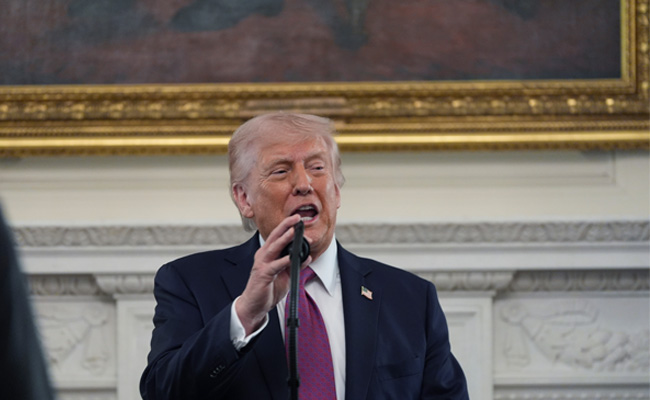
Trump did not refer to the conflict or the negotiations with Iran during his only public appearance of the day, when he addressed NCAA collegiate national champions at the White House on Tuesday afternoon.
Pakistan Prime Minister Shehbaz Sharif thanked Trump for extending the ceasefire with Iran and expressed hope that both sides would be able to “conclude a comprehensive peace deal” to end the conflict.
“On my personal behalf and on behalf of Field Marshal Syed Asim Munir, I sincerely thank President Trump for graciously accepting our request to extend the ceasefire to allow ongoing diplomatic efforts to take their course,” he said in a social media post.
Sharif said with the “trust and confidence reposed in (it), Pakistan shall continue its earnest efforts for a negotiated settlement of the conflict.”
“I sincerely hope that both sides will continue to observe the ceasefire and be able to conclude a comprehensive ‘Peace Deal’ during the second round of talks scheduled at Islamabad for a permanent end to the conflict,” he added.
Meanwhile, Treasury Secretary Scott Bessent announced sanctions on 14 individuals, entities and aircraft based in Iran, Turkiye and the United Arab Emirates for their alleged involvement in procuring or transporting weapons or weapons components on behalf of the Iranian regime.
“The Iranian regime must be held accountable for its extortion of global energy markets and indiscriminate targeting of civilians with missiles and drones,” Bessent said.
He warned that Iran’s Kharg Island storage facilities could reach capacity within days, potentially forcing fragile oil wells to shut down.
“Constraining Iran’s maritime trade directly targets the regime’s primary revenue lifelines,” he said.
The US imposed the blockade to pressure Tehran into ending its stranglehold on the Strait of Hormuz, a key shipping lane through which about 20 per cent of the world’s natural gas and crude oil transits in peacetime.
Iran’s grip on the strait has pushed oil prices sharply higher. Brent crude, the international benchmark, was trading close to USD 95 per barrel on Tuesday, up more than 30 per cent since February 28, the day Israel and the US launched strikes on Iran, triggering the war.
Pakistan had urged an extension of the truce due to uncertainty surrounding the second round of talks, which are still expected to be held later this week.
However, there was still no clarity on the date of the next round of talks. Pakistan has taken elaborate security measures, including deploying more than 10,000 security personnel, in preparation for the proposed negotiations.
The first round of US-Iran talks held on April 11 and 12 failed to produce a breakthrough, prompting a flurry of diplomatic efforts by host Pakistan to cool tensions and revive hopes for another round of dialogue.
Amid the uncertainty over the talks, Pakistan’s Deputy Prime Minister Ishaq Dar on Tuesday urged the two sides to extend the two-week ceasefire and give diplomacy a chance.
The Iran war began on February 28 with US-Israeli strikes.
Let the Truth be known. If you read VB and like VB, please be a VB Supporter and Help us deliver the Truth to one and all.
Bengal polls phase-1: Close to 90 pc polling till 5 pm amid sporadic clashes, assault on candidates
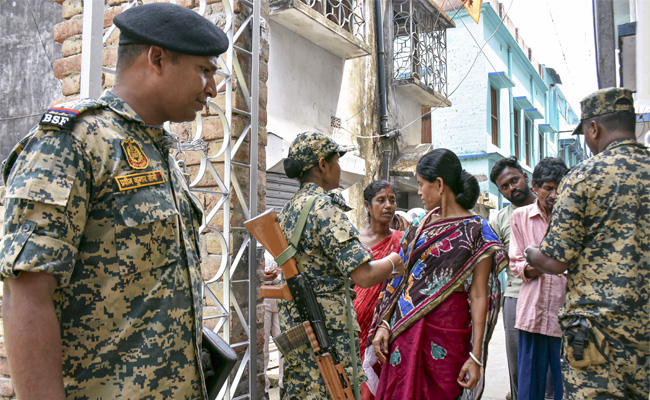
Kolkata (PTI): Close to 90 per cent of the 3.60 crore electors turned up to vote in the first phase of the West Bengal Assembly polls till 5 pm on Thursday, held under the shadow of large-scale name deletions under the SIR exercise, sporadic violence and assault on at least three candidates.
The voter turnout is among the highest in recent electoral history of the state.
Polling in 16 districts began at 7 am on Thursday amid tight security to decide the electoral fate of 1,478 candidates, including 167 women, in 152 constituencies of the 294-strong state Assembly.
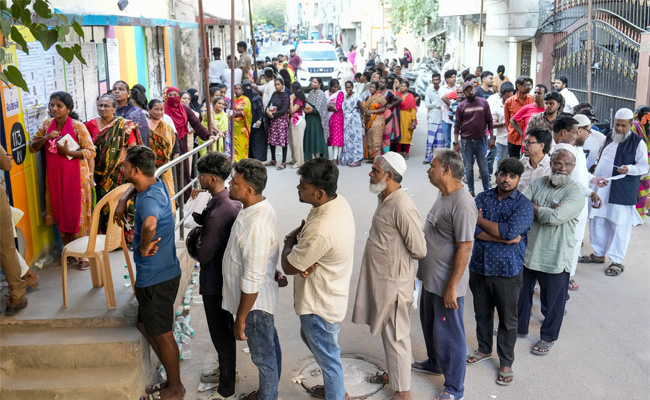
Long queues outside polling booths reflected strong voter participation in what is being seen as a crucial round in a high-stakes contest between the ruling Trinamool Congress (TMC) and the BJP.
The state recorded 89.93 per cent voter turnout till 5 pm, with the Dakshin Dinajpur district leading with 93.12 per cent polling. With voting slated to continue till 6 pm, political observers said the turnout might cross 95 per cent.
Analysts say the turnout reflects both heightened political mobilisation and the statistical impact of the Special Intensive Revision (SIR), which pruned over 91 lakh names from the voter's list across the state.
The steady climb, from 18.76 per cent in the first two hours to 41.11 per cent by 11 am and 62.18 per cent by 1 pm, underscored a strong voter response across geographies -- from the tea gardens of North Bengal to the communally sensitive belts of Murshidabad and the politically volatile Jangalmahal.
ALSO READ: Poppy husk worth Rs 1.5 crore seized in UP's Saharanpur, one arrested
Many of the districts that voted in the first phase had seen significantly higher turnouts in the 2021 Assembly elections when polling was held in eight phases.
The SIR exercise, which shrank the electorate by nearly 12 per cent, loomed large over the phase. While the Election Commission has maintained that the revision improved the accuracy of the rolls, opposition parties, particularly the TMC, have alleged large-scale disenfranchisement, turning turnout itself into a contested political statistic.
That tension spilled onto the ground in multiple districts.
Clashes, allegations of intimidation and attacks on candidates, including on two of the BJP, were reported from several constituencies, prompting the Election Commission to seek detailed reports even as it maintained that polling was "largely peaceful".
In Birbhum's Khoyrasol, tension escalated dramatically in the final hours after voters alleged that votes cast in favour of the TMC were being registered for the BJP. This triggered protests, a temporary halt in voting and clashes between locals and security personnel.
Eyewitnesses said the situation spiralled following an argument between polling officials and voters, with locals gathering outside the booth and staging a protest. While forces intervened to disperse the crowd, stone pelting was reported later, and security personnel resorted to mild force.
Earlier in the day, BJP candidate Suvendu Sarkar was allegedly manhandled in Dakshin Dinajpur's Kumarganj, while BJP MLA Agnimitra Paul's car was attacked in Asansol Dakshin, with stones shattering its rear windowpanes -- incidents the party cited as evidence of "targeted violence".
The TMC denied the allegations, accusing the BJP of attempting to "engineer" unrest.
Tension escalated further in Naoda when stones were allegedly hurled at the convoy of AJUP chief Humayun Kabir during his visit to a polling area, forcing security personnel to intervene. The incident triggered a brief flare-up, adding to the volatility in the constituency.
Clashes erupted between supporters of the TMC and the Aam Janata Unnayan Party (AJUP), leading to a baton charge by central forces.
Meanwhile, in Birbhum's Labhpur and Malda's Chanchal, BJP polling agents were allegedly assaulted by the TMC.
In Murarai, clashes between Congress and TMC workers left at least two injured. In Domkal, allegations surfaced that voters were prevented from reaching booths, necessitating a security escort.
The Election Commission, facing mounting pressure, reported receiving around 500 complaints by noon, with another 375 through the cVIGIL app. The TMC alone claimed to have lodged over 700 complaints by mid-afternoon, many related to alleged EVM malfunction and the conduct of central forces.
The EVM issue added another layer of political contestation to an already polarised phase where identity, citizenship, and the fallout of voter list revision have overtaken traditional issues like jobs and corruption.
Leader of the Opposition Suvendu Adhikari alleged that "TMC-sheltered criminals" were intimidating voters, while the TMC accused the BJP of using central agencies and forces to influence the electoral process.
District-wise data showed Dakshin Dinajpur recording the highest turnout of over 81 per cent, followed by Murshidabad at around 91 per cent, and Bankura and Cooch Behar, 92 per cent each.
The voter turnout was around 90 per cent in Malda, Jhargram and Paschim Medinipur, while Kalimpong recorded around 81 per cent polling.
The first phase, covering all 54 seats in North Bengal along with key constituencies in South Bengal, is central to the BJP's strategy of consolidating its northern stronghold, where it had surged in 2019 and remained competitive in 2021, and to the TMC's effort to blunt that expansion early in the contest.
In 2021, the BJP had won 59 of these 152 seats against the TMC's 93.