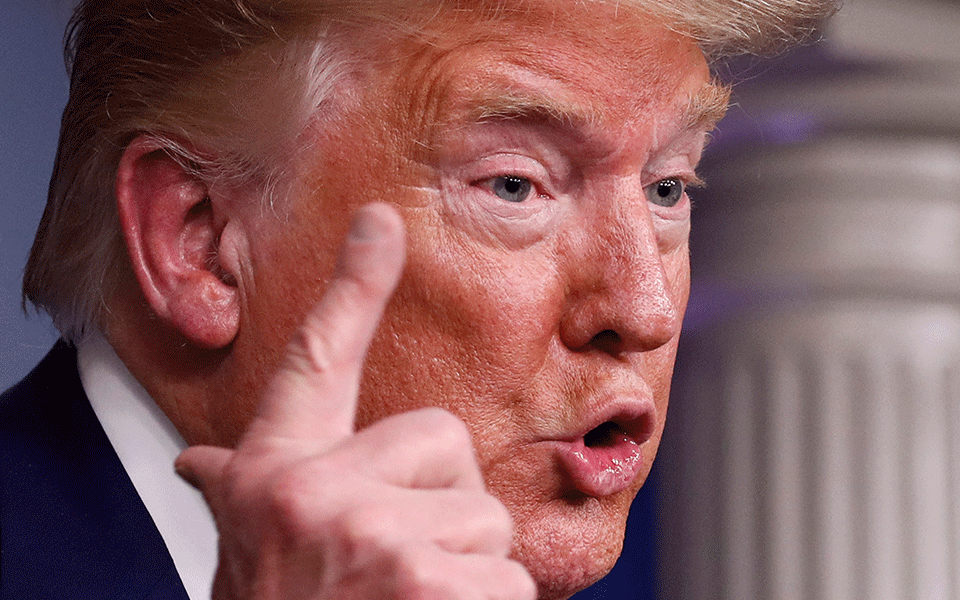
Washington: US President Donald Trump has extended the freeze on the most sought-after H-1B visas along with other types of foreign work visas by three months to protect American workers, saying while therapeutics and COVID-19 vaccines are recently available, their effect on the labour market and community health has not yet been fully realised.

The decision will impact a large number of Indian IT professionals and several American and Indian companies who were issued H-1B visas by the US government for the fiscal year 2021 beginning October 1.

The freeze on various categories of work visas was ordered by Trump through two proclamations on April 22 and June 22 last year. Hours before the freeze was set to expire on December 31, Trump issued another proclamation on Thursday to extend it until March 30.

He said that the reasons for which he had issued such a restriction has not changed.

The H-1B visa is a non-immigrant visa that allows US companies to employ foreign workers in specialty occupations that require theoretical or technical expertise. The technology companies depend on it to hire tens of thousands of employees each year from countries like India and China.

They would now have to wait at least till the end of March before approaching the US diplomatic missions to get stamping. It would also impact a large number of Indian IT professionals who are seeking renewal of their H-1B visas.

President Trump said that the effects of COVID-19 on the US labour market and the health of American communities is a matter of ongoing national concern, and the considerations present in the two previous proclamations have not been eliminated.

The 2019 Novel Coronavirus (COVID-19) continues to significantly disrupt Americans' livelihoods. While the November overall unemployment rate in the United States of 6.7 per cent reflects a marked decline from its April high, there were still 9,834,000 fewer seasonally adjusted nonfarm jobs in November than in February of 2020, Trump said in his proclamation.

The current number of new daily cases worldwide reported by the World Health Organization (WHO), for example, is higher than the comparable number present during June, and while therapeutics and vaccines are recently available for an increasing number of Americans, their effect on the labour market and community health has not yet been fully realised, he said.

Moreover, actions such as States' continued imposition of restrictions on businesses still affect the number of workers that can be hired as compared with February of 2020, Trump said, adding that his latest proclamation may be extended if necessary.

Let the Truth be known. If you read VB and like VB, please be a VB Supporter and Help us deliver the Truth to one and all.


Picture this: A constellation of high-tech sentinels orbiting Earth, not just watching the world below but vigilantly shielding their kin from unseen dangers. These aren't mere tools for mapping terrain or relaying signals—they're the vanguard of a new era in space exploration, where protection is as crucial as innovation. For India, this shift marks a bold leap from relying on satellites as silent witnesses to empowering them with their own defenders.

In 2024, an intriguing encounter unfolded in the vast expanse of orbit. A foreign satellite—its origins undisclosed—edged perilously close to one of India's key assets, a mere kilometre apart. This incident, first highlighted by Bloomberg News in September 2024, wasn't just a close call; it was a wake-up call that propelled India into rethinking its space strategy. Rather than viewing it solely as a threat, it underscored an opportunity: to pioneer advanced protective technologies that could redefine global space norms.

Enter the Guardian Satellites: India's Innovative Shield

At the heart of this evolution are guardian satellites, engineered to safeguard vital orbital infrastructure. These aren't aggressive warriors but sophisticated protectors, designed with precision and purpose. Bloomberg's insights reveal India is developing two variants. The first boasts a robotic manipulator—a feat of engineering that allows it to gently intercept and redirect intrusive spacecraft, ensuring safe distances without escalation. The second operates in coordinated swarms, forming dynamic barriers around threats, much like a synchronized team herding an unwelcome intruder away from a VIP event, all at altitudes exceeding 500 kilometres.

This ingenuity stems from a blend of necessity and creativity. By focusing on non-destructive methods, India's approach emphasizes de-escalation, potentially setting a standard for responsible space conduct amid growing congestion in orbit.

Catalysts for Change: Lessons from Recent Events

India's pivot wasn't born in isolation. The 2024 orbital rendezvous highlighted vulnerabilities, but it was the previous year's border tensions with Pakistan that truly accelerated progress. Over those intense four days, satellites became indispensable for real-time intelligence, guiding troop deployments and radar placements. Yet, a defence ministry-affiliated research group noted in May that China allegedly extended satellite assistance to Pakistan, enhancing their defensive capabilities. This revelation transformed space from a neutral domain into a strategic multiplier, prompting India to fortify its assets proactively.

Anil Bhatt, ex-Chief of Military Operations and now Director General of the Indian Space Association, emphasizes: "Interference or disruption of satellites is a tangible risk." He advocates for a balanced arsenal of protective measures, both tangible and intangible, to secure orbital superiority. For India, this means not just reacting to risks but innovating ahead of them, turning potential weaknesses into strengths.

Global Parallels: A Shared Quest for Orbital Resilience

India joins a select group of nations investing in orbital guardianship, yet its path is uniquely collaborative and tech-driven. China leads with over 1,100 satellites, as per N2YO.com, and has demonstrated agile "manoeuvre-capable" spacecraft, per a US Space Force statement to CNN in March 2025. These can shadow or interact with others, showcasing advanced propulsion and control systems. Japan, meanwhile, is prototyping defences against adversarial "interceptor" satellites, as per last year's media reports. The European Defence Fund has explored similar initiatives since 2023, reflecting a worldwide recognition that space assets demand robust safeguards.

What sets India apart is its emphasis on indigenous innovation and partnerships. With just over 100 satellites currently, India leverages quality over quantity, integrating cutting-edge AI and robotics to punch above its weight.

The Broader Vision: Building a Self-Reliant Space Ecosystem

This guardian programme is a cornerstone of India's expansive space roadmap. Bloomberg indicates advanced negotiations with domestic startups to deploy the inaugural test satellite in early 2026, with further missions slated for late 2025 or beyond. Once validated, state entities will amplify production, fostering a vibrant ecosystem.

Complementing this is the accelerated Space-Based Surveillance initiative, aiming for over 50 advanced reconnaissance satellites offering round-the-clock, all-weather imaging. Ambitious targets envision up to 150 units forming an unblinking orbital network over sensitive borders.

On the ground, India is establishing dedicated tracking hubs domestically and abroad, enhancing real-time monitoring of foreign orbits. Discussions with allies like France and the UAE for collaborative tracking, as confirmed by Bloomberg sources, signal a diplomatic dimension—turning space protection into a platform for international cooperation.

Redefining Space: From Exploration to Empowerment

Once a realm for peaceful pursuits like scientific discovery and global connectivity, space now demands active stewardship. Nations are deploying protective fleets, surveillance arrays, and adaptive systems, transforming the cosmos into a domain of strategic empowerment.

India's journey exemplifies this transition. By improvising on traditional satellite roles, it's not merely defending assets but advancing technology that could inspire global standards for orbital harmony. In this new chapter, India's guardians aren't just bodyguards—they're pioneers, ensuring the stars remain a frontier for progress, not conflict.

(Girish Linganna is an award-winning science communicator and a Defence, Aerospace & Geopolitical Analyst. He is the Managing Director of ADD Engineering Components India Pvt. Ltd., a subsidiary of ADD Engineering GmbH, Germany.)

Disclaimer: The views and opinions expressed in this article are solely those of the author. They do not necessarily reflect the views, policies, or position of the publication, its editors, or its management. The publication is not responsible for the accuracy of any information, statements, or opinions presented in this piece.