Trump has made it clear mediation offer on Kashmir not on table anymore: India's US Envoy
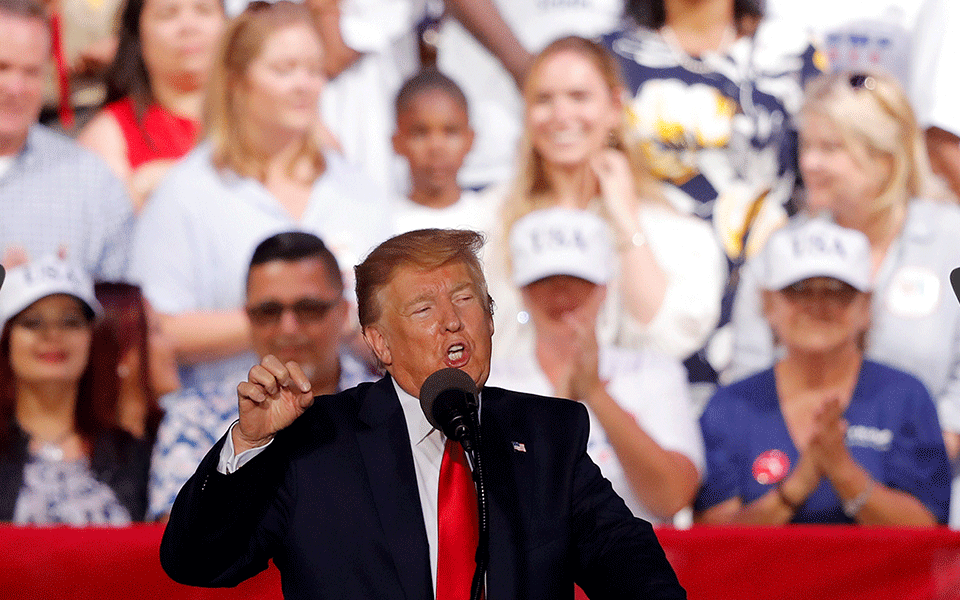
Washington: US President Donald Trump has made it clear that his offer of mediation on Kashmir is not on the table anymore, the Indian ambassador has said.
Ambassador Harsh Vardhan Shringla said on Monday that America's decades-old policy on Kashmir has been no mediation but to encourage India and Pakistan to resolve their differences bilaterally.
"President Trump has made it very clear that his offer to mediate on Jammu and Kashmir is dependent on both India and Pakistan accepting it. Since India has not accepted the offer of mediation, he has made it clear that this is not on the table anymore, Shringla told Fox News, the favourite news channel of the US president.
On July 22, during his joint media appearance with Pakistan Prime Minister Imran Khan at the White House, President Trump stunned India by saying that Prime Minister Narendra Modi sought his mediation/arbitration on the Kashmir issue, a claim that was seen by many as outlandish and carrying little credibility.
India asserted that no such request was made by Prime Minister Modi to the US president and all issues will have to be resolved with Islamabad bilaterally.
A week later, Trump climbed down from his previous statement, saying it was up to India and Pakistan to resolve the Kashmir issue but he was ready to assist if the two South Asian neighbours wanted him to help in resolving the issue.
He said India made it clear to America that any discussion on the issue, if at all warranted, will only be with Pakistan and only bilaterally, which has long been India's stated position.
Shringla said that America's policy on Kashmir has been no mediation but to encourage the two South Asian neighbours to resolve their differences bilaterally including on Kashmir, the pace and scope of which would be chosen by New Delhi and Islamabad.
That has been the United States longstanding policy, he said in response to a question referring to America's decades-old policy. Shringla said UN Secretary General Antonio Guterres was also very clear on the issue.
"He says, this issue has to be resolved bilaterally between India and Pakistan in keeping with the agreements that the two countries have signed: the Simla Agreement and the Lahore Declaration, he said.
"So, this is not an issue that is to be settled with, third parties. I think that was something that President Trump clarified and made clear, Shringla said.
State Department Spokesperson Morgan Ortagus last week said that there is no change in its policy on Kashmir as it called on India and Pakistan to maintain restraint and hold direct dialogue to resolve their differences.
Responding to a question, Shringla said that the measures taken by the Indian government in Kashmir are temporary and preventive in nature.
When the decision was announced, the possibilities of cross border infiltration and terrorism, we know that there would be incitement to violence. We have simply taken preventive steps, he said.
The restrictions in Kashmir are being eased even as we speak. Tens of thousands of people came out to celebrate the festival of Eid. They went to mosque, they prayed, the shops are open. There's even traffic jams in several cities. And we are progressively easing on the restrictions, Shringla said.
Let the Truth be known. If you read VB and like VB, please be a VB Supporter and Help us deliver the Truth to one and all.
Hospital wall collapse: CM orders suspension of executive engineer; kin of victims get solatium
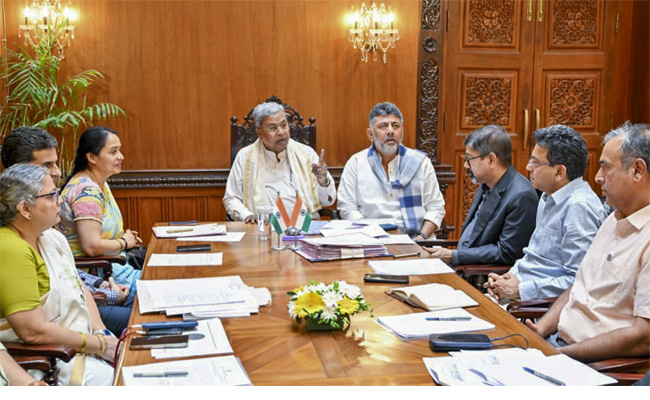
Bengaluru (PTI): Karnataka Chief Minister Siddaramaiah on Thursday ordered the immediate suspension of an executive engineer for the Bowring and Lady Curzon Hospital wall collapse that claimed the lives of seven people, during a high-level review meeting at Vidhana Soudha.
A compensation of Rs 5 lakh, as announced by the CM Siddaramaiah, was distributed to the families of seven victims who lost their lives in the tragedy on Wednesday evening, which occurred due to heavy downpour with gusty winds and hailstorm.
The meeting of municipal commissioners of the five corporations, chaired by the chief minister and attended by Deputy Chief Minister D K Shivakumar, focused on fixing accountability and examining lapses that led to the tragedy.
"Why was soil dumped in a way that damaged the wall? Why did you not monitor this?" Siddaramaiah asked, pulling up hospital authorities during the meeting.
A statement from the chief minister's office said that the CM ordered the immediate suspension of the executive engineer of the Karnataka Health Systems Development Project (KHSDP).
ALSO READ: Three arrested for running fake Aadhaar racket in UP's Badaun
He also questioned the hospital authorities, asking why they failed to monitor the dumping of soil that weakened the structure.
The chief minister directed that a notice be issued to the head of the Hospital.
During the meeting, Siddaramaiah said the rains had caused extensive damage in the city, with over 250 trees uprooted.
The Chief Minister instructed officials to take necessary measures before the onset of the monsoon to avoid untoward incidents.
Commissioners of all five municipal zones in Bengaluru have been asked to take precautionary steps, including trimming dry and dangerous tree branches, the CMO said.
Siddaramaiah also directed them to get the silt cleared from stormwater drains to prevent flooding, and that immediate action be taken to remove debris and fallen branches from roads.
Further, he instructed that barricades be placed at underpasses where water stagnates and restricts public movement.
The Greater Bengaluru Authority (GBA) Chief Commissioner M Maheshwar Rao said in a statement that Shivajinagar MLA Rizwan Arshad distributed compensation cheques of Rs 5 lakh each to the families of the deceased on Thursday.
Seven people, including a six-year-old girl, were killed and seven others injured when the compound wall collapsed amid heavy rain, strong winds and a hailstorm on Wednesday evening.
Police said the victims, comprising three from Bengaluru, two from Kerala on a study tour and one each from Uttar Pradesh and Assam, had taken shelter near the wall when it suddenly gave way, trapping them under the debris.
The chief minister questioned officials over the dumping of soil near the wall despite knowing it could weaken the structure, and directed that a notice be issued to the head of Bowring Hospital.
Siddaramaiah, who had visited the spot soon after the incident along with senior officials, reviewed the situation and ordered a detailed probe into the collapse.