Trump letter to Kim delivered to top N. Korean diplomat
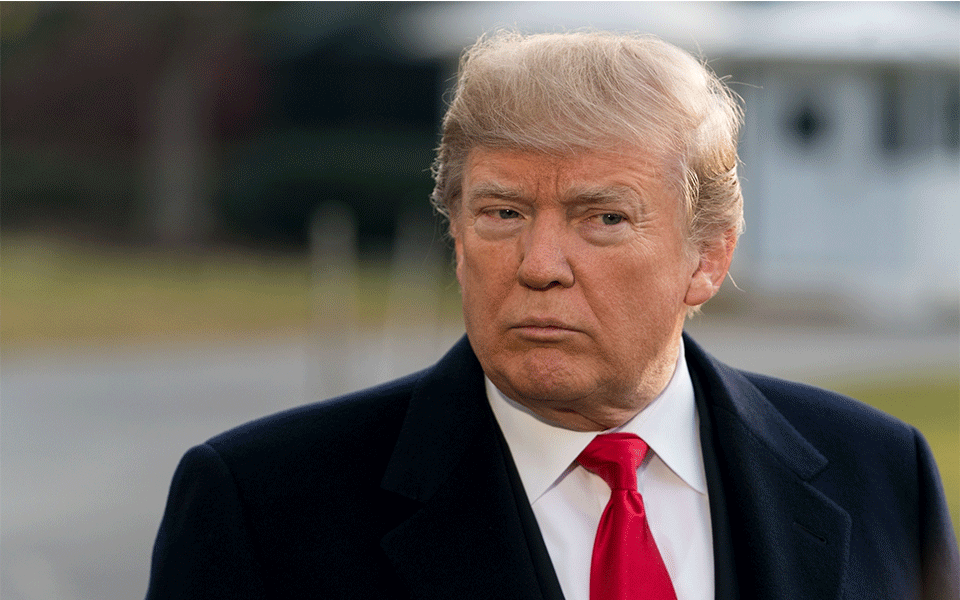
Singapore, Aug 4 : A US ambassador has given North Koreas top diplomat a letter from President Donald Trump to Pyongyang leader Kim Jong-un at a conference of Southeast Asia nations in Singapore, the State Department said on Saturday.
State Department spokeswoman Heather Nauert said that US Ambassador Sung Kim, travelling with Secretary of State Mike Pompeo, gave the letter from the President to North Korean Foreign Minister Ri Yong Ho immediately after they shook hands during the Association of Southeast Asian Nations (Asean) summit here, the Washington Post reported.
According to Nauert, Pompeo told Ri that they "should talk again soon" and Ri replied in the affirmative. "There are many productive conversations to be had," the North Korean official said.
Beyond the brief exchange at the group photo, Pompeo and Ri did not have a more formal meeting.
Nauert called it a "step in the right direction" from where the US and North Korea were a year ago.
"We had a quick, polite exchange," Pompeo wrote on Twitter. "Our US delegation also had the opportunity to deliver (Trump's) reply to Chairman Kim's letter."
This was a reference to Kim's recent letter to Trump, which the latter described as "nice" in a Twitter post.
During the event, Pompeo described himself as "optimistic" that the denuclearization of the Korean Peninsula remains an achievable goal, but one that will take time.
"From my meetings here, the world is united in seeing this achieved," he said. "There has not been single country that hasn't thanked the US for its efforts in moving the world towards the possibility of achieving this. … I'm optimistic that we will get this done in the timeline, and the world will celebrate what the UN Security Council has demanded."
Earlier Saturday, Pompeo suggested the timeline will be determined in large part by the North Korean leader.
"The ultimate timeline for denuclearization will be set by Chairman Kim, at least in part," he said in an interview with Channel NewsAsia.
"The decision is his. He made a commitment and we're very hopeful that over the coming weeks and months we can make substantial progress towards that and put the North Korean people on a trajectory towards a brighter future very quickly."
Let the Truth be known. If you read VB and like VB, please be a VB Supporter and Help us deliver the Truth to one and all.
NCW chief condemns rape-murder of 4-year-old girl in Pune, calls for swift action
New Delhi (PTI): National Commission for Women (NCW) Chairperson Vijaya Rahatkar has condemned the alleged rape and murder of a four-year-old girl in Maharashtra's Pune, calling it "deeply distressing" and a "blot on humanity".
The girl was allegedly raped and killed by a 65-year-old labourer, who has a criminal record, in Bhor tehsil of Pune on Friday. The accused allegedly lured the child to a cattle enclosure on the pretext of giving her food. After raping her, he killed her by hitting her with a stone, according to police.
The accused has been arrested.
In a post on X on Saturday, Rahatkar said the incident in the Nasrapur area in Pune was heartbreaking and has shaken society.
"The brutal torture and murder of a four-year-old innocent girl in Nasrapur (Bhor, Pune) is deeply painful, heartbreaking, and shocking. It is a blot on humanity," she said.
She said Pune Rural police has arrested the accused and noted that Maharashtra Chief Minister Devendra Fadnavis and Deputy Chief Minister Sunetra Pawar have assured strict action in the case.
Rahatkar said the NCW has taken cognisance of the matter and written to the National Commission for Protection of Child Rights (NCPCR), requesting the body to ensure necessary and prompt action.
It has also been recommended that the case be pursued under stringent provisions of the Protection of Children from Sexual Offences (POCSO) Act and be closely monitored from the filing of the chargesheet to proceedings in a fast-track special court to ensure time-bound justice, she added.
Ensuring justice for the victim and stringent punishment for the accused is a collective responsibility, the NCW chairperson underlined.
In a post on X, the NCW said it has taken suo motu cognisance of the extremely "heinous" incident.
"This heinous crime causes profound pain and outrage, and it highlights serious concerns regarding the safety of young girls," it said.
Strongly condemning this grave "inhuman act", the NCW said such crimes constitute a serious violation of children's rights and raise questions about society's security system.