Trump makes surprise visit to Iraq; meets US soldiers

Washington, Dec 27 : US President Donald Trump and First Lady Melania on Wednesday night made a surprise visit to Iraq to greet American soldiers stationed in the country.
This is his first visit to Iraq as the US President.
"I want to come and pay my respects most importantly to the great soldiers, great troopers we have here," Trump told a pool of reporters travelling with him. He stayed in the country for a few hours.
While in Iraq, Trump met with US military leaders and spoke to troops at the Al-Asad Air Base, a joint US-Iraqi military base west of Baghdad. A scheduled in-person meeting with Iraq's Prime Minister Adil Abdul-Mahdi was cancelled.
Trump's travel to Iraq was made public after he finished giving remarks to a group of about 100 mostly US special operations troops engaged in combat operations in Iraq and Syria.
When asked why he wanted to come to Iraq, Trump told reporters before a meeting with military leaders on base: "It's a place I have been talking about for many many years. I was talking about it as a civilian".
Trump travelled to Iraq unannounced during a partial government shutdown.
"We actually had a couple of set-ups but were cancelled for security reasons because people were finding out. Pretty sad when you spend seven trillion (US) dollars in the Middle East and going in has to be under this massive cover with planes all over and all of the greatest equipment in the world and you do everything to get in safely," he said, expressing his dissatisfaction over the current situation in the region.
Responding to questions, he said that he had concerns about coming to Iraq.
"Sure. When I heard what you had to go through?. I had concerns about the institution of the presidency. Not for myself personally. I had concerns for the First Lady, I will tell you. But if you would have see what we had to go through in the darkened plane with all window closed with no light anywhere. Pitch black. I've been on many airplanes. All types and shapes and sizes," Trump said.
"So did I have a concern? Yes I had a concern," he said.
After arriving at a dining facility at the base, Trump and Melania made their way through the crowd for about 15 minutes. Trump stopped to talk and signed several red 'Make America Great Again' hats service members had brought. At one point he signed an embroidered patch that read 'TRUMP 2020'.
One man with the name SINGER on his uniform shook Trump's hand. Trump turned to the reporters: "He came back into the military because of me," Trump said. Turning to the man, Trump added: "And I am here because of you".
Trump told reporters that he was pleased about his meeting with military leaders. He said they have a "great plan. You'll see. I wish I could tell you".
At one point, Trump stopped to talk football with a soldier named John Rader with the 201st Regional Support Group based in Atlanta, Georgia. Trump talked for a while about the Falcon's football losses in recent years.
Trump also paused to take photos and selfies with many service members. At one point Kyu Lee told that Trump he was the chaplain for Seal Team Five. Lee recalled Trump telling him: "Hey, in that case, let's take a picture".
The hall was decorated for Christmas with bells, foil balls, twinkling red green and blue coloured lights, the tables were covered in red and green table cloths. There were snowmen made of stacked tires painted white and Christmas trees fashioned from cut two by fours.
As hundreds of troops in uniform cheered, Melania took to the microphone and gave holiday and new year greetings to them and their families.
"I'm very proud of you," she added.
Let the Truth be known. If you read VB and like VB, please be a VB Supporter and Help us deliver the Truth to one and all.
Trump administration says its war in Iran has been 'terminated' before 60-day deadline
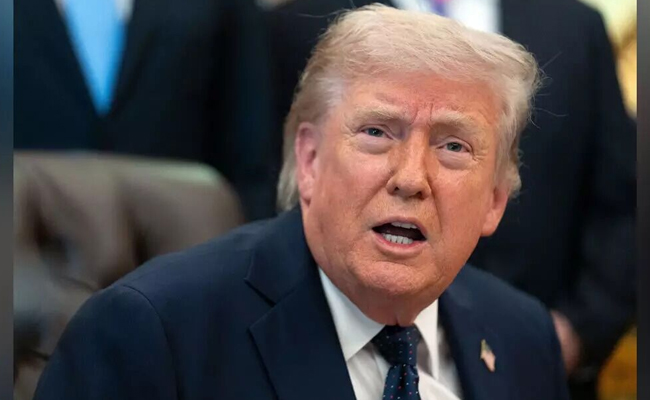
Washington (AP): The Trump administration is arguing that the war in Iran has already ended because of the ceasefire that began in early April, an interpretation that would allow the White House to avoid the need to seek congressional approval.
The statement furthers an argument laid out by Defense Secretary Pete Hegseth during testimony in the Senate earlier Thursday, when he said the ceasefire effectively paused the war. Under that rationale, the administration has not yet met the requirement mandated by a 1973 law to seek formal approval from Congress for military action that extends beyond 60 days.
A senior administration official, who spoke on condition of anonymity to discuss the administration's position, said for purposes of that law, “the hostilities that began on Saturday, Feb 28 have terminated.” The official said the US military and Iran have not exchanged fire since the two-week ceasefire that began April 7.
While the ceasefire has since been extended, Iran maintains its chokehold on the Strait of Hormuz, and the US Navy is maintaining a blockade to prevent Iran's oil tankers from getting out to sea.
Under the War Powers Resolution, the law that sought to constrain a president's military powers, President Donald Trump had until Friday to seek congressional authorisation or cease fighting. The law also allows an administration to extend that deadline by 30 days.
Democrats have pushed the administration for formal approval of the Iran war, and the 60-day mark would likely have been a turning point for a swath of Republican lawmakers who backed temporary action against Tehran but insisted on congressional input for something longer.
“That deadline is not a suggestion; it is a requirement,” said Sen Susan Collins, R-Maine, who voted Thursday in favour of a measure that would end military action in Iran since Congress hadn't given its approval. She added that “further military action against Iran must have a clear mission, achievable goals, and a defined strategy for bringing the conflict to a close."
Richard Goldberg, who served as director for countering Iranian weapons of mass destruction for the National Security Council during Trump's first term, said he has recommended to administration officials to simply transition to a new operation, which he suggested could be called “Epic Passage,” a sequel to Operation Epic Fury.
That new mission, he said, “would inherently be a mission of self-defence focused on reopening the strait while reserving the right to offensive action in support of restoring freedom of navigation.”
“That to me solves it all,” added Goldberg, who is now a senior adviser at the Foundation for Defense of Democracies, a hawkish Washington think tank.
During testimony before the Senate Armed Services Committee on Thursday, Hegseth said it was the administration's “understanding” that the 60-day clock was on pause while the two countries were in a ceasefire.
Katherine Yon Ebright, counsel at the Brennan Center's Liberty and National Security Program and an expert on war powers, said that interpretation would be a “sizeable extension of previous legal gamesmanship” related to the 1973 law.
“To be very, very clear and unambiguous, nothing in the text or design of the War Powers Resolution suggests that the 60-day clock can be paused or terminated,” she said.
Other presidents have argued that the military action they've taken was not intense enough or was too intermittent to qualify under the War Powers Resolution. But Trump's war in Iran would certainly not be such a case, Ebright said, adding that lawmakers need to push back against the administration on that kind of argument.