Trump orders freeze on all Venezuelan govt assets in US
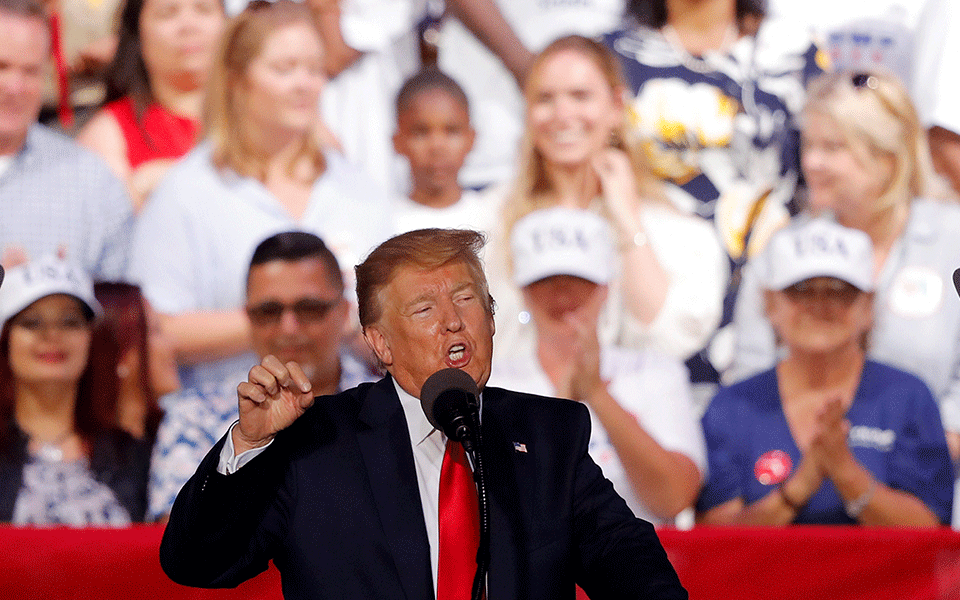
Washington: President Donald Trump on Monday ordered a freeze on all Venezuelan government assets in the United States and barred transactions with its authorities, in Washington's latest move against President Nicolas Maduro.
Trump took the step "in light of the continued usurpation of power by Nicolas Maduro and persons affiliated with him, as well as human rights abuses," according to the order.
The Wall Street Journal said the move was the first such against a Western Hemisphere government in over 30 years, and imposes restrictions on Caracas similar to those faced by North Korea, Iran, Syria and Cuba.
Asked last week if he was considering a "blockade or quarantine" of Venezuela, Trump responded: "Yes, I am." The order affects "all property and interests in property of the Government of Venezuela that are in the United States, that hereafter come within the United States, or that are or hereafter come within the possession or control of any United States person." These assets "are blocked and may not be transferred, paid, exported, withdrawn, or otherwise dealt in," the order said.
The measure also bars transactions with Venezuelan authorities whose assets are blocked.
It prohibits "the making of any contribution or provision of funds, goods, or services by, to, or for the benefit of any person whose property and interests in property are blocked pursuant to this order," as well as "the receipt of any contribution or provision of funds, goods, or services from any such person."
Venezuelan opposition leader Juan Guaido declared himself interim president earlier this year in a bid to oust Maduro that was backed by the United States and dozens of other countries.
But Guaido's efforts have stalled despite the international support and widespread discontent with Maduro, who has been able to cling to power with the backing of the country's security forces.
Guaido has tried to keep hope alive, encouraging Venezuelans weary after years of crisis not to give up.
Despite the loss of momentum, Guaido -- the speaker of the opposition-controlled National Assembly -- remains the greatest threat to Maduro, even though the body has been effectively rendered powerless by Caracas.
The oil-rich, cash-poor country has been in a deep recession for five years. Shortages of food and medicine are frequent, and public services are progressively failing.
Around a quarter of Venezuela's 30 million-strong population is in need of aid, according to the United Nations, while 3.3 million people have left the country since the start of 2016.
The International Monetary Fund says inflation will hit a staggering one million percent this year while the economy -- already in recession for five years -- will shrink by 35 percent.
Let the Truth be known. If you read VB and like VB, please be a VB Supporter and Help us deliver the Truth to one and all.
Hospital wall collapse: CM orders suspension of executive engineer; kin of victims get solatium
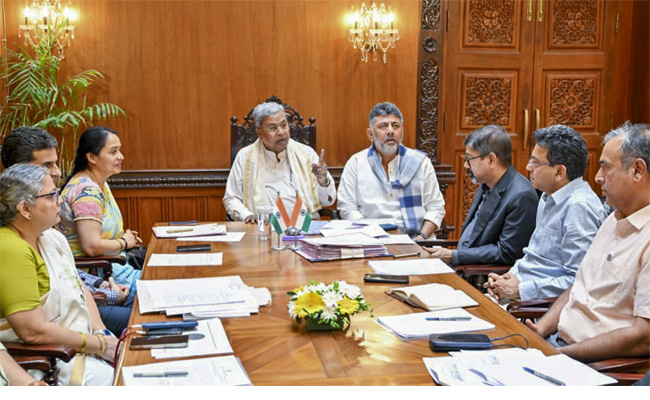
Bengaluru (PTI): Karnataka Chief Minister Siddaramaiah on Thursday ordered the immediate suspension of an executive engineer for the Bowring and Lady Curzon Hospital wall collapse that claimed the lives of seven people, during a high-level review meeting at Vidhana Soudha.
A compensation of Rs 5 lakh, as announced by the CM Siddaramaiah, was distributed to the families of seven victims who lost their lives in the tragedy on Wednesday evening, which occurred due to heavy downpour with gusty winds and hailstorm.
The meeting of municipal commissioners of the five corporations, chaired by the chief minister and attended by Deputy Chief Minister D K Shivakumar, focused on fixing accountability and examining lapses that led to the tragedy.
"Why was soil dumped in a way that damaged the wall? Why did you not monitor this?" Siddaramaiah asked, pulling up hospital authorities during the meeting.
A statement from the chief minister's office said that the CM ordered the immediate suspension of the executive engineer of the Karnataka Health Systems Development Project (KHSDP).
ALSO READ: Three arrested for running fake Aadhaar racket in UP's Badaun
He also questioned the hospital authorities, asking why they failed to monitor the dumping of soil that weakened the structure.
The chief minister directed that a notice be issued to the head of the Hospital.
During the meeting, Siddaramaiah said the rains had caused extensive damage in the city, with over 250 trees uprooted.
The Chief Minister instructed officials to take necessary measures before the onset of the monsoon to avoid untoward incidents.
Commissioners of all five municipal zones in Bengaluru have been asked to take precautionary steps, including trimming dry and dangerous tree branches, the CMO said.
Siddaramaiah also directed them to get the silt cleared from stormwater drains to prevent flooding, and that immediate action be taken to remove debris and fallen branches from roads.
Further, he instructed that barricades be placed at underpasses where water stagnates and restricts public movement.
The Greater Bengaluru Authority (GBA) Chief Commissioner M Maheshwar Rao said in a statement that Shivajinagar MLA Rizwan Arshad distributed compensation cheques of Rs 5 lakh each to the families of the deceased on Thursday.
Seven people, including a six-year-old girl, were killed and seven others injured when the compound wall collapsed amid heavy rain, strong winds and a hailstorm on Wednesday evening.
Police said the victims, comprising three from Bengaluru, two from Kerala on a study tour and one each from Uttar Pradesh and Assam, had taken shelter near the wall when it suddenly gave way, trapping them under the debris.
The chief minister questioned officials over the dumping of soil near the wall despite knowing it could weaken the structure, and directed that a notice be issued to the head of Bowring Hospital.
Siddaramaiah, who had visited the spot soon after the incident along with senior officials, reviewed the situation and ordered a detailed probe into the collapse.