Donald Trump presents PM Modi with top US honour 'Legion of Merit'
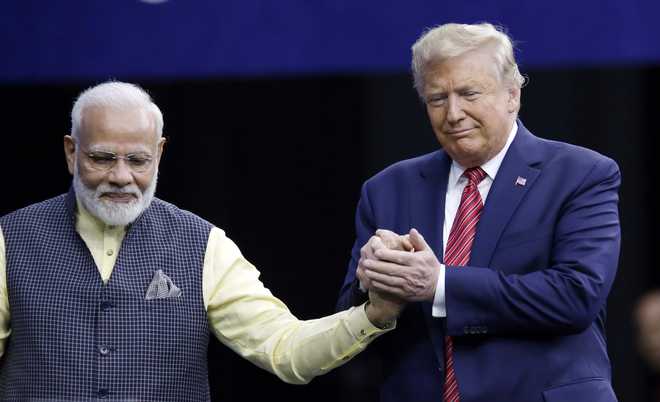
Washington, Dec 22: President Donald Trump has conferred the Legion of Merit, one of the highest military honours of the US, on Prime Minister Narendra Modi for his leadership in elevating bilateral strategic partnership and accelerating emergence of India as a global power.
India's Ambassador to the US, Taranjit Singh Sandhu, accepted the award on behalf of the prime minister from the US National Security Advisor Robert O'Brien at the White House on Monday.
President Trump "presented the Legion of Merit to Indian Prime Minister Narendra Modi for his leadership in elevating the US-India strategic partnership," O'Brien said in a tweet.
Modi was presented with the highest degree Chief Commander of the Legion Of Merit which is given only to the Heads of State or Government.
He was given the award in recognition of his steadfast leadership and vision that has accelerated India's emergence as a global power and elevated the strategic partnership between the United States and India to address global challenges.
In New Delhi, the Ministry of External Affairs said the award is in recognition of Prime Minister Modi's steadfast leadership and vision for India's emergence as a global power.
"The award is in recognition of the Prime Minister's steadfast leadership and vision for India's emergence as a global power, and exemplary contribution made by him for the advancement of the India-United States strategic partnership and promoting global peace and prosperity," it said in a statement.
O'Brien in another tweet said that Trump also presented the Legion of Merit to Australian Prime Minister Scott Morrison and Japan's former prime minister Shinzo Abe. The awards were received by their respective ambassadors in Washington DC.
President Trump "awarded the Legion of Merit to Japanese Prime Minister Shinzo Abe for his leadership and vision for a free and open Indo-Pacific," he said.
Trump awarded the Legion of Merit to Australian Prime Minister Morrison for his leadership in addressing global challenges and promoting collective security, O'Brien tweeted.
The United States is the latest country to confer its highest award to the Indian prime minister.
Other awards include Order of Abdulaziz Al Saud by Saudi Arabia in 2016, State Order of Ghazi Amir Amanullah Khan (2016), Grand Collar of the State of Palestine Award (2018), Order of Zayed Award by the United Arab Emirates (2019), Order of St Andrew by Russia (2019), Order of the Distinguished Rule of Nishan Izzuddin by the Maldives (2019).
“President @realDonaldTrump presented the Legion of Merit to Indian Prime Minister Narendra Modi for his leadership in elevating the U.S.-India strategic partnership. Ambassador @SandhuTaranjitS accepted the medal on behalf of Prime Minister Modi.” –NSA Robert C. O’Brien pic.twitter.com/QhOjTROdCC
— NSC (@WHNSC) December 21, 2020
Let the Truth be known. If you read VB and like VB, please be a VB Supporter and Help us deliver the Truth to one and all.
Fire breaks out in residential building in east Delhi, nine killed

New Delhi (PTI): At least nine people were killed after a fire broke out in a residential building in east Delhi's Vivek Vihar early Sunday, officials said.
The incident was reported around 3.48 am at a four-storey building in Vivek Vihar Phase-I, following which police, fire and disaster management teams rushed to the spot.
According to the police, the blaze engulfed flats on the second, third and fourth floors of the building, prompting a large-scale rescue operation.
The cause of the fire is yet to be ascertained.
"Around 10 to 15 people were rescued from the premises during the firefighting operation. Two of them, who sustained minor injuries, were shifted to the Guru Teg Bahadur Hospital," a senior police officer said.
A total of 12 fire tenders were pressed into service to douse the flames, while teams from the Delhi Disaster Management Authority (DDMA), traffic police and local police assisted in the rescue and evacuation efforts.
Police said the fire was brought under control after several hours.
The identities of the deceased are yet to be ascertained, and efforts are underway to determine the cause of the fire, police said.
Further investigation and proceedings are underway.