Trump says India charging US over 100 per cent tariffs on many products
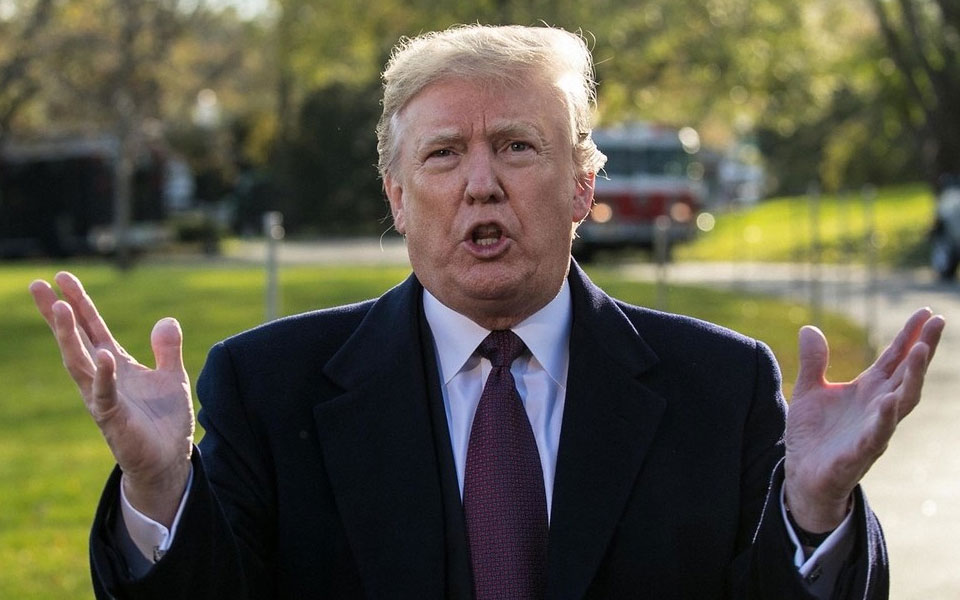
Washington:India charges America over 100 per cent tariffs on a large number of products while the US imposes nothing on the similar or same items, President Donald Trump has said, urging his administration to work on the "stupid trade".
His statement came days after he criticised India, saying it is one of the world's "highest taxing nations". The US President has repeatedly claimed that India is a "tariff king" and imposes "tremendously high" tariffs on American products.
Addressing the Republican Jewish Coalition in Las Vegas on Saturday, Trump said: "We have a case where a certain country, India, is charging us... what great country, great friend, Prime Minister (Narendra) Modi -- charging us over 100 per cent for many things".
The United States, he said, is charging India "nothing for similar or same" products.
In his speech, Trump indicated that he is receiving resistance from Senators for imposing reciprocal tariff on India. He cited India as a country other than China which imposes high tariffs on American products.
India, he alleged, continues to wage "stupid trade" and unfair trade practices, and called out Prime Minister Modi for the trade imbalance with the US.
"I have Senators who say, you can't do that. It's not free trade. When did they come from? Where did they come from? It's not free trade," he said, ramping up his rhetoric against India's trade and tariff policies.
He asked his senior administration officials to work on this. "Will you please work on them? It's the craziest thing. It's stupid trade. We have so much stupid trade," Trump said.
He said that as a result of such trades, the US has lost for many years now -- USD 800 billion a year on trade.
"Who the hell makes these deals? Those are not good negotiators. Actually, Democrats made a lot of them though. But Republicans met a lot of up too, that's the amazing thing. They made USD 800 billion. But we're getting it back. We'll get to give back. We're going to be getting a lot of it.
"I have to be a little bit politically correct by saying it's ok if we lose USD 20 billion with a country because we want to be nice. We want to be nice with everyone," Trump said, asserting that his administration is cracking down on countries that cheat.
Early this year at a White House event to announce his support for reciprocal tax, Trump said he was satisfied with the Indian decision to reduce the import tariff on high-end Harley-Davidson motorcycles from 100 per cent to 50 per cent.
Trump has said that his administration is fixing broken trade deals to protect the American workers.
Let the Truth be known. If you read VB and like VB, please be a VB Supporter and Help us deliver the Truth to one and all.
Mamata visits Bhabanipur EVM strong room, warns against counting irregularities
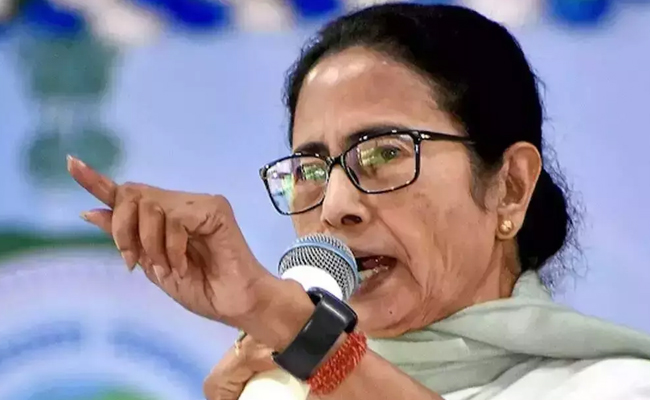
Kolkata (PTI): West Bengal Chief Minister and TMC supremo Mamata Banerjee early Friday warned against any attempt to tamper with the counting process, hours after she visited an EVM strong room in Bhabanipur, alleging possible malpractice.
Banerjee, who emerged around 12:07 am after spending nearly four hours at the counting centre for her Bhabanipur constituency housed in Sakhawat Memorial School in south Kolkata, said only one person would be allowed inside the designated counting area.
"Either the candidate or one agent can stay upstairs. I have also suggested installation of a CCTV camera for the media," she told reporters.
Stressing the need for transparency, she said, "It is essential to maintain transparency. People’s votes must be protected. I rushed here after receiving complaints. The central forces initially did not allow me to enter."
Sounding a stern note ahead of the May 4 counting, she added, "If there is any plan to tamper with the counting process, it will not be tolerated."
On Thursday evening, Banerjee had reached the Bhabanipur Assembly segment counting centre, which houses the strong room for EVMs used in the April 29 polling, citing suspicion of tampering with the machines.
She entered the premises along with her election agent and remained inside for hours, even as Kolkata Mayor and TMC candidate from the Kolkata Port segment Firhad Hakim reached the spot but could not meet her.
"I reached here upon learning that the chief minister has arrived. But I couldn’t meet her since she was already inside the premises, exercising her right as a candidate to visit strong rooms. I wasn’t allowed there. I will not be able to confirm what exactly is transpiring inside," Hakim said.
The development coincided with protests by TMC candidates Kunal Ghosh and Shashi Panja outside the Khudiram Anushilan Kendra in north Kolkata, where they staged a sit-in alleging irregularities and possible tampering of EVMs stored in strong rooms, leading to face-offs between TMC and BJP supporters.
Earlier in a video message, Banerjee had urged party leaders, workers and polling agents to maintain a 24-hour vigil on EVM strong rooms, alleging that the BJP could attempt to tamper with the machines before counting begins.
Her remarks come amid heightened political tension in the state following a fiercely contested Assembly election, with parties closely monitoring arrangements and raising concerns over transparency.