Trump says 'not much headway' in talks as shutdown drags on
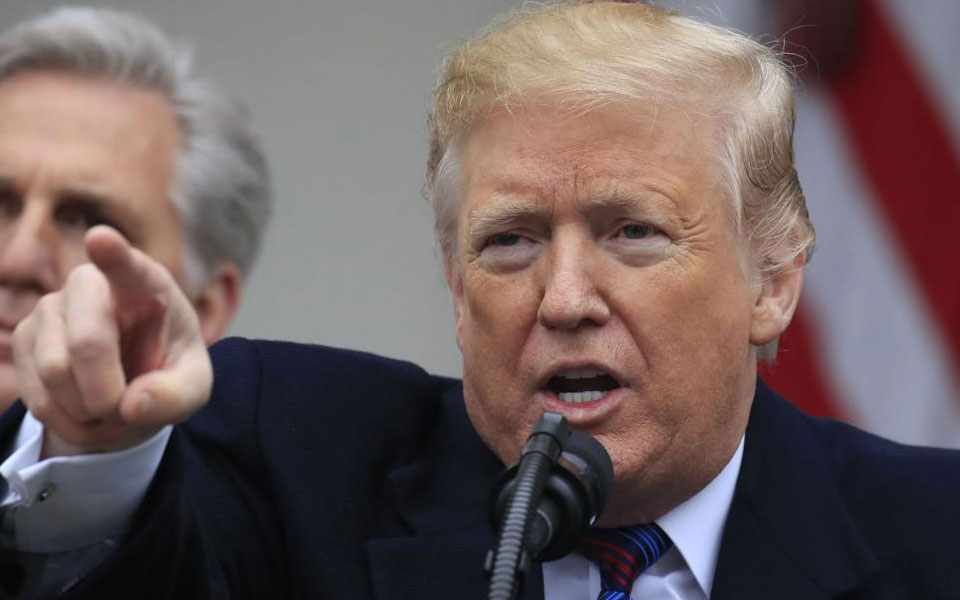
Washington, Jan 6 : White House officials and congressional aides emerged from talks aimed at ending a partial government shutdown over President Donald Trump's demands for border wall funding without a breakthrough Saturday, though they planned to return to the table the following day.
Trump tweeted: "Not much headway made today."
Democrats agreed there had been little movement, saying the White House did not budge on the demand for 5.6 billion and would not consider re-opening the government.
The White House said funding was not discussed in-depth, but the administration was clear they needed funding for a wall and that they wanted to resolve the shutdown all at once.
Accusations flew after the more than two-hour session led by Vice President Mike Pence.
Acting chief of staff Mick Mulvaney, in an interview aired on CNN, accused Democrats of being there to "stall." Democrats familiar with the meeting said the White House position was "untenable."
A White House official also said the meeting included a briefing on border security by Homeland Security Secretary Kirstjen Nielsen. Democrats sought written details from the Department of Homeland Security on their budget needs, which the White House said it would provide. The group plans to meet again Sunday.
With talks stalled, House Speaker Nancy Pelosi announced Saturday that House Democrats plan to start approving individual bills to reopen shuttered departments starting with Treasury to ensure Americans receive their tax returns.
"While President Trump threatens to keep the government shut down for 'years', Democrats are taking immediate further action to re-open government, so that we can meet the needs of the American people, protect our borders and respect our workers," Pelosi said.
Trump, who did not attend the discussions, spent the morning tweeting about border security.
Showing little empathy for the hundreds of thousands of federal workers furloughed or working without pay, Trump declared without citing evidence that most are Democrats.
He also asserted: "I want to stop the Shutdown as soon as we are in agreement on Strong Border Security! I am in the White House ready to go, where are the Dems?"
One Democrat, Maryland Sen. Chris Van Hollen, said in his party's weekly radio address that the shutdown "is part of a larger pattern of a president who puts his personal whims and his effort to score political points before the needs of the American people. ... He is pointing fingers at everyone but himself."
Trump and Democratic leaders met for roughly two hours Friday, but gave differing accounts of the session. Democrats reported little progress; Trump framed the weekend talks as a key step forward.
As the shutdown drags on, some Republicans are growing increasingly nervous. Some GOP senators up for re-election in 2020, including Cory Gardner of Colorado and Susan Collins of Maine, who has tried to broker deals to end past stalemates, have voiced discomfort with the shutdown in recent days.
Sen Thom Tillis of North Carolina penned an op-ed for The Hill, arguing that Congress should end the shutdown and make a deal on border security and immigration reforms.
In calling on Trump to reopen government while negotiations on border security continue, Democrats have emphasized families unable to pay bills due to absent paychecks. But Trump has repeatedly said he will not budge without money for the wall.
Trump asserted on Friday that he could declare a national emergency to build the wall without congressional approval, but would first try a "negotiated process." Trump previously described the situation at the border as a "national emergency" before he sent active-duty troops; critics described that as a pre-election stunt.
Trump said the federal workers who are furloughed or working without pay would want him to "keep going" and fight for border security. Asked how people would manage without a financial safety net, he said: "The safety net is going to be having a strong border because we're going to be safe."
Democrats expressed scepticism Friday that there would be a breakthrough.
"It's very hard to see how progress will be made unless they open up the government," said Senate Democratic leader Chuck Schumer of New York.
Trump confirmed to reporters that he privately told Democrats, in the Friday meeting with congressional leaders, that the shutdown could drag on for "months or even years."
A variety of strategies are being floated inside and outside the White House. Among them is the idea of trading wall money for a deal on immigrants brought to the country as young people and now here illegally.
But Trump made clear during his news conference that talk on DACA, the Deferred Action for Childhood Arrivals program, would have to wait.
Let the Truth be known. If you read VB and like VB, please be a VB Supporter and Help us deliver the Truth to one and all.
Bhojshala complex registered as 'mosque' in old revenue records: Muslim side to MP HC
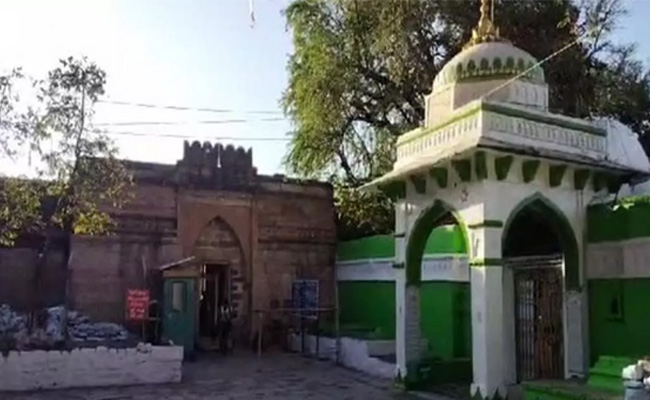
Indore (PTI): The disputed Bhojshala Temple-Kamal Maula Mosque complex has historically been registered as a 'mosque' in revenue records and available sources don't clearly mention any Saraswati temple established by then-king Raja Bhoj, the Muslim side has told the Madhya Pradesh High Court.
The Hindu community considers Bhojshala a temple dedicated to Goddess Saraswati, while the Muslim side calls the 11th-century monument Kamal Maula Mosque. The disputed complex located in Dhar district is protected by the Archaeological Survey of India (ASI).
During the hearing before the HC's Indore bench of Justices Vijay Kumar Shukla and Justice Alok Awasthi on Wednesday, Qazi Moinuddin questioned two PILs filed as intervenors in the Bhojshala case by an organisation named Hindu Front for Justice, one Kuldeep Tiwari and another individual.
Moinuddin claims to be a descendant of Sufi saint Maulana Kamaluddin Chishti and the 'Sajjadanashin' (spiritual head, guru, or successor of a Sufi shrine, khanqah, or religious site).
The PILs state that Bhojshala is actually a Saraswati temple and only Hindus should be granted the right to worship at the disputed complex.
Moinuddin's lawyer, Noor Ahmed Sheikh, claimed in the court that his client's ancestors, who are descendants of Maulana Kamaluddin Chishti, have historically held titles to the complex, and the site was also recorded as a "mosque" in government revenue records.
He contended that those associated with the management of the Kamal Maula Mosque, located within the complex, have been in "continuous and peaceful occupation" of the site for a long time.
Citing Muslim law, Sheikh argued that in the case of religious property, particularly a mosque or its related properties, officials such as the Sajjadanashin and Mutawalli (person entrusted with management, maintenance, and administration of a Waqf), and their descendants, not only have the right to intervene, but also have the right to manage and use such a structure.
Citing provisions of the Ancient Monuments Preservation Act 1904, the Muslim side's lawyer said the term "in-charge of the property" is used in this law, which makes it clear that the person or party who has been in charge of a property for a long time has rights over it.
During the hearing, Touseef Warsi, the lawyer representing the Maulana Kamaluddin Welfare Society of Dhar, claimed that Hindu parties in both PILs had made "misleading representations" regarding historical facts before the high court.
He further claimed that available historical sources do not clearly mention the existence of a Saraswati temple established by Raja Bhoj, the legendary king of the Parmar dynasty who ruled Dhar from 1010 to 1055.
The ASI, a central government agency, has adopted three different positions in the lawsuits filed regarding the Bhojshala dispute, changing its answers from time to time, and this situation raises serious questions about judicial scrutiny of the complex, Warsi submitted.
He raised objections regarding the ASI's process of scientific survey of the Bhojshala complex, carried out on the HC order in 2024, and the method of videography and requested the court to examine these objections.
The hearing in the Bhojshala case will continue on Thursday.
The HC has been regularly hearing four petitions and one writ appeal since April 6, contesting the religious nature of the monument.