Trump says US bombed military sites on island vital to Iran's oil network
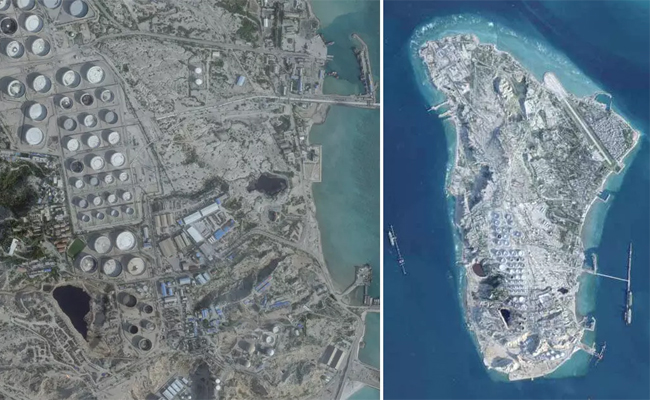
Dubai (AP): President Donald Trump said the US bombed military sites Friday on an island vital to Iran's oil network, while an American official said 2,500 more Marines and an amphibious assault ship are being sent to the Middle East nearly two weeks into the war with the Islamic Republic.
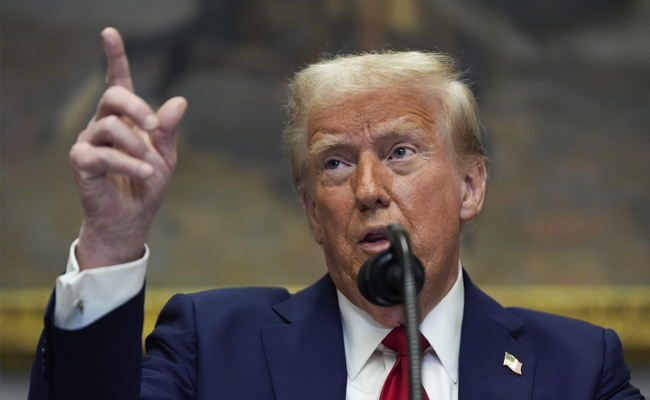
Trump said US forces “obliterated” targets on Iran's Kharg Island — home to the primary terminal that handles the country's oil exports — and warned that the island's oil infrastructure could be next. Just a day before, the speaker of the Iranian parliament said such a strike would provoke a new level of retaliation.
Earlier Friday in the Iranian capital, a large explosion rocked a central square where thousands of people gathered for an annual state-organised rally to support the Palestinians and call for Israel's demise. Israel had warned that it would target the area in central Tehran.
There were no reports of casualties. The decision to proceed with the demonstration attended by some senior government officials, and Israel's threat to target it, underscored the fierce determination on both sides in a war that has rattled the global economy and shows no sign of letting up.
Iran has continued to launch widespread missile and drone attacks on Israel and neighbouring Gulf states, and has effectively closed the Strait of Hormuz, through which a fifth of the world's traded oil passes, even as US and Israeli warplanes pummel military and other targets across Iran.
The humanitarian crisis in Lebanon deepened, with nearly 800 people killed and 850,000 displaced as Israel launched waves of strikes against Iran-backed Hezbollah militants and warned there would be no let up.
In an interview with Fox News, Trump said the war would end “when I feel it in my bones.” He was also more measured about whether Iranians could topple the Islamic government.
“So I really think that's a big hurdle to climb for people that don't have weapons,” Trump said, citing Iran's paramilitary Basij force, which has played a central role in crushing recent nationwide protests.
Marines and assault ship will add to US forces
--------------------------------------------------
Elements from the 31st Marine Expeditionary Unit and the amphibious assault ship USS Tripoli have been ordered to the Middle East, according to the US official, who spoke to The Associated Press on condition of anonymity to discuss sensitive military plans.
Marine Expeditionary Units are able to conduct amphibious landings, but they also specialize in bolstering security at embassies, evacuating civilians and disaster relief. The deployment does not necessarily indicate that a ground operation is imminent or will take place.
The new Marine deployment was first reported by The Wall Street Journal.
The 31st Marine Expeditionary Unit, as well the Tripoli and other amphibious assault ships carrying the Marines, are based in Japan and have been in the Pacific Ocean for several days, according to images released by the military. The Tripoli was spotted by commercial satellites sailing alone near Taiwan, putting it more than a week away from the waters off Iran.
Earlier in the week, the Navy had 12 ships, including the aircraft carrier USS Abraham Lincoln and eight destroyers, operating in the Arabian Sea. Should the Tripoli join this flotilla, it would be the second-largest ship behind the Lincoln in the region.
While the total number of US service members on the ground in the Middle East is not clear, Al-Udeid Air Base alone, one of the largest in the region, typically houses some 8,000 US troops in Qatar.
US strikes Persian Gulf island after Iran's warning
-------------------------------------------------------
The US strikes on Iran's Kharg Island in the Persian Gulf targeted military sites but left alone its oil infrastructure for now, Trump said in a social media post.
But he warned that if Iran or anyone else interferes with the passage of ships through the Strait of Hormuz, he will reconsider his decision not to “wipe out the Oil Infrastructure.”
On Thursday, the Iranian parliament speaker, Mohammad Bagher Qalibaf, warned in a social media post that attacks on the islands on Iran's southern maritime frontier would cause Iran to “abandon all restraint,” underscoring how central they are to the country's economy and security.
Explosion rocks area of mass demonstration
-------------------------------------------------
The explosion in Tehran rocked the Ferdowsi Square area midday, where thousands had gathered for an annual Quds Day rally, chanting “death to Israel” and “death to America.”
Israel had issued a warning on a Farsi-language X account for people to clear the area shortly before the blast. But few Iranians would have seen it, as authorities have almost completely shut down the internet. Footage showed people chanting “God is greatest,” as smoke rose in the area.
The Israeli military later posted a second message in Farsi, noting the head of Iran's judiciary was at the rally and criticizing Iran for blocking many from seeing their warning.
The hard-liner who leads Iran's judiciary, Gholamhossein Mohseni Ejei, was giving an interview on state television at the demonstration when the strike happened. His bodyguards encircled him, as he raised his fist and said Iran “under this rain and missiles will never withdraw.”
US says 15,000 targets struck in Iran since the start of the war
-------------------------------------------------------------------
Israel earlier announced another wave of strikes in Iran targeting infrastructure, and said its air force had hit more than 200 targets in the last 24 hours, including missile launchers, defense systems and weapons production sites.
In Washington, US Defence Secretary Pete Hegseth said that over 15,000 enemy targets have been struck — more than 1,000 a day since the war began.
He also sought to address concerns about the bottling of the Strait of Hormuz, telling reporters: “We have been dealing with it and don't need to worry about it.”
All six crew of US refuelling plane confirmed dead after crash
-----------------------------------------------------------------
The US military confirmed on Friday that all six crew members of an American KC-135 refuelling plane were killed when it crashed in Iraq, bringing the US death toll to at least 13 service members.
Ohio Gov. Mike DeWine said three of the victims were from his state and had deployed with the Ohio Air National Guard's 121st Air Refueling Wing.
US Central Command said the crash wasn't related to friendly or hostile fire, and that two aircraft were involved, including one that landed safely.
The KC-135 is the fourth publicly acknowledged aircraft to crash as part of the US military's operations against Iran. Last week, three American fighter jets were mistakenly downed by friendly Kuwaiti fire.
New Iranian attacks across the region
-----------------------------------------
Iran continued its daily attacks on oil and other infrastructure across the Gulf. In Oman, two people were killed when two drones crashed in the Sohar region, the Oman News Agency reported.
The US Navy destroyer USS Oscar Austin shot down an Iranian ballistic missile over Turkiye on Friday, a US official said on condition of anonymity in order to discuss ongoing military operations. It was the third such interception over the NATO member in the last two weeks.
Fighting escalates between Israel and Hezbollah
----------------------------------------------------
An Israeli strike in southern Lebanon hit a health care centre in the village of Burj Qalaouiyah, killing 12 doctors, paramedics and nurses, the Lebanese Health Ministry said early Saturday.
Earlier, at least eight people were killed in a strike on the southern coastal city of Sidon, the ministry said Friday.
The ministry said 773 people — including more than 100 children and 18 paramedics — have been killed since fighting erupted between Israel and Iran-backed Hezbollah militants 10 days ago.
Let the Truth be known. If you read VB and like VB, please be a VB Supporter and Help us deliver the Truth to one and all.
Case registered over social media posts 'threatening' Kerala CM’s security officer

Thiruvananthapuram (PTI): A case has been registered and a probe launched into social media posts allegedly threatening a member of Chief Minister Pinarayi Vijayan’s security team with consequences once the UDF comes to power, officials said on Sunday.
The Thiruvananthapuram City Cyber Police registered the case based on a complaint filed by Chief Minister’s security staff member Sandeep Sasidharan.
The Congress had earlier alleged that Sandeep and another officer, Anil Kumar, brutally assaulted two Youth Congress-KSU activists including using flower pot when they protested against the Chief Minister during the Navakerala Sadas programme in Alappuzha in 2023.
A subsequent probe was conducted against both officers, and the Crime Branch later gave them a clean chit.
Recently, following the conclusion of the state assembly election on April 9, several social media posts allegedly made by Congress, Youth Congress and KSU activists claimed that revenge would be taken once the LDF government is removed and the UDF comes to power.
Police said cases have been registered against Facebook accounts named Arun Rajendran, Tom Kuriakose, Yaser KP, Sony Panamthanam, Sarath Pillai, KSU Kanjiramkulam, Rahul John C and Youth Congress Battle.
According to the FIR, the complainant’s photograph and name were used in several social media posts threatening him with consequences and containing abusive language.
Police said the social media account holders have been identified and will soon be summoned as part of the investigation.
The case has been registered under Sections 296(b) (uttering obscene words causing public annoyance), 351(2) (criminal intimidation), and 3(5) (acts done by several persons) of the Bharatiya Nyaya Sanhita.