Trump says would ''certainly intervene'' on Kashmir if India, Pak want him to
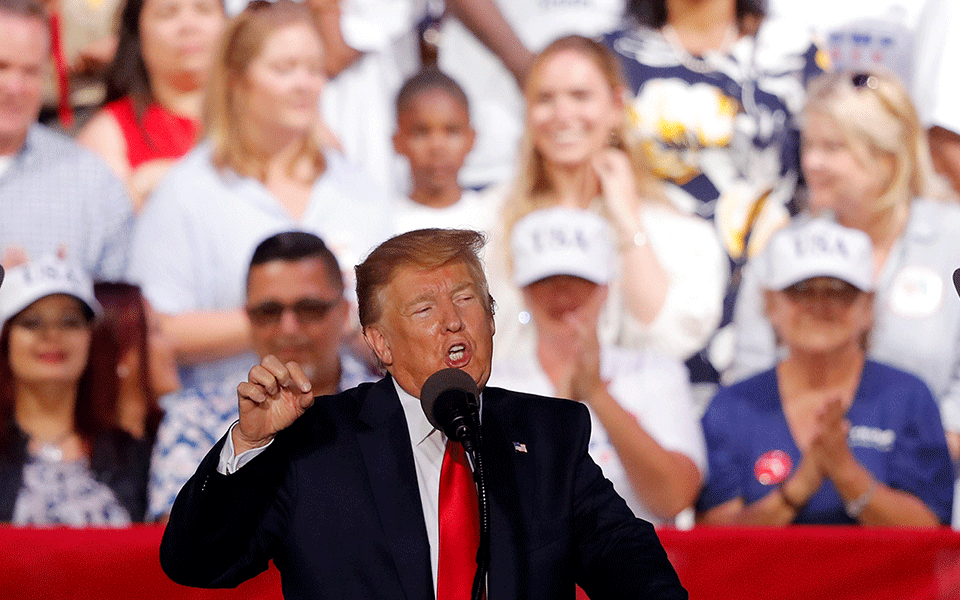
Washington: US President Donald Trump has said he would "certainly intervene" between India and Pakistan on Kashmir if they wanted him to, days after he stunned New Delhi with his claim that Prime Minister Narendra Modi asked him to mediate on the vexed issue.
Trump on Thursday said it was up to India and Pakistan to resolve the Kashmir issue but he was ready to assist if the two South Asian neighbours wanted him to help in resolving the issue.
He was referring to his last month's meeting with Pakistan Prime Minister Imran Khan at the White House, wherein he stunned India by saying that Modi, during their bilateral meeting on the the sidelines of G-20 Summit in Japan, sought his mediation on the Kashmir issue.
However, India rejected the offer, while Pakistan welcomed his statement.
When asked how would he "want to resolve the Kashmir issue", Trump said, "If I can, if they wanted me to, I would certainly intervene."
"It's really up to Prime Minister (Narendra) Modi (to accept the offer of mediation)," Trump told reporters responding to a question on India not accepting his offer of mediation on Kashmir.
"Have they accepted the offer or not?", Trump sought a clarification when asked about India's rejection of his mediation offer.
"I think they are fantastic people - Khan and Modi -- I mean. I would imagine they could get along very well, but if they wanted somebody to intervene, to help them . and I spoke with Pakistan about that and I spoke frankly in (sic) India about it," Trump said.
He rued that the issue of Kashmir had been going on for a long time.
"That's been going on, that battle, for a long time," he said.
Last week, in his joint media appearance with Pakistan Prime Minister Khan in his Oval Office, Trump stunned India by saying that Prime Minister Modi sought his mediation/arbitration on the Kashmir issue.
Trump said the Indian Prime Minister asked for this during their bilateral meeting in Japan in June on the sidelines of the G-20 Summit. India quickly denied it and said the Kashmir issue was never discussed between Modi and Trump.
Indian External Affairs Minister S Jaishankar refuted that Modi ever made that request.
"We heard remarks by President Donald Trump in a meeting with Prime Minister Imran Khan of Pakistan, to the press that he is ready to mediate, if requested by India and Pakistan, on Kashmir issue," he said in a statement to the Indian Parliament.
Let the Truth be known. If you read VB and like VB, please be a VB Supporter and Help us deliver the Truth to one and all.
Confident we are going to win Kerala: Shashi Tharoor
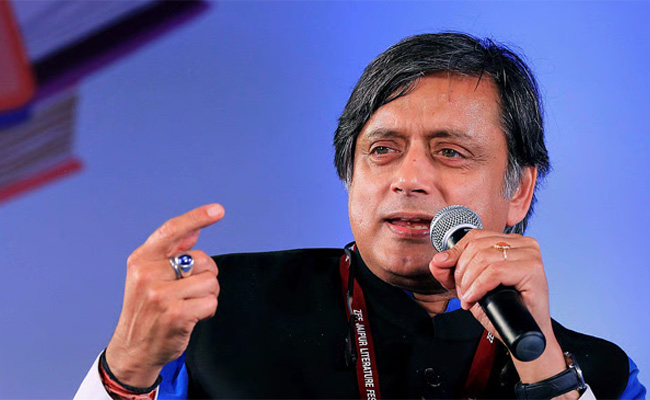
New Delhi (PTI): Congress leader Shashi Tharoor on Thursday expressed confidence in the victory of the United Democratic Front (UDF) in Kerala, saying the Congress-led alliance will win more than 75 seats out of the total 140 in the state.
Tharoor, who hails from Kerala, said he was not surprised to see the results of the exit polls, most of which predicted a victory for the UDF that has been out of power for 10 years in the state.
"We have been on the ground. I have campaigned in 59 constituencies across 12 districts out of 14. I was very confident we are going to win.
"Everything that I have picked up from not just my party colleagues and workers but also from other observers, media and others have always convinced me that we were going to score a comfortable win of above 75 seats. And all the (exit) polls have confirmed the same thing," he told reporters here.
The Thiruvananthapuram MP said he was not surprised to see the results of the exit polls but in general he was not a big fan of exit polls in India.
"Because ours is not purely a homogenous society. We have to take into account gender issue, caste issue, class issue, regional disparities. You never get a convincingly large enough sample to give an accurate poll and now there is the additional complication that we have heard about in West Bengal this year that many people are unwilling to answer the questions of the pollsters," he said.
The Congress leader said normally, it used to be below 10 per cent that people said that they would not answer.
"Even if you are a reputable exit pollster, in Bengal, one polling company has said 60 per cent of people refused to answer. So, what is the worth of a poll where 60 per cent of your respondents have not answered," he said.
Several exit polls on Wednesday predicted a comeback by the Congress-led UDF in Kerala after 10 years, dethroning the CPI(M)-led Left Democratic Front (LDF).
Polling for the 140-member Kerala assembly was held on April 9. Results of assembly elections in West Bengal, Tamil Nadu, Assam, Puducherry, besides Kerala, will be announced on May 4.