Trump signs executive orders banning TikTok, Wechat
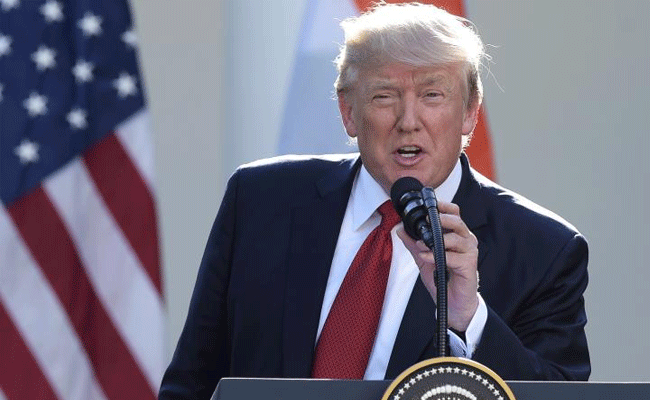
Washington: US President Donald Trump has signed executive orders banning popular Chinese apps like TikTok and WeChat, terming them a threat to the national security and to the country's economy.
The ban comes into effect in 45 days, Trump said in his two separate executive orders signed on Thursday.
India was the first country to ban TikTok and WeChat, citing national security concerns. India has banned as many as 106 Chinese apps, a move welcomed by both the Trump administration and the US lawmakers.
In a communique to the Congress, Trump said the spread in the United States of mobile applications developed and owned by the companies in China continues to threaten the national security, foreign policy, and economy of the country.
"At this time, the order takes action to address one mobile application in particular, TikTok," he said.
TikTok, a video-sharing mobile application owned by the Chinese company ByteDance Ltd, automatically captures vast swaths of information from its users, Trump said.
This data collection threatens to allow the Chinese Communist Party access to Americans' personal and proprietary information - potentially allowing China to track the locations of federal employees and contractors, build dossiers of personal information for blackmail, and conduct corporate espionage, he alleged.
TikTok also reportedly censors content that the Chinese Communist Party deems politically sensitive, such as content concerning protests in Hong Kong and China's treatment of Uyghurs and other Muslim minorities. TikTok may also be used for disinformation campaigns that benefit the Chinese Communist Party, the president said.
"To deal with this threat, the order prohibits, beginning 45 days after the date of this order, to the extent permitted under applicable law, any transaction by any person, or with respect to any property, subject to the jurisdiction of the United States, with ByteDance Ltd. (a.k.a. Zijie Tiaodong), Beijing, China, or its subsidiaries, in which any such company has any interest, as identified by the Secretary of Commerce (Secretary)," Trump said.
He delegated power to the Commerce Secretary to take such actions, including adopting appropriate rules and regulations, and to employ all powers granted to the President by International Emergency Economic Powers Act as may be necessary to implement the order.
The order also directs all department and agencies to take all appropriate measures within their authority to implement the order, Trump said.
In separate executive order, Trump said WeChat, a messaging, social media, and electronic payment application owned by the Chinese company Tencent Holdings Ltd., reportedly has over one billion users worldwide, including users in the United States.
"Like TikTok, WeChat automatically captures vast swaths of information from its users - threatens to allow the Chinese Communist Party access to Americans' personal and proprietary information," he said.
WeChat also captures the personal and proprietary information of Chinese nationals visiting the United States, thereby allowing the Chinese Communist Party a mechanism for keeping tabs on Chinese citizens who may be enjoying the benefits of a free society for the first time in their lives, he alleged.
"WeChat, like TikTok, also reportedly censors content that the Chinese Communist Party deems politically sensitive and may also be used for disinformation campaigns that benefit the Chinese Communist Party," Trump said.
In recent weeks, US Secretary of State Mike Pompeo has accused TikTok of collecting personal information of Americans.
TikTok has previously stressed that its US user data is already stored on US-based servers and backed up in Singapore, and is therefore not subject to Chinese law as some US officials have feared.
Let the Truth be known. If you read VB and like VB, please be a VB Supporter and Help us deliver the Truth to one and all.
Zubeen Garg's drowning in Singapore highlights vessel operators' responsibility: legal experts

Singapore (PTI): The drowning of Indian singer-composer Zubeen Garg has brought the spotlight on rules and regulations that concern responsibilities of vessel operators when dealing with intoxicated passengers, according to a media report that cited legal experts.
A cultural icon in India’s northeastern region, 52-year-old Garg travelled to Singapore in September 2025 to perform at a live event. A day before his performance, he went on a yacht trip with a group of people. He drowned while swimming in the sea near Lazarus Island, which is a popular diving spot.
His death shook his home state Assam, where millions came out on the streets mourning. Later, police cases were registered against the organiser of the event, his manager and some others.
Nico Lee, managing director of the Triangle Legal law firm, told The Straits Times that Singapore has Maritime and Port Authority of Singapore (Port) Regulations under which there are provisions to debar drunk passengers.
The owner, agent or captain of the vessel must not allow persons under the influence of alcohol or drugs onboard if they are intoxicated to a point where they endanger safety of the vessel, its crew or any person in it.
“In terms of civil liability, it could be argued that a yacht captain is negligent, as he owes a prima facie duty of care to guests on board under general negligence principles,” Lee was quoted as saying by the newspaper.
The singer and his entourage of about 15 individuals were partying on a chartered vessel, which they had boarded at Marina at Keppel Bay.
A death certificate issued by the Singapore General Hospital listed his cause of death as drowning.
An autopsy report suggested that Garg had 333 mg of alcohol per 100 ml of blood in his system, which was four times the legal limit for driving in Singapore and is likely to have impacted his coordination.
Citing Garg’s case, Lee said the circumstances were serious, as the controller of the vessel knew that the guest was intoxicated. Also, he may not have understood or processed a safety briefing for all passengers.
“That combination makes reliance on an ordinary briefing inadequate. If intoxication reaches a level that endangers the safety of the vessel or persons on board, the person in charge should not permit boarding at all,” he said.
According to Lee, the vessel’s operators could also have assigned a crew member to directly supervise him or ensure that he received a one-to-one explanation when he was capable of understanding.
Part of the responsibility could be attributed to the guest if he chose to enter the water and ignore instructions or behave dangerously despite the yacht owner or charterer’s best efforts, Lee said.
Vanessa Sandhu from Clifford Law LLP told The Straits Times that a key question is whether the yacht captain or operator owed a “duty of care” to the passenger and, if so, whether a breach of that duty caused the death.
“A yacht captain and operator generally owe passengers a duty to take reasonable care for their safety while on board, including swimming or water activities. This may include providing safety equipment and issuing appropriate safety instructions,” the daily quoted Sandhu as saying.
“However, the standard of care is an objective one, based on what a reasonable captain or operator would have done in the circumstances. It is not an absolute obligation to prevent all harm,” she said.
During the coroner’s inquiry, the operators of the vessel had said that no one had forced the singer to consume alcohol or enter the water, and that the entire entourage was informed on the yacht about the necessity of wearing life jackets before going for a swim.
A coroner’s inquiry on March 25 ruled Garg’s death as accidental drowning. On April 1, the police said that investigations into the singer's death had concluded, with no evidence of foul play.
However, in Assam, where seven persons were arrested in connection with Garg’s case, and some of them charged with murder, the matter is being heard in the court. All the suspects have denied any wrongdoing.