Trump signs order to rename Department of Defence as Department of War
Washington (AP): After months of campaigning for the Nobel Peace Prize, President Donald Trump sent a sharply different message on Friday when he signed an executive order aimed at rebranding the Department of Defence as the Department of War.
Trump said the switch was intended to signal to the world that the United States was a force to be reckoned with, and he complained that the Department of Defence's name was “woke.”
“I think it sends a message of victory. I think it sends, really, a message of strength,” Trump said of the change as he authorised the Department of War as a secondary title for the Pentagon.
Congress has to formally authorise a new name, and several of Trump's closest supporters on Capitol Hill proposed legislation earlier Friday to codify the new name into law.
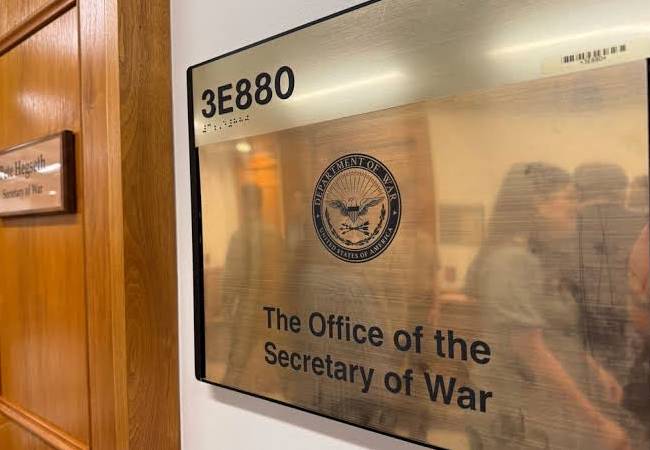
But already there were cosmetic shifts. The Pentagon's website went from “defence.gov” to “war.gov.” Signs were swapped around Hegseth's office while more than a dozen employees watched. Trump said there would be new stationery, too.
Defence Secretary Pete Hegseth, whom Trump has begun referring to as the “secretary of war,” said during the signing ceremony that “we're going to go on offense, not just on defense,” using “maximum lethality” that won't be “politically correct.”
The attempted rebranding was another rhetorical salvo in Trump's efforts to reshape the US military and uproot what he has described as progressive ideology.
Bases have been renamed, transgender soldiers have been banned and websites have been scrubbed of posts honouring contributions by women and minorities to the armed forces.
He's also favoured aggressive — critics say illegal — military action despite his criticism of “endless wars” under other administrations. He frequently boasts about the stealth bomber strike on Iran's nuclear facilities, and he recently ordered the destruction of a boat that the US says was carrying drugs off the coast of Venezuela.
The Republican president insisted that his tough talk didn't contradict his fixation on being recognised for diplomatic efforts, saying peace must be made from a position of strength. Trump has claimed credit for resolving conflicts between India and Pakistan; Rwanda and the Democratic Republic of the Congo; and Armenia and Azerbaijan, among others. (He's also expressed frustration that he hasn't brought the war between Russia and Ukraine to a conclusion as fast as he wanted.)
“I think I've gotten peace because of the fact that we're strong,” Trump said, echoing the “peace through strength” motto associated with President Ronald Reagan
When Trump finished his remarks on the military, he dismissed Hegseth and Gen Dan Caine, chairman of the Joint Chiefs of Staff, from the room.
“I'm going to let these people go back to the Department of War and figure out how to maintain peace,” Trump said.
Florida Republican Rep Greg Steube proposed legislation in the House to formally change the name of the department.
“From 1789 until the end of World War II, the United States military fought under the banner of the Department of War,” Steube, an Army veteran, said in a statement. “It is only fitting that we pay tribute to their eternal example and renowned commitment to lethality by restoring the name of the Department of War' to our Armed Forces.”
Sens Rick Scott, R-Fla, and Mike Lee, R-Utah, are introducing companion legislation in the Senate.
The Department of War was created in 1789, then renamed and reorganised through legislation signed by President Harry Truman in 1947, two years after the end of World War II.
The Department of Defence incorporated the Department of War, which oversaw the Army, plus the Department of the Navy and the newly created independent Air Force.
Hegseth complained that “we haven't won a major war since” the name was changed. Trump said, “We never fought to win.”
Trump and Hegseth have long talked about restoring the Department of War name.
In August, Trump told reporters that “everybody likes that we had an unbelievable history of victory when it was Department of War. Then we changed it to Department of Defence.”
When confronted with the possibility that making the name change would require an act of Congress, Trump told reporters that “we're just going to do it.”
“I'm sure Congress will go along,” he said, “if we need that.”
Trump and Hegseth have been on a name-changing spree at the Pentagon, sometimes by sidestepping legal requirements.
For example, they wanted to restore the names of nine military bases that once honoured Confederate leaders, which were changed in 2023 following a congressionally mandated review.
Because the original names were no longer allowed under law, Hegseth ordered the bases to be named after new people with similar names. For example, Fort Bragg now honours Army Pfc Roland L Bragg, a World War II paratrooper and Silver Star recipient from Maine, instead of Confederate Gen Braxton Bragg.
In the case of Fort A P Hill, named for Confederate Lt Gen Ambrose Powell Hill, the Trump administration was forced to choose three soldiers to make the renaming work.
The base now honours Union soldiers Pvt Bruce Anderson and 1st Sgt Robert A Pinn, who contributes the two initials, and Lt Col Edward Hill, whose last name completes the second half of the base name.
The move irked Republicans in Congress who, in July, moved to ban restoring any Confederate names in this year's defense authorisation bill.
Rep Don Bacon of Nebraska, a Republican who co-sponsored the earlier amendment to remove the Confederate names, said that “what this administration is doing, particularly this secretary of defence, is sticking his finger in the eye of Congress by going back and changing the names to the old names.”
Let the Truth be known. If you read VB and like VB, please be a VB Supporter and Help us deliver the Truth to one and all.
Austrian police detain suspect in case of rat poison found in baby food jars on supermarket shelves

Vienna (AP): Police in eastern Austria say a 39-year-old suspect has been arrested after rat poison turned up in some HiPP baby food jars on supermarket shelves in central Europe.
HiPP, which recalled some of its baby food jars in Austria, Slovakia and the Czech Republic after the case came to light last month, said in a statement Saturday it was “greatly relieved” by the arrest, and would provide further updates as verified details come in.
The Burgenland State Criminal Police Office, under the direction of prosecutors, said a probe was launched after poison turned up in a baby food jar purchased at a supermarket in the city of Eisenstadt on April 18.
It said the suspect was being questioned, and that no further details would be immediately provided. The Burgenland public prosecutor's office has announced an investigation into suspected “intentional endangerment of the public.”
The Austrian Press Agency reported that an expert report on the toxicity of the poison was pending. A total of five tampered baby food jars were seized before they could be consumed, APA reported.
Authorities said previously they believe the tampering occurred in 190-gram (6.7-ounce) jars of baby food made with carrots and potatoes for 5-month-olds that were sold from SPAR supermarkets in Austria.
HiPP responded by recalling all of its baby food jars sold at SPAR supermarkets — which include SPAR, EUROSPAR, INTERSPAR and Maximarkt stores — in Austria as a precaution. Vendors in Slovakia and the Czech Republic also removed all of the brand's baby jars from sale.
The company said the recall was not due to any product or quality defect on its part, and said the jars left its facility in “perfect condition.”
Police said a customer at the time of the discovery had reported that a jar appeared to have been tampered with, but no one had consumed the baby food.