Trump vows to ‘finish job’, thanks Middle East allies; urges countries to show courage, buy US oil
Says US will ‘hit Iran extremely hard’ over next 2-3 weeks, threatens power plants
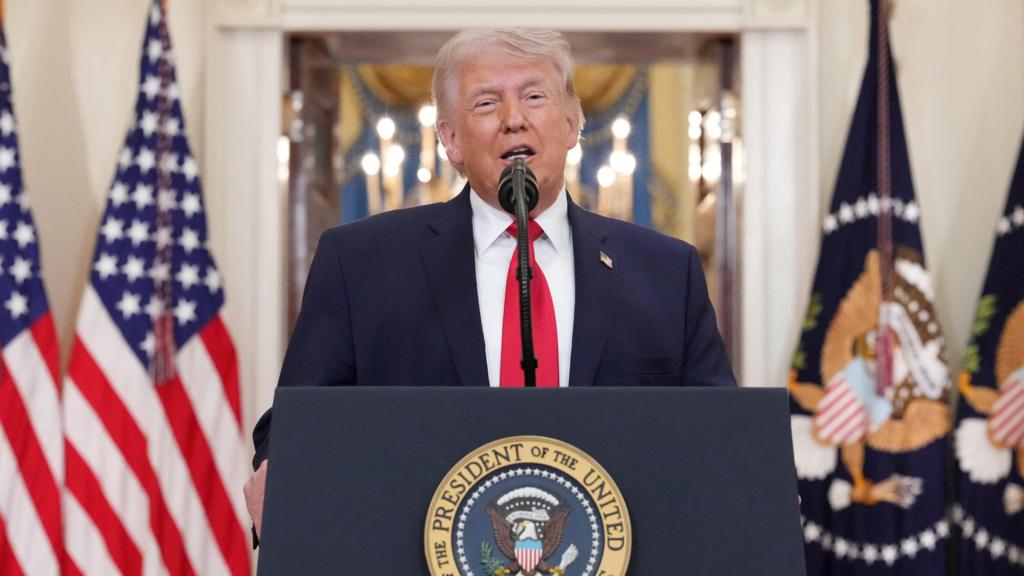
Washington: US President Donald Trump has said the United States is close to achieving its objectives in Iran, while thanking key allies in the Middle East for their support.
“We are gonna finish the job. We are getting very close,” Trump said, expressing appreciation to Israel, Saudi Arabia, Qatar, the UAE and Bahrain. “They’ve been great and we will not let them fail in any way shape or form,” he added.
Trump claimed that US military operations against Iran have delivered major results over the past month. Referring to “Operation Epic Fury”, he said American forces had carried out “swift, decisive, overwhelming victories on the battlefield”.
He said Iran’s naval and air capabilities had been severely weakened and its ability to launch missiles and drones had been significantly reduced. “Their ability to launch missiles and drones is dramatically curtailed, and their weapons factories and rocket launchers are being blown to pieces – very few of them left,” he said.
The US president also repeated his criticism of the 2015 nuclear deal signed under former President Barack Obama, claiming it would have allowed Iran to develop nuclear weapons. Iran has consistently maintained that its nuclear programme is peaceful.
Trump said the US military campaign aims to weaken Iran’s ability to support proxy groups and prevent it from developing nuclear weapons. “Taken together, these actions will cripple Iran militarily,” he said, adding that key strategic objectives are “nearing completion”.
In a separate remark, Trump urged countries dependent on Gulf oil to take action and suggested they should rely more on American energy supplies. He called on them to show “delayed courage” and secure the Strait of Hormuz, which has been affected by the ongoing conflict.
“[They] should have done it before, should have done it with us, as we asked. Go to the strait and just take it, protect it,” he said, adding that the United States has sufficient oil resources.
The remarks come as tensions remain high in the region, with continued military exchanges and growing concerns over global energy supplies.
“We will continue until our objectives are fully achieved. Thanks to the progress, we’ve made, I can say we are on track to complete all of America’s objectives shortly, very shortly,” the US president said.
We are going to hit them extremely hard over the next two to three weeks. We are going to take them back to the stone ages where they belong,” he added.
He further added that “regime change was never our goal” but that “regime change has occurred because of their original leader’s death”.
He’s also warned Iran of strikes on power plants if no deal is agreed.
“If during this period of time, no deal is made, we have our eyes on key targets. If no deal is reached we are going to hit every one of their electric generating plants very hard, and probably simultaneously,” he says.
Let the Truth be known. If you read VB and like VB, please be a VB Supporter and Help us deliver the Truth to one and all.
Man arrested with Rs 2.54-crore heroin in Mumbai

Mumbai (PTI): Police have arrested a man and seized over 500 grams of heroin worth Rs 2.54 crore in the illicit market from him in Mumbai, officials said on Friday.
The police's Anti-Narcotics Cell (ANC) made the drug seizure in Santacruz in the western suburbs. The operation was conducted by the Kandivali unit of the ANC on Thursday as part of a special crackdown against drug trafficking in the area, they said.
Acting on specific inputs, an ANC team conducted a raid in Santacruz (East) and intercepted a man. During a search, the team recovered 508 grams of high-grade heroin from his possession, an official said.
The seized contraband, a highly addictive, opioid drug derived from morphine, is estimated to be worth Rs 2.54 crore in the international market, he informed.
Following the seizure, a case was registered against the man under relevant sections of the Narcotic Drugs and Psychotropic Substances (NDPS) Act, 1985, and he was formally placed under arrest in the early hours of Friday.
The police are currently investigating the source of the drug and trying to identify the intended recipients of the consignment, he said.