Trump wants Jordan, Egypt to accept more Palestinian refugees, floats plan to 'clean out' Gaza
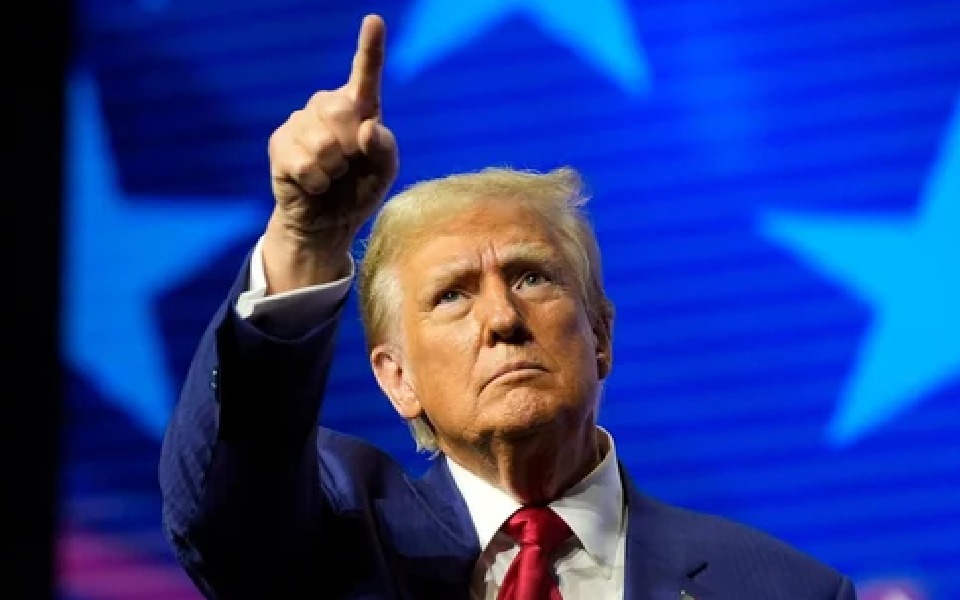
Aboard Air Force One, Jan 26 (AP): President Donald Trump said he would like to see Jordan, Egypt and other Arab nations increase the number of Palestinian refugees they are accepting from the Gaza Strip, potentially moving out enough of the population to “just clean out” the war-torn area to create a virtual clean slate.
During a 20-minute question-and-answer session Saturday with reporters aboard Air Force One, Trump also said he has ended his predecessor's hold on sending 2,000-pound bombs to Israel. That lifts a pressure point meant to reduce civilian casualties during Israel's war with Hamas in Gaza, which is now halted by a tenuous ceasefire.
“We released them today," Trump said of the bombs. “They've been waiting for them for a long time." Asked why he lifted the ban on those bombs, Trump responded, “Because they bought them.”
Trump has built his political career around being unapologetically pro-Israel. On his larger vision for Gaza, Trump said he had call earlier in the day with King Abdullah II of Jordan and would speak Sunday with President Abdel Fattah el-Sissi of Egypt.
“I'd like Egypt to take people,” Trump said. “You're talking about probably a million and a half people, and we just clean out that whole thing and say, You know, it's over.'”
Trump said he complimented Jordan for having successfully accepted Palestinian refugees and that he told the king, “I'd love for you to take on more, cause I'm looking at the whole Gaza Strip right now, and it's a mess. It's a real mess.”
Such a drastic displacement of people would openly contradict Palestinian identity and deep connection to Gaza. Still, Trump said the part of the world that encompasses Gaza, has “had many, many conflicts” over centuries. He said resettling “could be temporary or long term”.
“Something has to happen," Trump said. “But it's literally a demolition site right now. Almost everything's demolished, and people are dying there.” He added: “So, I'd rather get involved with some of the Arab nations, and build housing in a different location, where they can maybe live in peace for a change.”
Israeli Prime Minister Benjamin Netanyahu, in a statement Sunday, thanked Trump for “keeping your promise to give Israel the tools it needs to defend itself.” He did not mention Trump's suggestion on Palestinian refugees.
Trump has offered nontraditional views on the future of Gaza in the past. He suggested after he was inaugurated on Monday that Gaza has “really got to be rebuilt in a different way".
The new president added then, "Gaza is interesting. It's a phenomenal location, on the sea. The best weather, you know, everything is good. It's like, some beautiful things could be done with it, but it's very interesting."
Resuming delivery of large bombs, meanwhile, is a break with then-President Joe Biden, who halted their delivery in May as part of an effort to keep Israel from launching an all-out assault on the southern Gaza city of Rafah. A month later, Israel did take control of the city, but after the vast majority of the 1 million civilians that had been living or sheltering in Rafah had fled.
“Civilians have been killed in Gaza as a consequence of those bombs and other ways in which they go after population centres,” Biden told CNN in May when he held up the weapons. “I made it clear that if they go into Rafah ... I'm not supplying the weapons that have been used historically to deal with Rafah, to deal with the cities, that deal with that problem.”
The Biden pause had also held up 1,700 500-pound bombs that had been packaged in the same shipment to Israel, but weeks later those bombs were delivered.
Trump's action comes as he has celebrated the first phase of a ceasefire between Hamas and Israel that has paused the fighting and seen the release of some hostages held by Hamas in Gaza in return for hundreds of Palestinian prisoners held by Israel.
Negotiations have yet to begin in earnest on the more difficult second phase of the deal that would eventually see the release of all hostages held by Hamas and an enduring halt to the fighting.
If the remaining hostages are not released, the Israeli government has threatened to resume its war against Hamas, which launched a massive assault against Israel on Oct 7, 2023.
Let the Truth be known. If you read VB and like VB, please be a VB Supporter and Help us deliver the Truth to one and all.
Will of people supreme, says Mahua Moitra after BJP's landslide victory in Bengal

Kolkata (PTI): A day after the Trinamool Congress faced a drubbing by the BJP in the West Bengal assembly elections, TMC MP Mohua Moitra on Tuesday said her party respects the mandate as the will of the people is supreme.
She also said that the party will continue the fight for a “secular country”.
In a post on X, Moitra said, “The will of the people is supreme. If Bengal wanted BJP, then Bengal has got BJP. We respect that.”
The BJP on Monday scripted history by winning 206 seats to secure more than a two-thirds majority in the West Bengal assembly polls, ending the TMC’s 15-year rule.
"We fought the good fight against unimaginable odds on an uneven pitch and for that I am proud of my leader & my party," Moitra said.
She said the TMC will continue to stand and fight for a secular country where the constitution, and "not brute majoritarianism, is the last word”.