Turkish President Recep Tayyip Erdogan raises Kashmir issue during UNGA address
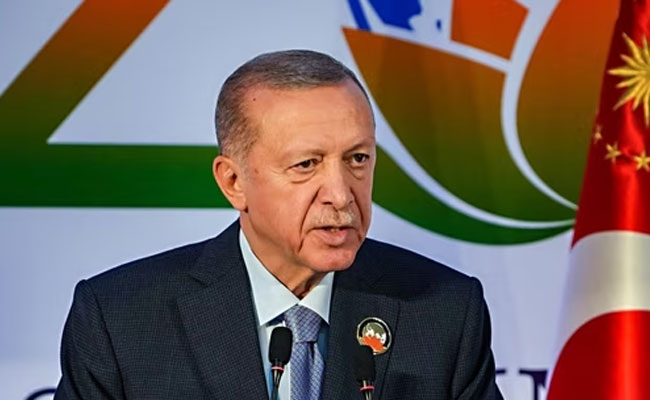
United Nations (PTI): Turkish President Recep Tayyip Erdogan raised the issue of Kashmir during his address to world leaders at the high-level 78th session of the UN General Assembly session here.
"Another development that will pave the way for regional peace, stability and prosperity in South Asia will be the establishment of a just and lasting peace in Kashmir through dialogue and cooperation between India and Pakistan," Erdogan said in his address to the General Debate Tuesday.
"As Turkiye, we will continue to support the steps to be taken in this direction," he said.
His comment comes weeks after he met Prime Minister Narendra Modi on the sidelines of the G20 Summit in New Delhi during which both the leaders discussed strengthening trade and infrastructure relations.
Erdogan said it was a matter of pride that India was playing a role at the United Nations Security Council. He said he favoured making five permanent and 15 "temporary" members as permanent members of the UN Security Council.
"Those 20 (5+15) should be permanent members of the UNSC in rotation. But as you know, the world is bigger than five. When we say the world is larger than five, what we mean is that it's not only about the US, UK, France, China and Russia," he said.
In recent years, the Turkish leader has referred to the issue of Kashmir in his address to world leaders at the high-level UN General Assembly session.
Last year, Erdogan raked up the issue of Kashmir during his address to world leaders at the high-level UN General Assembly session here.
"India and Pakistan, after having established their sovereignty and independence 75 years ago, they still haven't established peace and solidarity between one another. This is much unfortunate. We hope and pray that a fair and permanent peace and prosperity will be established in Kashmir," Erdogan had said.
In 2020, Erdogan in his pre-recorded video statement to the General Debate had made a reference to Jammu and Kashmir. India had at that time termed it as "completely unacceptable", saying Turkey should learn to respect the sovereignty of other nations and reflect on its own policies more deeply.
Let the Truth be known. If you read VB and like VB, please be a VB Supporter and Help us deliver the Truth to one and all.
MediaOne TV Facebook page restored after block linked to ‘government request’

Kochi: The official Facebook page of Malayalam news channel MediaOne TV has been restored after being blocked without prior notice, the broadcaster said on Wednesday.
The channel was quoted by Maktoob as saying that the restriction was lifted automatically, with Meta Platforms informing it that the action had been taken following a “government request” which has now expired or been reversed.
The development came shortly after the channel approached the Kerala High Court challenging the blocking of its page, terming it arbitrary and in violation of legal provisions and judicial precedents. The High Court had issued notice to Meta via email hours before the restriction was withdrawn.
In its petition, the channel said access to its Facebook page had been restricted for users in India without citing any specific content or alleged violation. It contended that while individual posts may be taken down under applicable a rule, blocking an entire page goes beyond the scope of such measures.
The incident followed an earlier action taken against the channel in 2022, when the Ministry of Information and transmitting prohibited it from transmitting. It cited national security concerns regarding the Ministry of Home Affairs' refusal of security clearance.
The Supreme Court of India in April 2023 set aside the ban, observing that national security claims cannot be made without substantive basis and that criticism of government policies does not render a media outlet anti-national.