Two Indian climbers die on Mount Kanchenjunga in Nepal
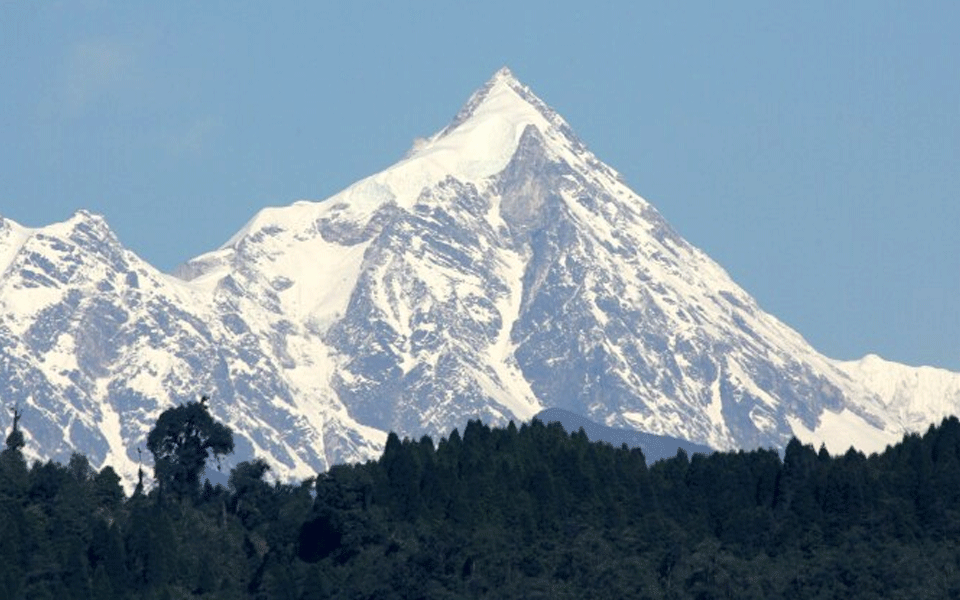
Kathmandu: Two Indian climbers have died in Nepal due to altitude ailments after one of them successfully scaled Mount Kanchenjunga, the world's third tallest peak, an official said Thursday.
Biplab Baidya (48) and Kuntal Karar (46) died Wednesday night above Camp IV after they were unable to continue their descent from near the 8,586-meter summit due to hypothermia and snowblindness.
"Biplab made it successfully to the summit point while Kuntal fell sick on his way. The Indian duo died while climbing down from the peak," Mira Acharaya, a staffer at Nepal's Ministry of Tourism team deployed at the base camp, told PTI.
According to fellow climbers, the incident occurred when the duo were being brought to Camp IV from an altitude of 8,400 metres through a herculean rescue operation carried out by Project Possible team leader Nirmal 'Nims' Purja along with the fellow members.
"Later, they succumbed to high altitude sicknesses," Pasang Sherpa, Manager at Peak Promotion Pvt Ltd told The Himalayan Times.
They were part of a five-member team of climbers from West Bengal, Sherpa said.
"Two Indian climbers and a German mountaineer who also suffered from serious frostbite will be evacuated from the high altitude camp as early as possible," he said.
Another climber from Chile is missing from above Camp IV of Mount Kanchenjunga since last evening.
Rodrigo Vivanco from Chile went missing on the descent after he reportedly made it to the summit late on Wednesday, Sherpa said, adding that a team has already left for Camp IV to conduct a search operation.
Mount Kangchenjunga is the third highest mountain in the world. It rises with an elevation of 8,586 metres in a section of the Himalayas called Kangchenjunga Himal delimited in the west by the Tamur River, in the north by the Lhonak Chu and Jongsang La, and in the east by the Teesta River.
Let the Truth be known. If you read VB and like VB, please be a VB Supporter and Help us deliver the Truth to one and all.
Amit Shah holds meeting with Ladakh L-G for smooth ‘darshan’ of Lord Buddha’s relics
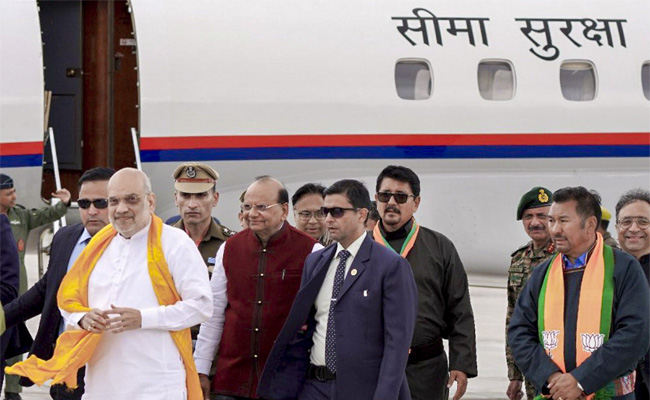
Leh (PTI): Union Home Minister Amit Shah on Thursday took a meeting with Ladakh Lieutenant Governor V K Saxena and senior officials of the Union territory to ensure that people can have 'darshan' of the sacred relics of Lord Buddha for the next two weeks without any inconvenience.
In a message on X, Shah, who reached Leh on Thursday, said that Friday will be a historic day for Ladakh when people can have 'darshan' of the sacred relics of Lord Buddha on the auspicious occasion of Buddha Purnima.
“I consider myself fortunate that I, too, will have the rare opportunity tomorrow to have darshan of these holy relics,” Shah said in the post in Hindi.
"To ensure that these sacred relics are easily accessible for darshan by the people of Ladakh over the next two weeks, I held a meeting today with the lieutenant governor of Ladakh and the concerned officials in this regard,” he said.
Shah is on a two-day visit to Ladakh during which he will attend the first-ever international exposition of the holy relics of Lord Buddha in India, commencing on Buddha Purnima on Friday.
The sacred relics were brought to Leh from Piprahwa in Uttar Pradesh in a special Indian Air Force aircraft on Wednesday by Drukpa Thuksey Rinpoche and Khenpo Thinlas Chosal from the Matho Monastery.
The relics, excavated from Piprahwa (ancient Kapilvastu), will be displayed at Jive Tsal, Choglamsar, from May 2 to 10.
The relics were accorded a ceremonial reception on their arrival in Leh, as people poured out of their homes and gathered along the roads to pay their respect.
The Piprahwa relics refer to ancient sacred remains and associated objects linked to Gautam Buddha, which were discovered at Piprahwa, an archaeological site in Uttar Pradesh near the Nepal border.
The relics have gained renewed global significance in recent years, especially after a collection of associated gems and offerings was repatriated to India in July 2025 from a British family and a private collection, ending over a century of colonial possession.
The relics have been exhibited internationally in several countries; this is the first time they have been brought out from their original place of preservation for exposition within India.
The relics were previously exhibited in Thailand, Mongolia, Vietnam, Russia, Singapore, Bhutan, Sri Lanka and Myanmar, attracting global attention and devotion, according to a statement.
In Ladakh, the relics will be open for public veneration at Jivetsal from May 2 to May 10. They will subsequently be taken to Zanskar on May 11 and 12, followed by exposition at the Dharma Centre in Leh from May 13 to May 14, before being returned to Delhi on May 15, it said.