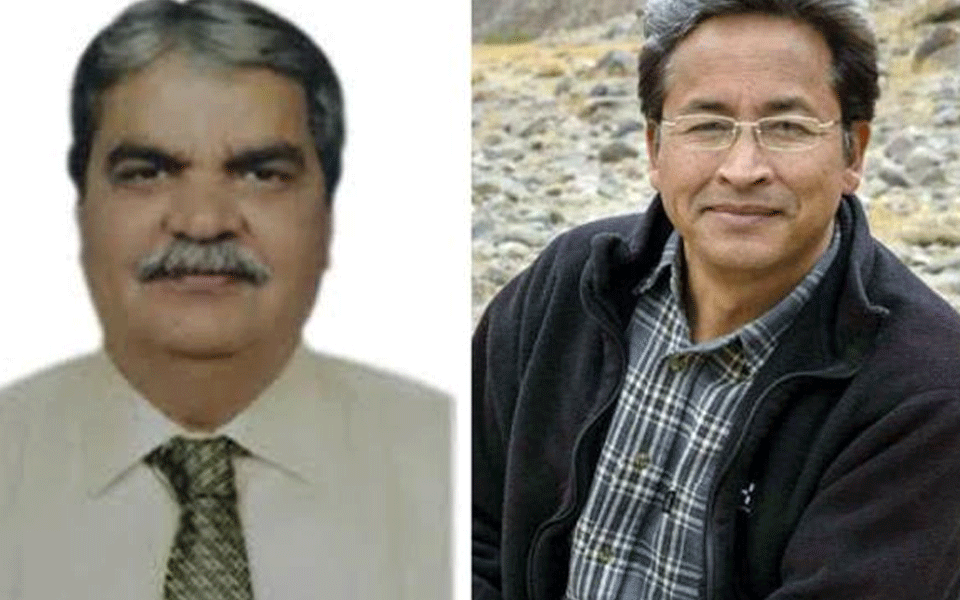
Manila, Aug 31 : Two Indian nationals, Bharat Vatwani and Sonam Wangchuk, on Friday were given the Ramon Magsaysay award, popularly known as Asia's Nobel Prize.

At a ceremony in Manila, Cambodian activist Youk Chhang, Filipino Howard Dee, Vietnam's Vo Thi Hoang Yen and East Timore's Maria de Lourdes Martins Cruz were also honored for their work.

"All are unafraid to take on large causes. All have refused to give up despite meagre resources, daunting adversity and strong opposition," Carmencita Abella, president of the Ramon Magsaysay Award Foundation said, Efe reported.

Vatwani has dedicated his life for rescuing mentally ill people from the streets of India - who number around 400,000 according to estimates - and providing them with shelter and treatment through his Shraddha Rehabilitaion Foundation.

Since 1988, Vatwani has helped around 7,000 mental patients, reuniting many of them with their families.

Wangchuk has been recognised for "his uniquely systematic, collaborative and community-driven reform of learning systems in remote northern India, thus improving the life opportunities of Ladakhi youth, and his constructive engagement of all sectors in local society to harness science and culture creatively for economic progress, thus setting an example for minority peoples in the world".

Chhang survived the large-scale violence and oppression of the Khmer Rouge regime in Cambodia and returned to his country after living in exile to head the Documentation Center, which has gathered evidence about the regime's crimes against humanity.

The institution has collected and digitized around a million documents since 1995 from around 23,000 forced-labour camps, where around two million people were killed, and recorded the testimonies of around 10,000 victims and aggressors.

Dee, the former Philippine ambassador to the Vatican and Malta, as well as a former negotiator with the communist rebels, was honoured for working for peace through sustainable development and poverty reduction in areas affected by armed conflict.

Dee founded the Assisi Development Foundation in 1975 along with Jesuit priest Francisco Araneta and the organization has carried out more than 4,100 projects benefiting around 10.5 million Filipinos.

Martins Cruz established the Secular Institute of Brothers and Sisters in Christ, which takes care of the poorest sections of the society in East Timor with projects in health, education and agriculture, while Vietnam's Vo Thi Hoang Yen has dedicated herself to improving the quality of life of people with disabilities.

Let the Truth be known. If you read VB and like VB, please be a VB Supporter and Help us deliver the Truth to one and all.


New Delhi (PTI): As the conflict in West Asia widened, India on Tuesday emphasised the interest of one crore Indian nationals in the region and voiced concern over consequences for the Indian economy due to possible disruptions in energy supplies, even as Prime Minister Narendra Modi discussed the evolving situation with leaders of Oman, Kuwait and Qatar.

In its second statement since the US-Israel strikes on Iran and Tehran's subsequent retaliation, India once again called for "dialogue and diplomacy" to end the conflict, noting that New Delhi has critical stakes in the security and stability of West Asia and the current developments "evoke great anxiety".

New Delhi said it will continue to closely monitor the evolving situation and take relevant decisions in the national interest, adding it is in touch with the governments in the region as well as other key partners.

"In recent days, we have not only witnessed an intensification of the conflict but also its spread to other nations. The destruction and deaths have mounted, even as normal life and economic activities come to a halt," the Ministry of External Affairs (MEA) said.

"As a proximate neighbour with critical stakes in the security and stability of the region, these developments evoke great anxiety."

The ministry said almost one crore Indian citizens are living in West Asia, and their safety and well-being are of "utmost priority" for New Delhi. "We cannot be impervious to any development that negatively affects them," it said.

The conflict in West Asia intensified with Iran continuing to pound several Gulf countries in retaliation for the joint attack against it by Israel and the US. The US and Israel have also carried out fresh strikes on Iran.

As part of its offensive, Iran has blocked the strategically located Strait of Hormuz shipping route, triggering a surge in global oil prices.

"Our trade and energy supply chains also traverse this geography. Any major disruption has serious consequences for the Indian economy," the ministry said.

The Strait of Hormuz handles nearly 20 per cent of the world's total oil and gas supplies. About 50 per cent of India's oil imports, or roughly 2.6 million barrels a day, pass through the Strait.

Iran has carried out a wave of attacks mainly targeting Israel and American military bases in several Gulf countries, including the UAE, Bahrain, Kuwait, Jordan and Saudi Arabia.

The Iranian retaliation increased after Tehran announced early Sunday that its Supreme Leader Ayatollah Ali Khamenei had been killed in the Israel-US strike.

"As a country whose nationals are prominent in the global workforce, India is also firmly opposed to attacks on merchant shipping. Already, some Indian nationals have lost their lives or are missing as a result of such attacks in the last few days," it said.

"In this background, India strongly reiterates its call for dialogue and diplomacy. We raise our voice clearly in favour of an early end to the conflict. Already, many lives have been regrettably lost, and we express our grief in that regard," it added.

It is learnt that at least three Indian nationals were killed in Iranian attacks on two merchant vessels in the waters off Oman.

The statement by the MEA, however, was silent on the killing of Ayatollah Khamenei.

The ministry said Indian embassies and consulates in the affected countries remain in close touch with Indian nationals and community organisations, issuing regular advisories.

"They have also extended all possible help to those stranded by the conflict. The embassies and consulates will continue to be proactive in addressing various consular aspects of this conflict," it said.

"We are in touch with the governments of this region as well as other key partners. The prime minister and external affairs minister have held discussions with their counterparts," it added.

Following his phone conversation with the Emir of Qatar, Sheikh Tamim bin Hamad Al Thani, PM Modi said India stands "firmly" in solidarity with the Gulf nation and strongly condemns any violation of its "sovereignty and territorial integrity".

"We emphasised the urgent need to restore peace and stability in the region through dialogue and diplomacy. I also conveyed my appreciation for his continued support and care for the Indian community in Qatar during this challenging time," he said.

The prime minister described his phone conversation with the Crown Prince of Kuwait, Sheikh Sabah Al-Khaled Al-Hamad Al-Mubarak Al-Sabah, as "productive" and conveyed to him that India condemns the violation of Kuwait's sovereignty and territorial integrity.

"We underscored the significance of dialogue and diplomacy in restoring regional peace and stability. Appreciated the Kuwaiti leadership's continued support to ensure the safety and well-being of the Indian community in Kuwait," Modi said on social media.

In his phone conversation with Oman Sultan Haitham bin Tariq, Modi "deeply appreciated" Oman's continued support for the Indian community.

"Condemned the violation of Oman's sovereignty and territorial integrity.

We agreed that sustained diplomatic engagement is essential for the earliest restoration of regional peace and stability," the prime minister said.

India issued the first statement on February 28, hours after the US and Israel launched the military offensives against Iran.

"We had expressed our deep concern at the cankar spoke to the European Union's High Representative for Foreign Affairs and Security Policy Kaja Kallas and discussed the situation in West Asia. Our discussions focused on the ongoing conflict in Iran and the Gulf," Jaishankar said on X.

The US military has said six of its personnel were killed in the conflict so far. The US-Israeli strikes have killed at least 787 people, the Iranian Red Crescent Society said. According to reports, at least 11 people were killed in Israel.

In a related development, the Indian embassy in Iran has relocated most Indian students from Tehran.

"Due to the heightened risk perception in Tehran city, the Embassy of India has relocated most Indian students who were in Tehran," the Indian mission said.

The students were taken to locations outside of Tehran. The embassy arranged transportation, food and accommodation for the students.