Two top US senators ask Blinken to raise farmers issue
say Indians will determine path ahead on new laws
Washington: Two top Democratic senators have urged US Secretary of State Antony Blinken to raise with the Indian leaders the issue of treatment of peaceful farmer protesters and journalists even as they acknowledged that it is for the people and the Government of India to determine the path forward on its recently enacted farm laws.
In a letter to Blinken, Senate Foreign Relations Committee Chairman Bob Menendez and Senate Majority Leader Chuck Schumer on Thursday urged the Biden administration to further engage with Prime Minister Narendra Modi's government over its treatment of farmers in India who have been peacefully demonstrating against the passage of new farm laws.
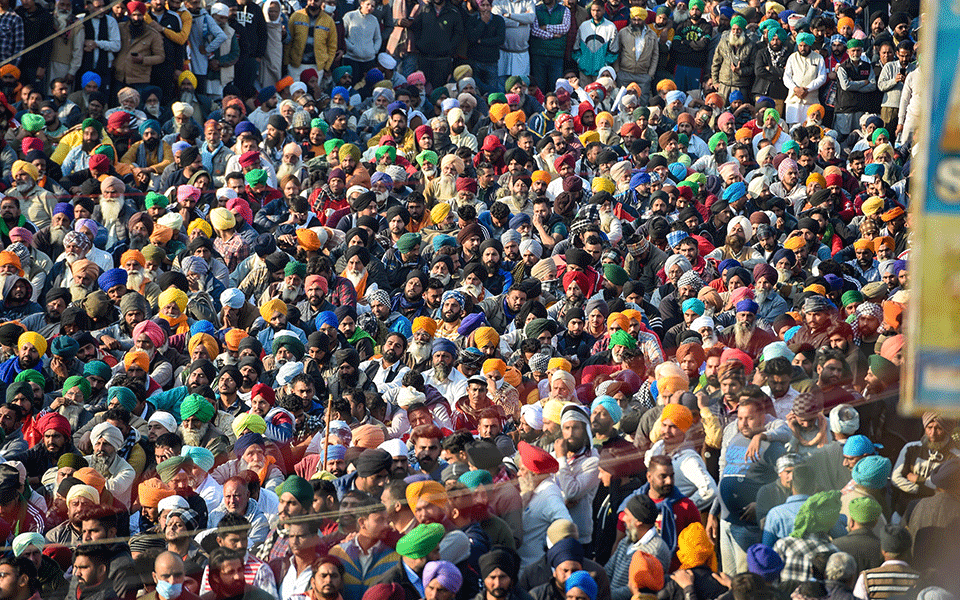
Farmers, mostly from Punjab, Haryana and western Uttar Pradesh, have been camping at several Delhi border points, including Tikri, Singhu and Ghazipur, since November 28, demanding a complete repeal of the three farm laws and a legal guarantee on the minimum support price (MSP) for their crops.
The government has denied allegations that it was trying to put an end to the MSP and the mandi system.
India has also emphasised that the protests by farmers must be seen in the context of India's democratic ethos and polity and the Ministry of External Affairs last month said that some vested interest groups have tried to mobilise international support against the country.
In their joint letter to Blinken, Menendez and Schumer noted that India is a "long-term strategic partner with deep ties to the United States thanks to our many shared values and our large and valued Indian American community."
"In light of these shared values and strong connections, we write with serious concern regarding the response of the Indian government to the farmer protests, they said.
In their letter, released to the press on Thursday, the two senators urged Blinken to raise the importance of freedom of speech and the right to peaceful protest in conversations with his Indian counterparts and to ensure that State Department officials at all levels do so as well.
After becoming the Secretary of State, Blinken has spoken with External Affairs Minister S Jaishankar multiple times. The readouts of the phone calls do not indicate that Blinken raised this issue, under pressure from his party leaders, with Jaishankar. The Biden administration has insisted that the two countries share democratic values.
Schumer and Menendez said the months-long demonstrations have been met with orders from the central government and local authorities to shut off internet access in protest areas, cut off water and electricity supplies for the tens of thousands living in protest camps, and impede the work of journalists reporting on the protests.
India's people and the government will determine the path forward on these laws, and peaceful dialogue and respect for the viewpoints of all peaceful actors should drive that decision," they said.
"As the US pursues a more perfect union here at home, including efforts to bolster the rule of law and our democracy, those efforts reinforce the importance of addressing challenges to democracies abroad as well, they wrote.
The letter by Schumer and Menendez comes a day after the latter wrote a similar letter to Defence Secretary Lloyd Austin, who is visiting India this week.
There has been no response from either Austin or Blinken if they plan to raise these issues with their Indian counterparts, especially when the Biden administration is going out of its way in its outreach with the Modi government given the serious challenge it is facing from China.
Blinken and the US National Security Advisor have met their Chinese counterparts in Anchorage, Alaska. This is the first in-person meriting that the Biden administration is having with the Chinese leadership.
In their letter, Menendez and Schumer said following the passage of new farm laws last fall, the farmers have engaged in over 100 days of peaceful demonstrations to express their opposition to certain policies.
While we do not take a position on internal Indian policy matters, we recognise and condemn that on January 26, a small faction of protesters engaged in unacceptable violence at the Red Fort in New Delhi, but protest leaders quickly condemned the violence and the vast majority of protesters remained peaceful.
"However, Indian authorities at different levels of government have used that day's events as a pretext to undertake a broader and sustained crackdown on peaceful protesters, journalists, and government critics, they alleged.
Noting that they are alarmed by the sedition charges against a leading
Opposition politician and a 22-year-old climate activist related to the protests, the two senators said that the central government has repeatedly ordered Twitter to shut down accounts that relate to or report on the protests, including those of media organisations and journalists, and threatened to arrest Indian Twitter employees if the microblogging site fails to comply, as reported by CNN.
At the same time, Indian authorities have also sought to hinder the work of journalists reporting on the protests. Indian authorities have filed criminal complaints against at least 10 journalists for their reporting on the protests, including charges of sedition.
"Reporters Without Borders said the accusations represent a headlong assault on press freedom, and Indian press freedom groups have characterised them as an intimidation tactic to stifle the media, the senators wrote.
In the past, both Schumer and Menendez have spoken about the important role that India has in the US' China policy.
They have both called for a strong relationship with India. Both have been sponsors of some key legislations on the matter.
Prominent among them include the Democracy Technology Partnership Act which says that the world's major liberal-democratic nations must work together in a technology partnership to ensure that these technologies advance democratic institutions, norms, and values, contributing to global peace and prosperity.
The Democracy Technology Partnership Act establishes an inter-agency office at the US Department of State to lead in the creation of a new partnership among the world's tech-leading democracies.
Multiple rounds of talks between the Indian government and farmer unions have not been able to resolve the deadlock over the new agri laws.
The government has said it has shown the utmost respect for protests by farmers and has remained engaged in dialogue with them to address their concerns.
Let the Truth be known. If you read VB and like VB, please be a VB Supporter and Help us deliver the Truth to one and all.
Indian startup's 'Drishti' satellite launched aboard SpaceX rocket
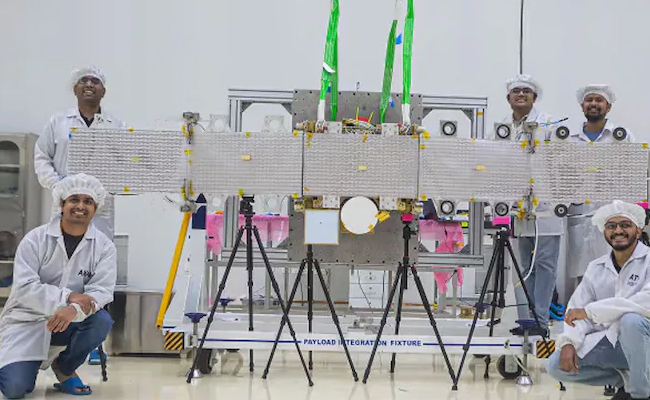
New Delhi (PTI): Bengaluru-based space start-up GalaxEye's Mission Drishti satellite was launched on Sunday aboard SpaceX's Falcon 9 rocket from California.
Mission Drishti is the world's first OptoSAR satellite, integrating electro-optical (EO) and synthetic aperture radar (SAR) sensors into a single operational platform, according to the company.
While EO sensors capture high-resolution images during sunlight and clear skies, SAR sensors provide all-weather and all-time images, using radar pulses.
In a statement, Suyash Singh, founder and CEO of GalaxEye, said, "With the satellite (Mission Drishti) now successfully in orbit, our immediate focus is on completing its commissioning. As we move through this phase, we are already witnessing strong global interest in the differentiated datasets enabled by our OptoSAR payload."
The satellite will help address long-standing limitations of conventional systems and enable more reliable and consistent data acquisition across diverse environmental conditions, the company said.
As a dual-use Earth observation satellite, the mission will support use cases across defence, agriculture, disaster management, maritime monitoring, and infrastructure planning.
The satellite is also expected to complement India's broader initiatives, including the 29 active Earth Observation satellites outlined in ISRO's recent annual report.
The launch came after five years of indigenous research and development, and extensive environmental testing and performance validation of the Mission Drishti.
In a statement, Lt Gen AK Bhatt (Retd), director general of Indian Space Association (ISpA), said, "GalaxEye has achieved what only a few global players have, which is seamlessly combining optical and SAR capabilities on a single platform to enable persistent, all-weather intelligence."
What stands out is not just the technology, but its broader impact on how downstream applications will increasingly define value in the space economy, particularly in Earth observation, where timely, decision-grade insights are critical," he added.
ISpA is the premier industry association of space and satellite companies in the country.
Union Minister Jitendra Singh also took note of the Mission Drishti launch, saying the development marked a significant milestone in India's space journey.
In a post on X, the minister said, "The successful launch of the world's first OptoSAR satellite, and the largest privately-built satellite in the country, reflects the immense potential of our young innovators driving nation-building."
GalaxEye aims to scale up Mission Drishti to a constellation of 10 satellites by 2030, developing a robust and sovereign Earth observation infrastructure for India.