Typhoon deaths in Philippines top 100, mayors appeal for aid
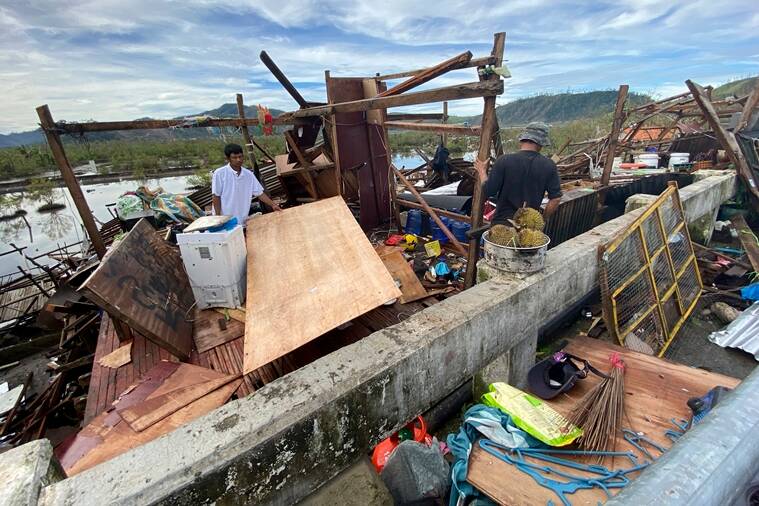
Manila, Dec 19: The governor of an island province in the central Philippines said Sunday at least 72 people died in the devastation wrought by Typhoon Rai in more than half of the towns that managed to contact him, bringing the death toll in the strongest typhoon to batter the country this year to at least 146.
Gov. Arthur Yap of Bohol province said 10 others were missing and 13 injured, and suggested the fatalities may still considerably increase with only 33 out of 48 mayors able to report back to him due to downed communications.
Officials were trying to confirm a sizable number of deaths caused by landslides and extensive flooding elsewhere.
In statements posted on Facebook, Yap ordered mayors in his province of more than 1.2 million people to invoke their emergency powers to secure food packs for large numbers of people along with drinking water.
Both have been urgently sought in several hard-hit towns.
After joining a military aerial survey of typhoon-ravaged towns, Yap said it is very clear that the damage sustained by Bohol is great and all-encompassing.
He said the initial inspection did not cover four towns, where the typhoon blew in as it rampaged through central island provinces on Thursday and Friday.
The government said about 780,000 people were affected, including more than 300,000 residents who had to evacuate their homes.
At least 64 other typhoon deaths were reported by the disaster-response agency, the national police and local officials. Most were hit by falling trees and collapsed walls, drowned in flash floods or were buried in landslides.
Officials on Dinagat Islands, one of the southeastern provinces first pounded by the typhoon, separately reported 10 deaths just from a few towns, bringing the overall fatalities so far to 146.
President Rodrigo Duterte flew to the region Saturday and promised 2 billion pesos ( 40 million) in aid.
He met officials in Maasin City in Southern Leyte province where he was born. Duterte's family later relocated to the southern city of Davao, where he served as a longtime mayor before rising to the presidency.
The moment I was born into this world, I told my mother, `Let's not stay here because this place is really prone to typhoons,' Duterte told officials.
At its strongest, the typhoon packed sustained winds of 195 kilometers (121 miles) per hour and gusts of up to 270 kph (168 mph), making it one of the most powerful in recent years to hit the disaster-prone archipelago, which lies between the Pacific Ocean and the South China Sea.
Floodwaters rose rapidly in Bohol's riverside town of Loboc, where residents were trapped on their roofs and in trees.
They were rescued by the coast guard the following day.
On Dinagat Islands, an official said the roofs of nearly all the houses, including emergency shelters, were either damaged or blown away entirely.
At least 227 cities and towns lost electricity, which has since been restored in only 21 areas, officials said, adding that three regional airports were damaged, including two that remain closed.
The deaths and widespread damage left by the typhoon ahead of Christmas in the largely Roman Catholic nation brought back memories of the catastrophe inflicted by another typhoon, Haiyan, one of the most powerful on record.
It hit many of the central provinces that were pummelled last week, leaving more than 6,300 people dead in November 2013.
At the Vatican, Pope Francis expressed his closeness Sunday to the people of the Philippines, referencing the typhoon that destroyed many homes.
About 20 storms and typhoons batter the Philippines each year. The archipelago also lies along the seismically active Pacific Ring of Fire region, making it one of the countries most susceptible to natural calamities.
Let the Truth be known. If you read VB and like VB, please be a VB Supporter and Help us deliver the Truth to one and all.
Vartha Bharati–Sankalp predictions align closely with Karnataka bypoll results

Bengaluru: The Vartha Bharati–Sankalp election analysis has shown a high level of accuracy in predicting the outcome of the recent Karnataka Assembly by-elections held in May 2026, correctly calling winners in both constituencies and closely estimating vote share trends.
The by-elections were held in Bagalkot and Davanagere South, drawing significant political attention as both seats were seen as key tests for the ruling Congress and opposition BJP.
According to the analysis, Vartha Bharati–Sankalp had made three major projections ahead of the results the winning party, vote share percentages, and margin of victory.
In both constituencies, the platform accurately predicted that the Congress would emerge victorious. The outcome matched the projections, with Congress candidates winning in Bagalkot and Davanagere South.
In terms of vote share, the predictions were largely in line with the final results. In Bagalkot, the BJP’s vote share was forecast in the range of 40 to 46 per cent, while the actual figure stood at 42.9 per cent. The Congress vote share, however, exceeded expectations, with the party securing 55.4 per cent against a projected range of 43 to 48 per cent.
The margin of victory in Bagalkot turned out to be significantly higher than anticipated. While the projection had placed the margin between 2,000 and 3,500 votes, the final margin was around 22,332 votes.
In Davanagere South, the predictions also remained largely accurate. The Congress vote share was projected between 43 and 51 per cent, and the final figure stood at 43.9 per cent. The BJP was expected to secure between 42 and 50 per cent but ended with 40.3 per cent.
The analysis had also identified the role of SDPI as a potential spoiler in the constituency. While its vote share was estimated around 6 per cent, the party eventually secured around 12 per cent of the vote.
The margin of victory in Davanagere South was predicted to be between 1,500 and 2,600 votes. The actual margin was higher at around 5,708 votes, though the contest remained relatively close as anticipated.
Overall, the performance of Vartha Bharati–Sankalp stood out for correctly identifying the winning parties in both seats and maintaining close accuracy in vote share estimates, with only limited deviations in specific cases.