Uganda's schools reopen, ending world's longest lockdown

Kampala (Uganda), Jan 10: Uganda's schools reopened to students on Monday, ending the world's longest school disruption due to the COVID-19 pandemic.
The reopening caused traffic congestion in some areas of the capital, Kampala, and students can be seen carrying their mattresses in the streets, a back-to-boarding school phenomenon not witnessed here for nearly two years.
Uganda's schools have been fully or partially shut for more than 83 weeks, the world's longest disruption, according to figures from the UN cultural agency. The shutdown affected more than 10 million learners.
The East African country of 44 million people first shut down its schools in March 2020, shortly after the first coronavirus case was confirmed on the African continent. Some classes were reopened to students in February 2021, but a total lockdown was imposed again in June as the country faced its first major surge.
For many parents, the reopening was long overdue.
Inevitably, we have to open up schools, said Felix Okot, the father of a 6-year-old kindergartner. The future of our kids, the future of our nation, is at stake. The country's schools cannot wait forever for the pandemic's end, he warned.
The protracted school lockdown proved controversial in a country where measures aimed at stemming the spread of the virus were ignored by many. Vaccine scepticism, even among health workers, remains a problem, with growing reports of fake COVID-19 vaccination cards sold in downtown Kampala.
Many students returning to school are believed to have had no help during the lockdown. Most public schools, which serve the vast majority of children in Uganda, were unable to offer virtual schooling. The Associated Press reported in November on students in a remote Ugandan town where weeds grew in classrooms and some students worked in a swamp as gold miners.
Some critics pointed out that the government of President Yoweri Museveni an authoritarian who has held power for 36 years and whose wife is the education minister did little to support home-based learning. Museveni justified the lockdown by insisting that infected students were a danger to their parents and others.
There are many things which can't be predicted right now. The turnout of students is unpredictable, the turnout of teachers is unpredictable," said Fagil Mandy, a former government inspector of schools now working as an independent consultant. I am more worried that many children will not return to school for various reasons, including school fees.
Mandy also noted concern that a virus outbreak will spread very fast in crowded schools, urging close monitoring by school administrators.
Welcoming the reopening of Uganda's schools, Save the Children warned that lost learning may lead to high dropout rates in the coming weeks without urgent action," including what it described as catch-up clubs.
The aid group warned in a statement Monday of a wave of dropouts as returning students who have fallen behind in their learning fear they have no chance of catching up .
It remains to be seen how long Uganda's schools will remain open, with an alarming rise in virus cases in recent days. In the past week health authorities have been reporting a daily positivity rate in excess of 10%, up from virtually zero in December. Museveni has warned of a possible new lockdown if intensive care units reach 50% occupancy.
Hoping for a smooth return to school, authorities waived any COVID test requirements for students. An abridged curriculum also has been approved under an arrangement to automatically promote all students to the next class.
Uganda has received foreign support toward the reopening of schools.
The UN children's agency and the governments of the UK and Ireland announced financial support focusing on virus surveillance and the mental health of students and teachers in 40,000 schools. They said their support was key for Uganda's school system to remain open.
Let the Truth be known. If you read VB and like VB, please be a VB Supporter and Help us deliver the Truth to one and all.
Vartha Bharati–Sankalp predictions align closely with Karnataka bypoll results
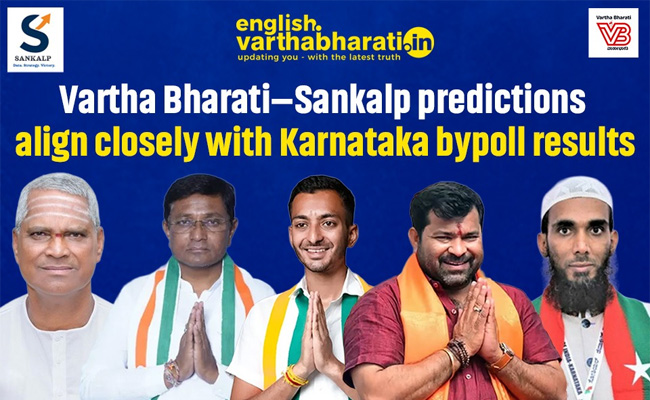
Bengaluru: The Vartha Bharati–Sankalp election analysis has shown a high level of accuracy in predicting the outcome of the recent Karnataka Assembly by-elections held in May 2026, correctly calling winners in both constituencies and closely estimating vote share trends.
The by-elections were held in Bagalkot and Davanagere South, drawing significant political attention as both seats were seen as key tests for the ruling Congress and opposition BJP.
According to the analysis, Vartha Bharati–Sankalp had made three major projections ahead of the results the winning party, vote share percentages, and margin of victory.
In both constituencies, the platform accurately predicted that the Congress would emerge victorious. The outcome matched the projections, with Congress candidates winning in Bagalkot and Davanagere South.
In terms of vote share, the predictions were largely in line with the final results. In Bagalkot, the BJP’s vote share was forecast in the range of 40 to 46 per cent, while the actual figure stood at 42.9 per cent. The Congress vote share, however, exceeded expectations, with the party securing 55.4 per cent against a projected range of 43 to 48 per cent.
The margin of victory in Bagalkot turned out to be significantly higher than anticipated. While the projection had placed the margin between 2,000 and 3,500 votes, the final margin was around 22,332 votes.
In Davanagere South, the predictions also remained largely accurate. The Congress vote share was projected between 43 and 51 per cent, and the final figure stood at 43.9 per cent. The BJP was expected to secure between 42 and 50 per cent but ended with 40.3 per cent.
The analysis had also identified the role of SDPI as a potential spoiler in the constituency. While its vote share was estimated around 6 per cent, the party eventually secured around 12 per cent of the vote.
The margin of victory in Davanagere South was predicted to be between 1,500 and 2,600 votes. The actual margin was higher at around 5,708 votes, though the contest remained relatively close as anticipated.
Overall, the performance of Vartha Bharati–Sankalp stood out for correctly identifying the winning parties in both seats and maintaining close accuracy in vote share estimates, with only limited deviations in specific cases.