UK court remands Nirav Modi till June 27
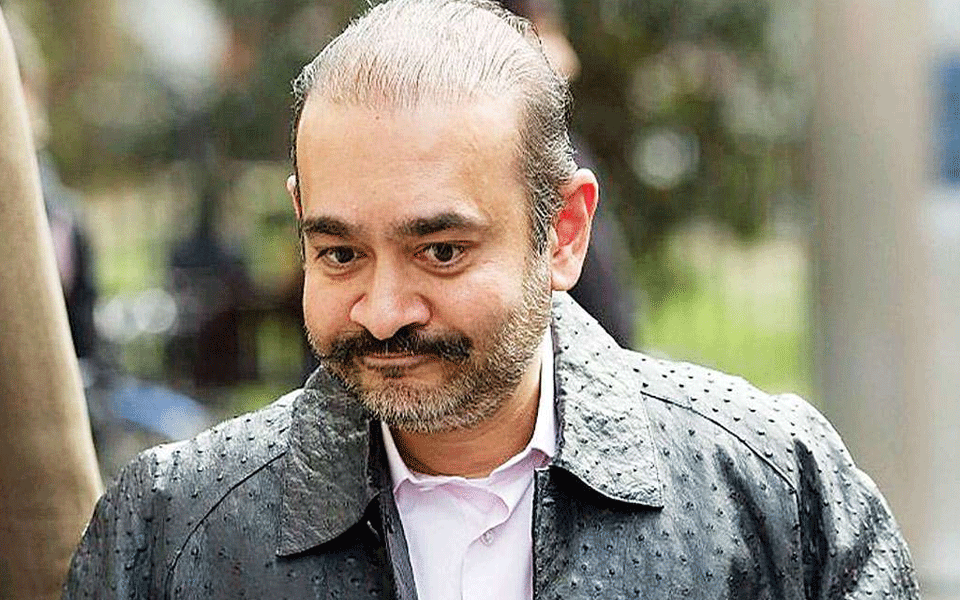
London: A UK court on Thursday extended till June 27 the remand of fugitive diamond merchant Nirav Modi, who is fighting his extradition to India in the nearly USD 2 billion Punjab National Bank (PNB) fraud and money laundering case.
The 48-year-old has been lodged at Wandsworth prison in south-west London since his third attempt at seeking bail was rejected by Chief Magistrate Emma Arbuthnot at the last hearing at Westminster Magistrates' Court earlier this month.
He was produced before Judge Arbuthnot for the first case management hearing in the case. The judge remanded him till June 27.
The judge also asked the Indian government to provide within 14 days the information on which prison he will be held at.
Modi was arrested by uniformed Scotland Yard officers on an extradition warrant from a Metro Bank branch in central London as he attempted to open a new bank account on March 19 and has been in prison since.
During subsequent hearings, Westminster Magistrates' Court was told that Modi was the "principal beneficiary" of the fraudulent issuance of letters of undertaking (LoUs) as part of a conspiracy to defraud PNB and then laundering the proceeds of crime.
Arbuthnot, the judge who had ordered the Mallya extradition in December 2018, has been very firm with the CPS, representing the Indian government, about proper indexing of all documents to be submitted to the court in relation to the case.
Let the Truth be known. If you read VB and like VB, please be a VB Supporter and Help us deliver the Truth to one and all.
Power tariffs under BESCOM to rise from May 1
Bengaluru (PTI): Power bills for consumers under the Bangalore Electricity Supply Company Limited (BESCOM) will go up from May 1, following an order issued by the Karnataka Electricity Regulatory Commission (KERC) on Friday.
The hike comes after KERC allowed the BESCOM to recover a revenue deficit of Rs 2,068 crore incurred in 2024-25, from the consumers.
As a result, for every unit of electricity consumed in 2024-25, the customers will be charged an additional 56 paise, it said.
"BESCOM shall calculate, for each of the active consumers of FY2024-25 the amount to be recovered based on their actual energy consumption during FY2024-25. Such amount shall be recovered during FY 2026-27 in equal monthly instalments, to be called as 'FY25 True up Charges', commencing from the first meter reading date falling on or after 1 May 2026 and concluding with the reading date ending on 30 April 2027," the order said.
"It is further ordered that BESCOM shall maintain a separate head of account, allocated for the purpose, to record the adjustment of the said amount to ensure full recovery of the deficit," it added.
Similarly Chamundeshwari Electricity Supply Corporation Limited (CESC) has also recorded a revenue deficit of Rs 121.71 crore and can collect an additional 15 paisa per unit for consumption in 2024-25, official sources said.