UN top court orders Israel to open more land crossings for aid into Gaza
The Hague (Netherland), Mar 28: The top United Nations court on Thursday ordered Israel to take measures including opening more land crossings to allow food, water, fuel and other supplies into Gaza to tackle crippling shortages in the war-ravaged enclave.
The International Court of Justice issued two new so-called provisional measures in a case brought by South Africa accusing Israel of acts of genocide in its military campaign launched after the October 7 attacks by Hamas. Israel stringently denies it is committing genocide and says its military campaign is self defence.
Thursday's order came after South Africa sought more provisional measures, including a ceasefire, citing starvation in Gaza. Israel urged the court not to issue new orders.
In its legally binding order, the court told Israel to takemeasures "without delay" to ensure "the unhindered provision at scale by all concerned of urgently needed basic services and humanitarian assistance" including food, water, fuel and medical supplies.
It also ordered Israel to immediately ensure that its military does not take action that could that could harm Palestinians' rights under the Genocide Convention, "including by preventing, through any action, the delivery of urgently needed humanitarian assistance".
The court told Israel to report back in a month on its implementation of the orders.
Israel's Foreign Ministry had no immediate comment on the order.
In a written response earlier this month to South Africa's request for more measures, Israel said that claims by South Africa in its request were "wholly unfounded in fact and law, morally repugnant, and represent an abuse both of the Genocide Convention and of the Court itself".
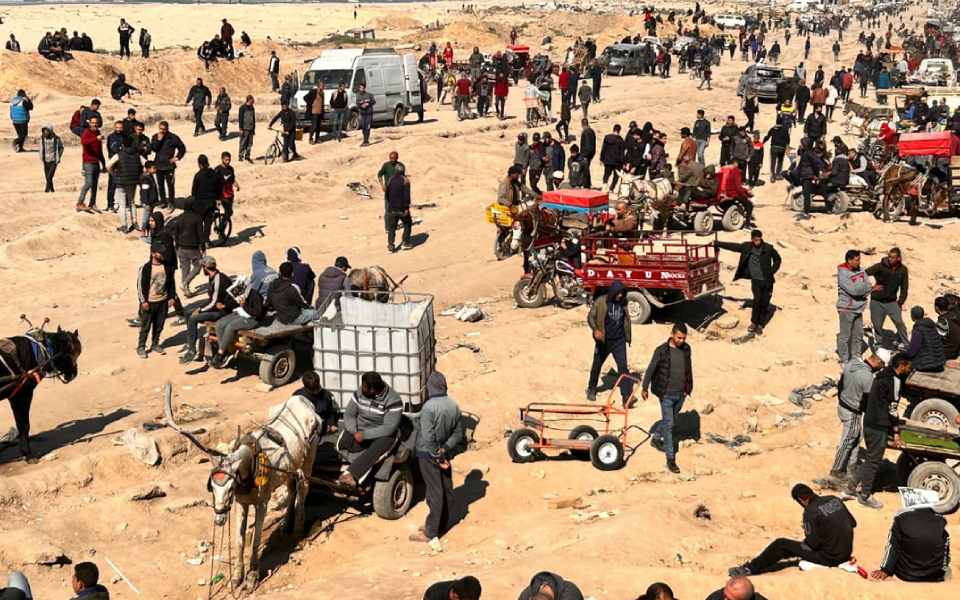
After initially sealing Gaza's borders in the early days of the war, Israel began to allow humanitarian supplies to flow in. It says it places no restrictions on the amounts of humanitarian aid allowed into Gaza and accuses the United Nations of failing to properly organise the deliveries.
The UN and international aid groups say deliveries have been impeded by Israeli military restrictions, ongoing hostilities and the breakdown of public order.
Israel has been working with international partners on a plan to soon begin deliveries of aid by sea.
Israel has repeatedly feuded with the United Nations, particularly UNRWA, the UN refugee for Palestinian refugees and main provider of aid in Gaza. Israel accuses the agency of tolerating and even cooperating with Hamas a charge UNRWA denies.
The court said in its order that "Palestinians in Gaza are no longer facing only a risk of famine ... but that famine is setting in." It cited a report from the United Nations Office for the Coordination of Humanitarian Affairs that said at least 31 people, including 27 children, having already died of malnutrition and dehydration.
The world court said that earlier orders imposed on Israel after landmark hearings in South Africa's case, "do not fully address the consequences arising from the changes in the situation" in Gaza.
The Israeli military has repeatedly claimed that Israel is ready to let in unlimited amounts of aid into Gaza, but that international aid organisations are unable to distribute the aid, leading to the bottleneck. On Tuesday, the army said they inspected 258 aid trucks but only 116 were distributed within Gaza by the UN.
COGAT, the Israeli military body in charge of Palestinian civilian affairs, has also run pilot programs to inspect the humanitarian aid at Israel's main checkpoints in the south and then use land crossings in central Gaza to try to bring aid to the devasted northern part of the Strip. They had no immediate comment on the ICJ ruling.
Let the Truth be known. If you read VB and like VB, please be a VB Supporter and Help us deliver the Truth to one and all.
India, Vietnam elevate ties to enhanced comprehensive strategic partnership; set USD 25 bn
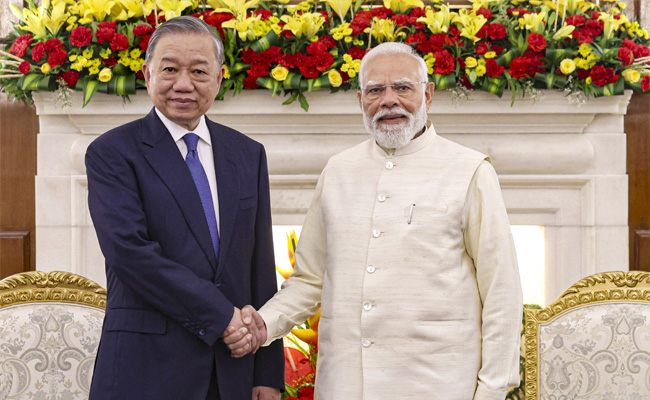
New Delhi (PTI): India and Vietnam on Wednesday elevated their ties to an enhanced comprehensive strategic partnership and set a USD 25 billion annual trade target by 2030 as Prime Minister Narendra Modi and Vietnamese President To Lam held talks focusing on expanding bilateral ties in areas of trade, defence, and critical minerals in the face of increasing geopolitical upheavals.
Following the Modi-Lam meeting, the two sides signed as many as 13 agreements which will provide for deeper two ways engagements in a range of areas including digital payments, rare earth minerals, pharmaceuticals, education, banking and culture.
Modi and Lam also deliberated on the situation in the Indo-Pacific amid China's increasing assertiveness in the region, and agreed to continue to contribute to the rule-of-law, peace, stability, and prosperity.
It is understood that China's growing military muscle-flexing in the South China Sea also figured in the delegation-level talks between the two sides.
Elected as president earlier this month, Lam began his first state visit to India on Tuesday, leading a high-level delegation for a three-day trip.
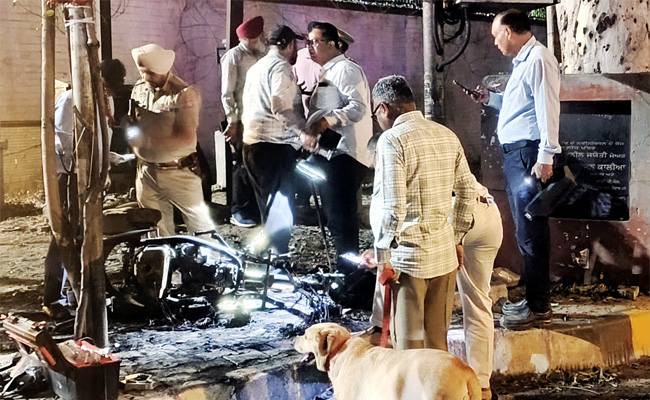
ALSO READ: Explosives used in blast outside Punjab Frontier BSF HQ in Jalandhar: Punjab Police
"A decade ago, Vietnam became India's first comprehensive strategic partner in ASEAN (Association of Southeast Asian Nations) . Since then, our relations have made rapid and comprehensive progress," Modi said in his media statement.
"Building on this strong foundation, today we are elevating our relations to the level of Enhanced Comprehensive Strategic Partnership. We will now advance our partnership to even higher goals," he said.
"Our cooperation will reach new levels in every area ' culture, connectivity, and capacity building, as well as security, sustainability, and supply chain resilience," Modi added.
He noted that the bilateral trade between India and Vietnam has doubled in the last decade to reach USD 16 billion and that the target now is to increase it to USD 25 billion by 2030.
Modi also cited a plethora of agreements signed between the two countries to emphasis that the economic engagement is expected to witness a significant upswing going forward.
"The MoU between our drug authorities will now increase access to Indian medicines in Vietnam. Exports of Indian agricultural, fisheries, and animal products to Vietnam are also set to become easier. Very soon, Vietnam will taste India's grapes and pomegranates," he said.
The two sides also agreed to update the India-ASEAN trade agreement by the end of this year.
"This will provide a new impetus to trade and investment between India and all ASEAN countries. New initiatives in critical minerals, rare earths, and energy cooperation will ensure the economic security and supply chain resilience of both countries," Modi said.
"To boost financial connectivity, we have today decided to enhance cooperation between our central banks. India's UPI and Vietnam's fast payment systems will soon be linked. Furthermore, we are strengthening state-to-state and city-to-city cooperation between the two countries," he noted.
Modi said India is grateful to Vietnam for its strong condemnation of the Pahalgam terrorist attack and standing with India in its fight against terrorism.
"In this era of global turmoil and economic challenges, thanks to their talent, good governance, and economic reforms, India and Vietnam are emerging as the world's fastest-growing economies," he said.
"Now, through our enhanced strategic partnership, we will support each other's rapid growth. As the Buddha's teachings say, 'If you light a lamp for someone else, it also illuminates your own path'," Modi said.
He also described Vietnam a a key pillar of India's Act East Policy and Vision Ocean.
"In the Indo-Pacific region as well, we share a common outlook. Through our strengthening defence and security cooperation, we will continue to contribute to the rule-of-law, peace, stability, and prosperity," he said.
The prime minister said India will broaden its relations with ASEAN with Vietnam's cooperation.
In his remarks, Lam said both sides agreed to deepen political trust and elevate security cooperation.
Last year, the two sides inked a pact to set up a framework for submarine search, rescue and support mechanism. They also signed a letter of intent (LoI) to strengthen bilateral defence industry collaboration.