United Kingdom public tribunal to probe Uighur 'genocide' claims
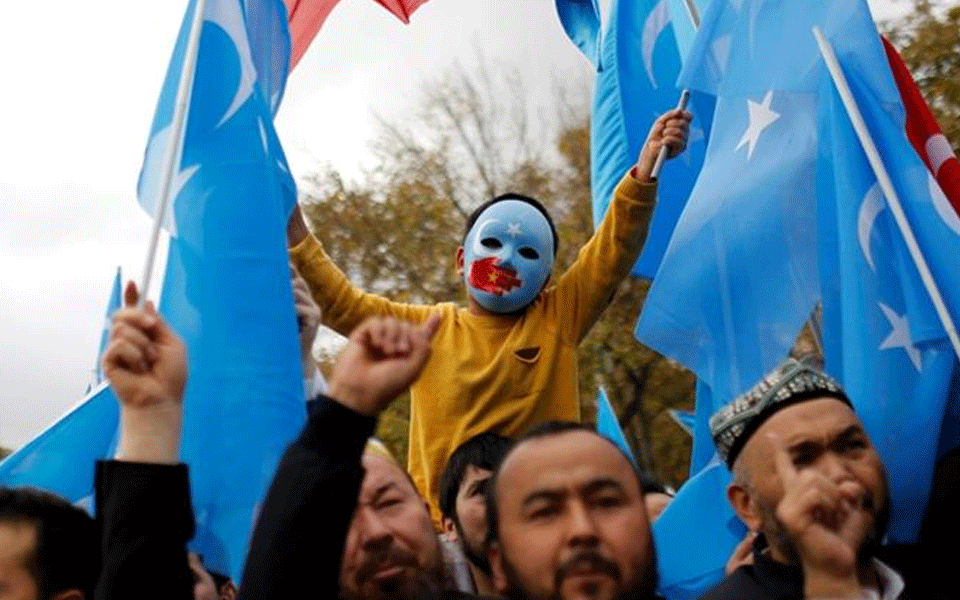
London: A prominent British human rights lawyer is convening an independent tribunal in London to investigate whether the Chinese government's alleged rights abuses against Uighur Muslims in the far western Xinjiang region constitute genocide or crimes against humanity.
The tribunal is expected to reveal new evidence and testimony over several days' hearings next year. While the tribunal does not have government backing, it is the latest attempt to hold China accountable for its treatment of the Uighurs and ethnic Turkic minorities, who have been subject to an unprecedented crackdown since 2017.
Barrister Geoffrey Nice, who previously led the prosecution of ex-Serbian President, Slobodan Milosevic over the Balkans war and worked with the International Criminal Court, was asked by the World Uighur Congress to investigate ongoing atrocities and possible genocide against the Uighur people.
Allegations against China about potential genocide are questions that should be asked and answered but such claims have never been legally scrutinized in public, Nice told The Associated Press.
Organisers are in the initial stages of gathering evidence, and expect to receive a substantial number of submissions from Uighurs exiled abroad over the next few months.
New evidence that may emerge includes testimony from several former security guards who were involved in the Xinjiang detention camps.
At the moment, the strongest evidence would appear to be evidence of incarceration and possibly evidence of enforced sterilization, Nice said.
A recent investigation by the AP found that the Chinese government is systematically forcing birth control on Uighurs and other Muslims in an apparent effort to reduce their population.
The report found that authorities regularly subject minority women to pregnancy checks and force intrauterine devices, sterilisation and abortion on hundreds of thousands.
While scores have been thrown in detention camps for alleged religious extremism, many others were sent to the camps simply for having too many children.
Such enforced sterilization practices could breach the Genocide Convention, Nice said.
The Chinese Embassy in London did not respond to emailed requests for comment. Chinese officials have repeatedly derided allegations of rights abuses in Xinjiang as fabricated, and insist that all ethnicities are treated equally.
China has long suspected the Uighurs, who are mostly Muslim, of harbouring separatist tendencies because of their distinct culture, language and religion.
In a lengthy press conference in August, the Chinese ambassador to the U.K. played graphic videos of terrorist attacks in Xinjiang to show that the Chinese government's measures there are necessary and important.
Ambassador Liu Xiaoming also called allegations about rights abuses in Xinjiang made in Western media lies of the century," and denied that nearly 1 million Uighurs have been detained in Xinjiang.
The London tribunal's judgement is not binding on any government. However, Nice said the process will nonetheless be one way to address the lack of action in tackling the alleged abuses by filling the gap with reliable information.
There is no other way of bringing the leadership of the (Chinese) Communist Party collectively or individually to judgement, Nice said.
In July, lawyers representing exiled Uighur activists filed a complaint with the International Criminal Court against China, asking the court in The Hague, Netherlands, to investigate the forced repatriation of thousands of Uighurs from Cambodia and Tajikistan and alleged genocide in Xinjiang.
However, Beijing does not recognize the international court's jurisdiction, and Nice who is not involved in that case said it will likely focus more on the repatriating countries' culpability and less on that of Chinese authorities.
The World Uighur Congress, an international organization representing Uighur exiles, has provided initial evidence and funding to the London tribunal. Organisers expect to hold two public hearings in London next year.
The tribunal will comprise of at least seven members who will act as jury.
They include British property businessman Nicholas Vetch, one of the organizers. A verdict is expected by the end of 2021.
Joanne Smith Finley at Newcastle University, an expert on Uighur studies, said the tribunal's findings may help pressure governments to impose sanctions such as bans on cotton from Xinjiang.
It does not have any true legal teeth in the sense that its determination will not be able to force any government to take any kind of action, she said.
However, I do think that its determination will be important in terms of putting pressure on the U.K. government and hopefully also other governments to take clear measures to persuade China to desist from these abuses.
Darren Byler, an academic at the University of Colorado, said an independent investigation would add a new perspective to the prevailing U.S.-centric reaction to the issue.
So far the world response to what is happening to the Uighurs and Kazakhs in northwest China has been largely confined to unilateral actions by the United States and been associated with President Trump's more general anti-China position, Byler said.
In July, the Trump administration imposed sanctions on three senior Chinese Communist Party officials for alleged human rights abuses targeting Uighurs, ethnic Kazakhs and other minorities in Xinjiang, including mass detentions and forced population control.
Let the Truth be known. If you read VB and like VB, please be a VB Supporter and Help us deliver the Truth to one and all.
Manipur: Mortal remains of children killed in bomb attack handed over to family
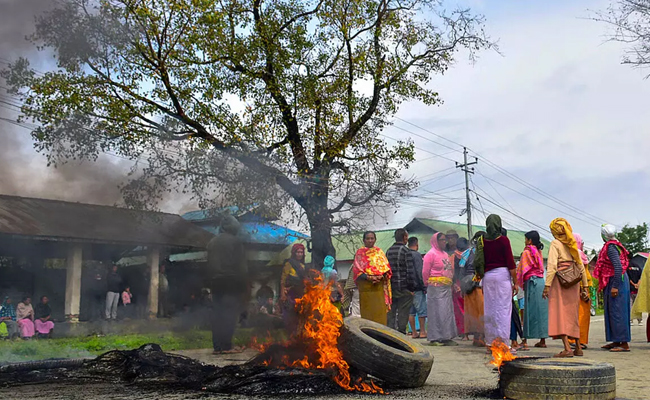
Imphal (PTI): The mortal remains of two children, who were killed in a bomb attack in Manipur's Bishnupur district in April, were handed over to family members on Saturday, officials said.
The bodies of the five-year-old boy and his six-month-old sister were kept in the morgue for 25 days, as the family members had refused to accept the mortal remains, demanding that the perpetrators be brought to book at the earliest.
On April 25, Chief Minister Y Khemchand Singh had appealed to the family members of the children to accept the bodies. Singh had also said that all efforts were underway to find the culprits.
The two children were killed in a bomb attack at Tronglaobi in Bishnupur district on April 7. Their bodies were kept in the morgue at the Regional Institute of Medical Sciences in Imphal.
The incident had triggered widespread violent protests in the five valley districts of Manipur, and the case was subsequently handed over to the NIA.
Hundreds of people lined up along the way to Tronglaobi to offer floral tributes, as the mortal remains were taken for the last rites in an open vehicle earlier in the day.