UN:Sushma discusses strategic cooperation, trade, development at bilaterals
United Nations, Sep 25 : External Affairs Minister Sushma Swaraj met nine leaders from across the globe in a whirlwind of bilateral interactions and spoke at the Nelson Mandela Peace Summit.
She began her day on Monday by attending the high-level event on counter-narcotics convened by US President Donald Trump, where she was seated at the front row.
India is one of 129 countries that have signed the pledge drafted by Trump on commitment towards international fight against drugs.
Although it was not a formal meeting, she greeted Bangladesh Prime Minister Sheikh Hasina when she came to the UN, India's Permanent Representative Syed Akbaruddin tweeted.
Sushma Swaraj met the Foreign Ministers of Australia, Spain, Ecuador, Colombia, Mongolia, Nepal, Morocco, Lichtenstein and Federica Mogherini, the European Union (EU) High Representative for Foreign Affairs.
The topics discussed during the meetings with the foreign ministers depended on the relations with those countries and ranged from strategic cooperation to trade and investment.
Meanwhile, Foreign Secretary Vijay Gokhale participated in the Special Meeting of the Conference on Interaction and Confidence Building Measures in Asia (CICA) -- a 26-member forum for cooperation in promoting peace, security and stability in Asia.
Ruchi Ghanashyam, the Secretary (West), spoke at the Africa Adaptation Initiative High-Level Roundtable. The organisation aims at facilitating finance and cooperation for the continent's development.
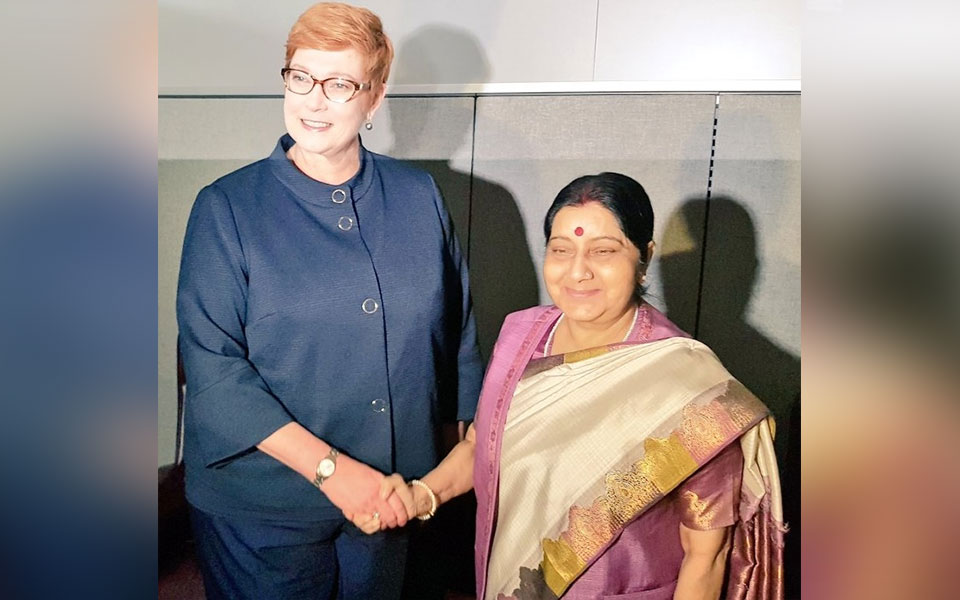
After Sushma Swaraj's meeting with Australian Foreign Minister Marise Payne, External Affairs Ministry spokesman Raveesh Kumar tweeted: "Strategic partnership gaining momentum!"
The two countries have been building up their strategic relations reinforced by the Quadrilateral Security Dialogue that includes the US and Japan.
Closer to home was the meeting with Nepal's Foreign Minister Pradeep Kumar Gyawali, which "took stock of our bilateral relationship", Kumar tweeted.
At the meeting with Ecuador Foreign Minister Jose Valencia Amores, there were "good discussion on ways to further consolidate bilateral relationship in the areas of trade, agriculture, pharma, IT and capacity building", according to Kumar.
Also from Latin America, Colombia's Foreign Minister, the discussions centred on cooperation on trade investment, pharma, mining, petroleum and capacity building, he tweeted.
With Spanish Foreign Minister Josep Borrell, Sushma Swaraj "explored ways to intensify ties in investment, renewable energy, water treatment, tourism and their contribution to our flagship initiatives", according to Kumar.
Mogherini and Sushma Swaraj "discussed issues related to trade and investment and exchanged views on the regional and global issues," Kumar said in a tweet.
He noted that India and the EU were bound by a "strategic partnership based on common values of democracy, freedom and rule of law."
"Celebrating the 25th anniversary of our diplomatic relations" Sushma Swaraj and Lichtenstein Foreign Minister Aurelia Frick "exchanged views on enhancing bilateral relations in trade and investment, particularly through participation at Indian trade fairs and tourism," Kumar tweeted.
On relations with Morocco, he noted that they stretched back to the time of Ibn Battuta, the 14th century explorer, and tweeted that Sushma Swaraj and "Morocco Foreign Minister, Nasser Bourita discussed strengthening cooperation in areas of commerce, pharma, cyber security, defence and culture".
She also met with Mongolian Foreign Minister Damdin Tsogtbaatar. The High-Level General Assembly session begins on Tuesday.
On the sidelines, she was to meet Fiji Prime Minister J.V. Bainimarama and the Foreign Ministers of Iraq, Cyprus, Moldova and Estonia.
Let the Truth be known. If you read VB and like VB, please be a VB Supporter and Help us deliver the Truth to one and all.
Four passengers arrested at BLR airport with hydroponic ganja worth over Rs 21.5 crore
Bengaluru (PTI): Four passengers who arrived from Bangkok at Kempegowda International Airport here were arrested with hydroponic ganja valued at over Rs 21.5 crore in two separate cases, officials said on Saturday.
They were intercepted at Terminal 2 of the airport on May 1, they added.
In the first case, Bengaluru Customs said in a post on ‘X’ that three passengers arriving from Bangkok were intercepted, and 52.68 kg of hydroponic ganja, valued at Rs 18.43 crore, was seized from their baggage.
In a separate case on the same day, another passenger arriving from Bangkok was intercepted, and 9 kg of hydroponic ganja, valued at Rs 3.15 crore, was seized from his baggage.
In both cases, the accused, whose identities have not been disclosed, were arrested under the Narcotic Drugs and Psychotropic Substances (NDPS) Act, officials added.