US and Israel look to Africa for resettling Palestinians uprooted from Gaza
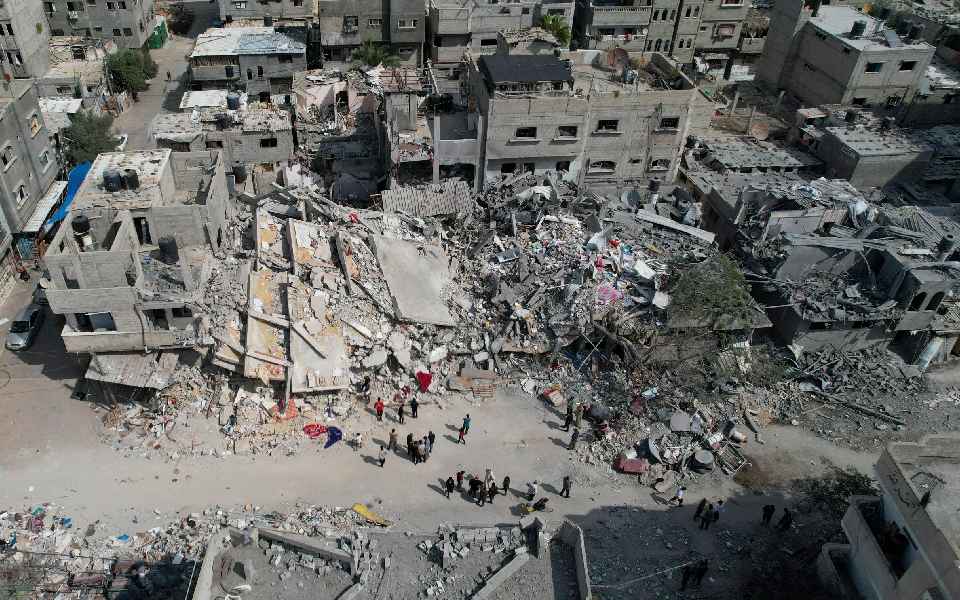
Jerusalem, Mar 14 (AP): The US and Israel have reached out to officials of three East African governments to discuss using their territories as potential destinations for resettling Palestinians uprooted from the Gaza Strip under President Donald Trump's proposed postwar plan, American and Israeli officials say.
The contacts with Sudan, Somalia and the breakaway region of Somalia known as Somaliland reflect the determination by the US and Israel to press ahead with a plan that has been widely condemned and raised serious legal and moral issues. Because all three places are poor, and in some cases wracked by violence, the proposal also casts doubt on Trump's stated goal of resettling Gaza's Palestinians in a “beautiful area.”
Officials from Sudan said they have rejected overtures from the US, while officials from Somalia and Somaliland told The Associated Press that they were not aware of any contacts.
Under Trump's plan, Gaza's more than 2 million people would be permanently sent elsewhere. He has proposed the US would take ownership of the territory, oversee a lengthy cleanup process and develop it as a real estate project.
The idea of a mass transfer of Palestinians was once considered a fantasy of Israel's ultranationalist fringe. But since Trump presented the idea at a White House meeting last month, Israeli Prime Minister Benjamin Netanyahu has hailed it as a “ bold vision.”
Palestinians in Gaza have rejected the proposal and dismiss Israeli claims that the departures would be voluntary. Arab nations have expressed vehement opposition and offered an alternative reconstruction plan that would leave the Palestinians in place. Rights groups have said forcing or pressuring the Palestinians to leave could be a potential war crime.
Still, the White House says Trump “stands by his vision.”
Speaking on condition of anonymity to discuss a secret diplomatic initiative, US and Israeli officials confirmed the contacts with Somalia and Somaliland, while the Americans confirmed Sudan as well. They said it was unclear how much progress the efforts made or at what level the discussions took place.
Separate outreach from the US and Israel to the three potential destinations began last month, days after Trump floated the Gaza plan alongside Netanyahu, according to the US officials, who said that Israel was taking the lead in the discussions.
Israel and the US have a variety of incentives — financial, diplomatic and security — to offer these potential partners. It is a formula that Trump used five years ago when he brokered the Abraham Accords — a series of mutually beneficial diplomatic accords between Israel and four Arab countries.
The White House declined to comment on the outreach efforts.
The offices of Netanyahu and Ron Dermer, the Israeli Cabinet minister and Netanyahu confidant who has been leading Israel's postwar planning, also had no comment.
But Finance Minister Bezalel Smotrich, a longtime advocate of what he calls “voluntary” emigration of Palestinians, said this week that Israel is working to identify countries to take in Palestinians. He also said Israel is preparing a “very large emigration department” within its Defense Ministry.
Here is a closer look at the places the officials say have been approached.
Sudan
The North African country was among the four Abraham Accord nations that agreed to normalize diplomatic relations with Israel in 2020.
As part of the deal, the US removed Sudan from its list of state supporters of terrorism, a move that gave the country access to international loans and global legitimacy. But relations with Israel never took off as Sudan plunged into civil war between government forces and the RSF paramilitary group.
The conflict has been marked by atrocities, including ethnically motivated killing and rape, according to the UN and rights groups. The International Criminal Court is investigating alleged war crimes and crimes against humanity, and then-President Joe Biden's administration in January said the RSF and its proxies were committing genocide.
The US and Israel would be hard-pressed to persuade Palestinians to leave Gaza, particularly to such a troubled country. But they could offer incentives to the Khartoum government, including debt relief, weapons, technology and diplomatic support.
Two Sudanese officials, speaking on condition of anonymity to discuss a sensitive diplomatic matter, confirmed that the Trump administration has approached the military-led government about accepting Palestinians.
One of them said the contacts began even before Trump's inauguration with offers of military assistance against the RSF, assistance with postwar reconstruction and other incentives.
Both officials said the Sudanese government rejected the idea. “This suggestion was immediately rebuffed,” said one official. ”No one opened this matter again.”
Military chief Gen. Abdel-Fattah Burhan told an Arab leaders' summit last week in Cairo that his country “categorically rejects" any plan that aims to transfer "the brotherly Palestinians from their land under whatever justification or name.”
Somaliland
Somaliland, a territory of over 3 million people in the Horn of Africa, seceded from Somalia over 30 years ago, but it is not internationally recognised as an independent state. Somalia considers Somaliland part of its territory.
Somaliland's new president, Abdirahman Mohamed Abdullahi, has made international recognition a priority.
An American official involved in the efforts confirmed that the US was “having a quiet conversation with Somaliland about a range of areas where they can be helpful to the US in exchange for recognition.”
The possibility of US recognition could provide an incentive for Abdullahi to back away from the territory's solidarity with the Palestinians.
The United Arab Emirates, another Abraham Accord country that has developed strong ties with Israel, once had a military base in Somaliland and maintains commercial interests there, including a port. The territory's strategic location, in the Gulf of Aden waterway near Yemen, home to the Houthi rebel group, could also make it a valuable ally.
Over the years, Somaliland has been lauded for its relatively stable political environment, contrasting sharply with Somalia's ongoing struggles amid deadly attacks by al-Qaida-linked group al-Shabab. Since 1991, Somaliland has maintained its own government, currency and security structures. Still, it has one of the lowest income levels in the world.
An official in Somaliland, speaking on condition of anonymity because he was not authorized to talk to the media, said his government has not been approached and is not in talks about taking in Palestinians.
Somalia
Somalia has been a vocal supporter of the Palestinians, often hosting peaceful protests on its streets in support of them. The country joined the recent Arab summit that rejected Trump's plan and seems like an unlikely destination for Palestinians, even if they did agree to move.
Sambu Chepkorir, a lawyer and conflict researcher in Nairobi, Kenya, said it is difficult to understand why Somalia would want to host Palestinians given the country's strong support for Palestinian self-rule.
“The realignments keep changing, and so maybe there is a hidden agenda in why Somalia,” Chepkorir said.
A Somali official, speaking on condition of anonymity because he was not authorized to talk to the media, said the country had not been approached about taking in Palestinians from Gaza and there had been no discussions about it.
Let the Truth be known. If you read VB and like VB, please be a VB Supporter and Help us deliver the Truth to one and all.
Maharashtra sets up state vaccination task force to strengthen immunisation programme

Mumbai (PTI): The Maharashtra government has set up a State Vaccination Task Force to strengthen the regular immunisation programme and review the progress of related campaigns, a health department official said on Monday.
The State Vaccination Task Force will comprise at least 29 members and will be headed by the administrative head of the health department, he informed.
The government has also constituted separate district-level and municipal vaccination task forces to improve implementation and address challenges at the grassroots level, he said.
Municipal task forces, chaired by respective civic commissioners, have been constituted in view of the vast urban population in Maharashtra and the role of civic bodies in implementing different health programmes.
The district-level task forces will function under the chairmanship of collectors.
"Complete immunisation of children at the appropriate age is an extremely simple, cost-effective and highly effective measure to reduce child mortality and the prevalence of diseases among kids. Immunisation is a powerful tool for reducing illness in children," maintained the official.
To ensure full vaccination of all children, the state government implements various campaigns from time to time as per the central government guidelines, he pointed out.
"Active participation and cooperation of other relevant government departments are essential (in making these campaigns successful)," according to the official.
The state-level body will review the regular immunisation programme, associated campaigns and vaccine-preventable diseases in detail. It will also conduct focused assessments of high-risk districts and municipal corporations, including vacancies at district, municipal and sub-district levels, availability of cold chain equipment, resource gaps and training requirements, he noted.
The state task force will review allocation and utilisation of funds for immunisation and ensure timely action by officers concerned based on reports from district and municipal task forces and state-level monitoring mechanisms, the official said.
It will also ensure active coordination and participation of other government departments in immunisation drives, while district and municipal task forces will carry out similar functions at their respective levels, the official added.