US blacklists 6 Chinese entities over balloon programme
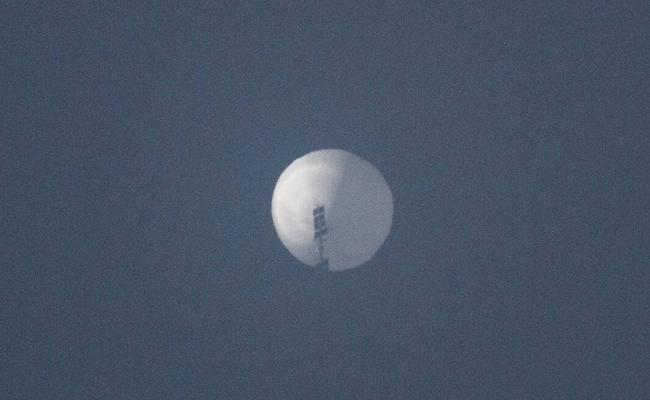
Beijing (AP): The United States on Friday blacklisted six Chinese entities it said were linked to Beijing's aerospace programs as part of its retaliation over an alleged Chinese spy balloon that traversed the country's airspace.
The economic restrictions followed the Biden administration's pledge to consider broader efforts to address Chinese surveillance activities and will make it more difficult for the five companies and one research institute to obtain American technology exports.
The move is likely to further escalate the diplomatic row between the U.S. and China sparked by the balloon, which was shot down last weekend off the Carolina coast. The U.S. said the balloon was equipped to detect and collect intelligence signals, but Beijing insists it was a weather craft that had blown off course.
The incident prompted Secretary of State Antony Blinken to abruptly cancel a high-stakes trip to Beijing aimed at easing tensions.
The U.S. Bureau of Industry and Security said the six entities were being targeted for "their support to China's military modernization efforts, specifically the People's Liberation Army's (PLA) aerospace programs including airships and balloons."
"The PLA is utilizing High Altitude Balloons (HAB) for intelligence and reconnaissance activities," it said.
Deputy Secretary of Commerce Don Graves said on Twitter his department "will not hesitate to continue to use" such restrictions and other regulatory and enforcement tools "to protect U.S. national security and sovereignty."
The six entities are Beijing Nanjiang Aerospace Technology Co., China Electronics Technology Group Corporation 48th Research Institute, Dongguan Lingkong Remote Sensing Technology Co., Eagles Men Aviation Science and Technology Group Co., Guangzhou Tian-Hai-Xiang Aviation Technology Co., and Shanxi Eagles Men Aviation Science and Technology Group Co.
On Friday, a U.S. military fighter jet shot down an unknown object flying off the remote northern coast of Alaska on orders from President Joe Biden. The object was downed because it reportedly posed a threat to the safety of civilian flights, instead of any knowledge that it was engaged in surveillance.
But the twin incidents in such close succession reflect heightened concerns over China's surveillance program and public pressure on Biden to take a tough stand against it. (AP)
Let the Truth be known. If you read VB and like VB, please be a VB Supporter and Help us deliver the Truth to one and all.
KKR defeat LSG via Super Over

Lucknow (PTI): Kolkata Knight Riders edged Lucknow Super Giants via Super Overs in a battle between two bottom-placed teams in the IPL, here on Sunday.
Chasing a modest 156, LSG suffered a batting collapse and managed to tie the contest and take it to Super Over with No. 9 Mohammed Shami striking a last-ball six against a wayward Kartik Tyagi, who leaked 16 runs in the final over.
But Sunil Narine bowled a stunning Super Over conceding just one run and taking two wickets to give KKR an easy target.
Rinku Singh then finished the chase with a boundary off first ball from Prince Yadav.
Earlier the KKR were in deep trouble with 93/7 in 15 overs but Rinku smashed a sensational 83 not out from 51 balls including four sixes in a row in the final over to lift them to 155/7.
Cameron Green (34) was the only other batter to reach double-digit scores as KKR suffered a familiar batting meltdown with Mohsin taking his maiden fifer.
In reply, LSG continued their dismal show with the bat to succumb to their fifth loss in a row.
Brief Scores:
Kolkata Knight Riders 155/7; 20 overs (Rinku Singh 83 not out, Cameron Green 34; Mohsin Khan 5/23). Lucknow Super Giants 155/8; 20 overs (Rishabh Pant 42). KKR won via Super Over.