US delays Huawei ban for 90 days
Washington: US officials have issued a 90-day reprieve on their ban on dealing with Chinese tech giant Huawei, saying breathing space was needed to avoid huge disruption.
A Commerce Department filing said the delay does not change the ban imposed by President Donald Trump on national security grounds, an action with major implications for US and Chinese technology firms.
Instead, it grants a temporary license that will allow Huawei to continue doing business with American firms.
"The Temporary General License grants operators time to make other arrangements and (gives) the Department space to determine the appropriate long term measures for Americans and foreign
telecommunications providers that currently rely on Huawei equipment for critical services," said Secretary of Commerce Wilbur Ross. "In short, this license will allow operations to continue for existing Huawei mobile phone users and rural broadband networks."
The Huawei confrontation has been building for years, as the world's largest company has raced to a huge advantage over rivals in next-generation 5G mobile technology.
US intelligence believes Huawei is backed by the Chinese military and that its equipment could provide Beijing's spooks with a backdoor into the communications networks of rival countries.
For that reason, Washington has pushed its closest allies to reject Huawei technology, a significant challenge given the few alternatives for 5G.
Last week, President Donald Trump declared a "national emergency" empowering him to blacklist companies seen as "an unacceptable risk to the national security of the United States" -- a move analysts said was clearly aimed at Huawei.
At the same time, the US Commerce Department announced the effective ban on US companies selling or transferring US technology to Huawei.
It is the implementation of this ban that was delayed Monday by 90 days. But the Huawei fight is over more than just US national security.
Washington sees Huawei's rise as emblematic of China's drive to wrest global technological and economic leadership from the United States.
Let the Truth be known. If you read VB and like VB, please be a VB Supporter and Help us deliver the Truth to one and all.
Amit Shah holds meeting with Ladakh L-G for smooth ‘darshan’ of Lord Buddha’s relics
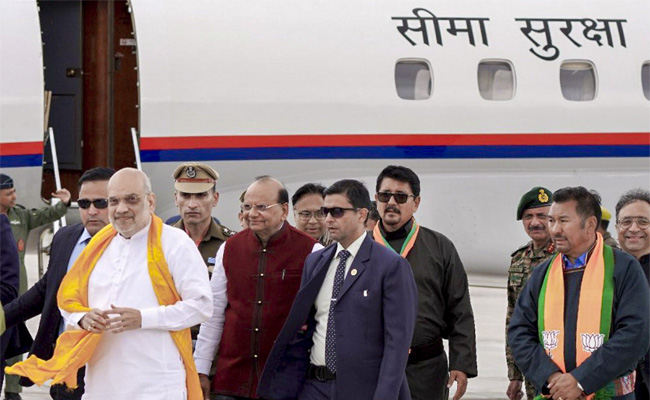
Leh (PTI): Union Home Minister Amit Shah on Thursday took a meeting with Ladakh Lieutenant Governor V K Saxena and senior officials of the Union territory to ensure that people can have 'darshan' of the sacred relics of Lord Buddha for the next two weeks without any inconvenience.
In a message on X, Shah, who reached Leh on Thursday, said that Friday will be a historic day for Ladakh when people can have 'darshan' of the sacred relics of Lord Buddha on the auspicious occasion of Buddha Purnima.
“I consider myself fortunate that I, too, will have the rare opportunity tomorrow to have darshan of these holy relics,” Shah said in the post in Hindi.
"To ensure that these sacred relics are easily accessible for darshan by the people of Ladakh over the next two weeks, I held a meeting today with the lieutenant governor of Ladakh and the concerned officials in this regard,” he said.
Shah is on a two-day visit to Ladakh during which he will attend the first-ever international exposition of the holy relics of Lord Buddha in India, commencing on Buddha Purnima on Friday.
The sacred relics were brought to Leh from Piprahwa in Uttar Pradesh in a special Indian Air Force aircraft on Wednesday by Drukpa Thuksey Rinpoche and Khenpo Thinlas Chosal from the Matho Monastery.
The relics, excavated from Piprahwa (ancient Kapilvastu), will be displayed at Jive Tsal, Choglamsar, from May 2 to 10.
The relics were accorded a ceremonial reception on their arrival in Leh, as people poured out of their homes and gathered along the roads to pay their respect.
The Piprahwa relics refer to ancient sacred remains and associated objects linked to Gautam Buddha, which were discovered at Piprahwa, an archaeological site in Uttar Pradesh near the Nepal border.
The relics have gained renewed global significance in recent years, especially after a collection of associated gems and offerings was repatriated to India in July 2025 from a British family and a private collection, ending over a century of colonial possession.
The relics have been exhibited internationally in several countries; this is the first time they have been brought out from their original place of preservation for exposition within India.
The relics were previously exhibited in Thailand, Mongolia, Vietnam, Russia, Singapore, Bhutan, Sri Lanka and Myanmar, attracting global attention and devotion, according to a statement.
In Ladakh, the relics will be open for public veneration at Jivetsal from May 2 to May 10. They will subsequently be taken to Zanskar on May 11 and 12, followed by exposition at the Dharma Centre in Leh from May 13 to May 14, before being returned to Delhi on May 15, it said.