U.S. Elections 2024 results: Suhas Subramanyam wins Congressional race from Virginia
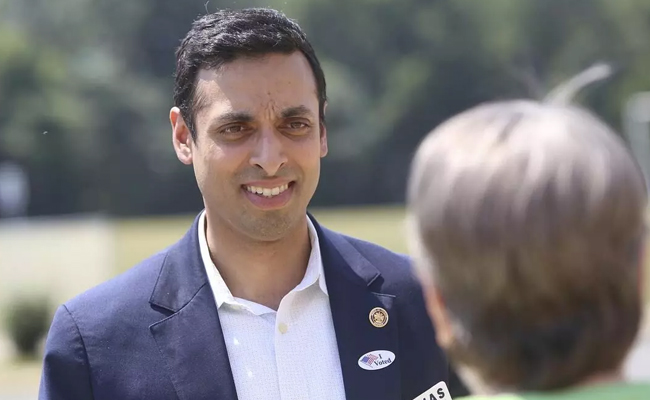
Washington (PTI): Suhas Subramanyam created history by becoming the first Indian American to be elected from Virginia and the entire East Coast.
Running for the US House of Representatives from the 10th Congressional District of Virginia, a Democratic stronghold, Subramanyam defeated Mike Clancy of the Republican Party.
He is currently a Virginia State Senator.
"I am honoured and humbled that the people of Virginia’s 10th District put their trust in me to take on the toughest fights and deliver results in Congress. This district is my home. I got married here, my wife Miranda and I are raising our daughters here, and the issues our community faces are personal to our family. It is an honour to continue serving this district in Washington," Subramanyam said.
He joins the Samosa Caucus in the Congress that currently comprises five Indian Americans – Ami Bera, Raja Krishnamoorthi, Ro Khanna, Pramila Jayapal and Shri Thanedar.
Shri Thanedar was re-elected for the second consecutive term.
He has represented the thirteenth Congressional District of Michigan since 2023.
Raja Krishnamoorthi, representing the seventh Congressional District of Illinois since 2017; was reelected.
Subramanyam’s parents arrived in the US -- through Dulles Airport -- in the late 70s.
“Dulles Airport was like their Ellis Island and when they came here they wanted a better life and we never imagined that someone like me named Suhas Subramanyam could be in the US Congress. But we want to make that a reality, and it starts with people coming out and voting in Virginia in November,” he told PTI in an earlier interview.
"My mom is from Bangalore, and my dad's from Chennai. He spent a lot of time in Secunderabad as well, because his father was in the military, so there was a military base there. They decided to come here to build a good life. My mother in particular really liked the idea of becoming a physician in America,” he said.
“She and my father met in medical school in Bangalore and then came out here in the late 70s. They just taught me a couple of values. One, service is very important, giving back, making a good life. Education is also important. One of the things they also wanted me to do was make sure I stay in touch with my Indian roots as well," he said. "So I would go back to India in the summers all the time. I still have family there. It's very important to me to continue that heritage and really not run just because I'm an Indian American, but I have a lot of ideas I want to do, but run being proud of my background, my heritage,” he had said.
Responding to a question, Subramanian advocated for a strong India-US relationship.
“The US-India relationship is so important because India is one of the most important democracies on earth. And so we want to make sure we have a good relationship with other democracies in the global sphere,” he said.
“The US and India have a naturally strong relationship. A lot of Indian Americans live here. We have a large Indian diaspora. A lot of Indian students come here to study. And a lot of US companies have offices in India. We have a strong economic partnership. I think now we can start to look at what a defence partnership could mean and how we can work together on technology transfer, on just having common strategic defence goals. I think that will be a very important relationship for both countries long term. And it's I think it's something that even setting aside the fact that I'm an American is something that I think will be really good for our country moving forward,” he said.
Let the Truth be known. If you read VB and like VB, please be a VB Supporter and Help us deliver the Truth to one and all.
CM Siddaramaiah alleges ‘criminal conspiracy’ in Sringeri recount, vows legal action
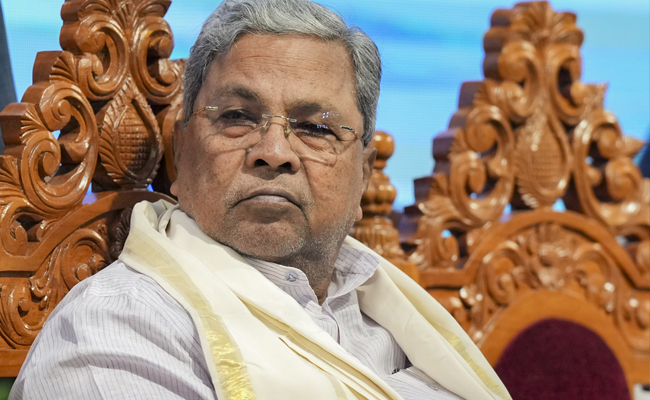
Bengaluru (PTI): Alleging a “criminal conspiracy” by BJP candidate D N Jeevaraj in the Sringeri Assembly poll recounting, Karnataka CM Siddaramaiah on Tuesday said the outcome was manipulated after valid postal ballot votes in favour of Congress leader T D Raje Gowda were tampered with during the recounting process.
Following a Karnataka High Court order on an election petition filed by Jeevaraj, challenging Raje Gowda’s election, the reverification and recounting were conducted on Saturday.
After the reverification and recount of postal ballots for the Sringeri Assembly constituency, votes polled in favour of Raje Gowda were reduced by 255, the returning officer said.
A report on the matter has been submitted to the Election Commission of India for further action, the officer added.
Congress leader Raje Gowda had won the 2023 Assembly polls from Sringeri by 201 votes, defeating his nearest rival Jeevaraj.
Addressing a press conference in Bengaluru, Siddaramaiah said the High Court had directed the recounting of postal ballots and that irregularities were noticed during the exercise conducted on May 2.
“This is a clear case of criminal conspiracy,” Siddaramaiah said, alleging that valid votes cast in favour of Raje Gowda were altered after being accepted by counting agents of all parties, including Congress, BJP, and JD(S).
He claimed that during the recounting of postal ballots, 255 votes were initially accepted as valid by all agents but were later tampered with by subordinate officials.
“There is a second mark on the votes polled in favour of Raje Gowda. They had accepted these as valid votes. Subsequently, another mark was made by officials. This is a clear case of criminal conspiracy,” he said.
When asked who was behind the alleged conspiracy, the CM replied, “It was hatched by Jeevaraj and others. It is planned.”
Siddaramaiah further alleged that the returning officer acted improperly by declaring the result despite the presence of an Election Commission observer during the recounting.
“Immediately after the counting, the returning officer announced the result. He should not have done so; this is against the law,” he said.
He pointed out that Raje Gowda had originally won by 201 votes, but after the recounting, the BJP candidate was declared the winner by 52 votes.
“The BJP has committed a criminal act of conspiracy. This is not vote chori but vote dacoity,” he alleged.
The CM said a police complaint had already been filed by Raje Gowda’s election agent, Sudhir Kumar, and emphasised the need for electoral integrity.
“We want transparency and free and fair elections. That is what our Constitution mandates,” he added.
Stating that the government would pursue legal remedies, Siddaramaiah said, “We are preparing an appeal challenging the returning officer’s announcement in a court of law.”
Responding to a separate query on elections in other states, the CM said there appeared to be an anti-incumbency factor in West Bengal, while results in Tamil Nadu were “surprising,” adding that Vijay’s party was emerging as the largest there.
Following the victory of party candidates in Bagalkote and Davanagere South, Siddaramaiah expressed confidence about future electoral prospects in Karnataka.
“Even in 2028, we will win the Assembly elections. We will come back,” the CM said.
Siddaramaiah added that he would order a forensic examination into the alleged tampering of postal ballots.