US government shutdown extends into next week
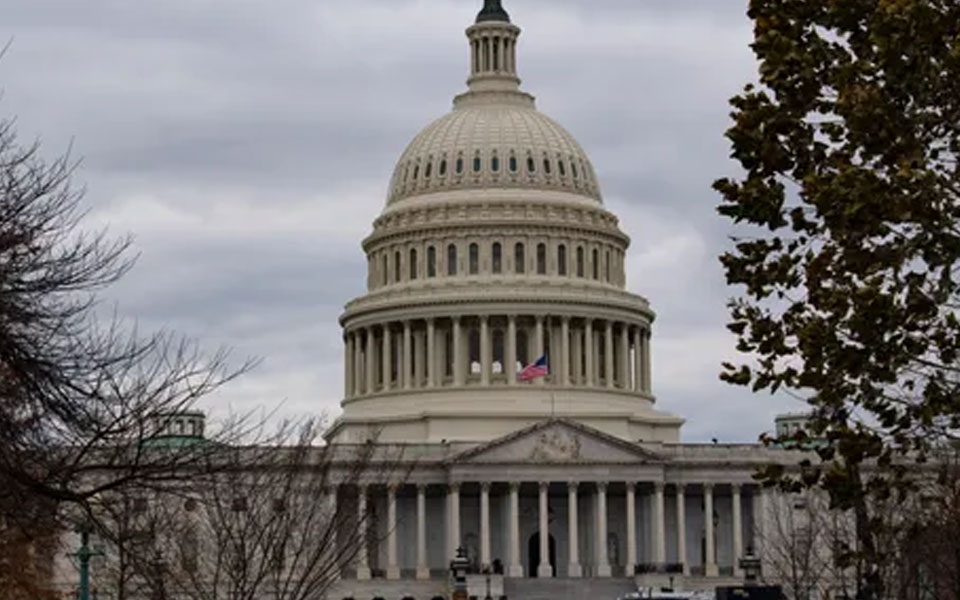
Washington, Dec 28 : The US government partial shutdown was set to stretch deep into next week after legislators failed Thursday to make a breakthrough in the row over President Donald Trump's demand for a US-Mexico border wall.
After convening for just a few minutes following the official Christmas break, a still nearly empty Senate adjourned, deciding to renew budget deliberations only next Wednesday, the last day of the current Republican-controlled Congress.
That would take the government shutdown, already on its sixth day, into 12.
Both sides have dug in, with Democrats refusing to provide USD 5 billion for Trump's border wall project and the president insisting he will not fully fund the government unless he gets the money.
White House spokeswoman Sarah Sanders accused Democrats of "openly choosing to keep our government closed to protect illegal immigrants rather than the American people."
She said Trump "will not sign a proposal that does not first prioritize our country's safety and security." As long as the wall debate holds up approval of a wider spending bill, about 800,000 federal employees are not getting salaries and non-essential parts of the government are unable to function.
Trump made clear he does not intend to give way first.
In a tweet Thursday, he once more accused Democrats of wanting to encourage illegal immigrants, "an Open Southern Border and the large scale crime that comes with such stupidity!" "Need to stop Drugs, Human Trafficking, Gang Members & Criminals from coming into our Country," he said in another tweet, also lambasting "Democrat obstruction of the needed Wall."
Opponents, including some in his Republican party, accuse the president of exaggerating the danger from illegal immigration for his own political gain.
"No end in sight to the President's government shutdown," Dick Durbin, a senior Democratic senator, tweeted.
"He's taken our government hostage over his outrageous demand for a 5 billion border wall that would be both wasteful and ineffective."
Partial government shutdowns are not an unusual weapon in Washington budget negotiations, where party divides make cooperation a rarity.
But the rancour has spiralled under Trump's abrasive administration and is set to go even higher after January 3 when the Democrats take over the House of Representatives, following their mid-term election victory.
The mess has contributed to worries over the outlook for the US economy in 2019, following a surging 2018 performance.
The stock market has plummeted in recent days, before a record recovery on Wednesday, under a variety of factors including Trump's barrage of criticism against the independent Federal Reserve.
Continuing the see-saw performance, Wall Street opened sharply lower Thursday but ended solidly higher on bargain hunting.
Large sections of the nearly 2,000-mile (3,200 kilometre) border with Mexico are already divided by fences and other barriers.
But immigrants -- some fleeing danger and others just looking for jobs -- continue to cross illegally.
Trump's critics say that he is trampling over legally protected asylum rights and argue that resources should be channelled into higher-tech alternatives to a wall.
Managing the flow of illegal border crossers has been complicated by a shift from single men to more vulnerable families, including small children.
Two youngsters from Guatemala have died while in custody of US authorities this month and Homeland Security Secretary Kirstjen Nielsen said that "extraordinary protective measures" were required to handle the flow.
US Customs and Border Protection Commissioner Kevin McAleenan warned Wednesday that the agency was unable to cope with the thousands of arrivals, as most facilities were built decades ago for men arriving alone.
"We need help from Congress. We need to budget for medical care and mental health care for children in our facilities," he told CBS News.
Let the Truth be known. If you read VB and like VB, please be a VB Supporter and Help us deliver the Truth to one and all.
AIITA welcomes Karnataka’s ban on obscene songs in school events

Bhatkal: The Karnataka unit of the All India Ideal Teachers Association (AIITA) has welcomed the Karnataka government’s decision to strictly ban school children from dancing to obscene songs during educational and cultural programmes in government, aided, and private schools across the state.
AIITA Karnataka State President M. R. Manvi congratulated the government for taking what he termed an important step to preserve the sanctity of education.
“Such decisions to safeguard the dignity of school children and uphold the values of education are the need of the hour. This rule should not be limited to government schools alone but must be strictly implemented in all private educational institutions as well,” he said.
He further urged the government to address other concerns within school programmes.
“The government should not only prohibit obscene dances in the name of school anniversaries, but also ensure that plays and dialogues that incite religious hatred are avoided. Schools should be centres of harmony, not platforms for spreading hatred,” he added.
According to a recent circular issued by the Department of School Education and Literacy, obscene dances are adversely affecting the mental health and moral values of students.
In this regard, schools have been advised to use songs that promote nationalism, positive thinking, the greatness of Kannada culture, and value-based traditions instead of inappropriate content during programmes.
The circular also emphasises that students should be dressed in decent attire.
AIITA also backed the department’s warning that disciplinary action would be taken against head teachers if such guidelines are violated. The association has further demanded that district Deputy Directors of Public Instruction strictly monitor the implementation of these rules.