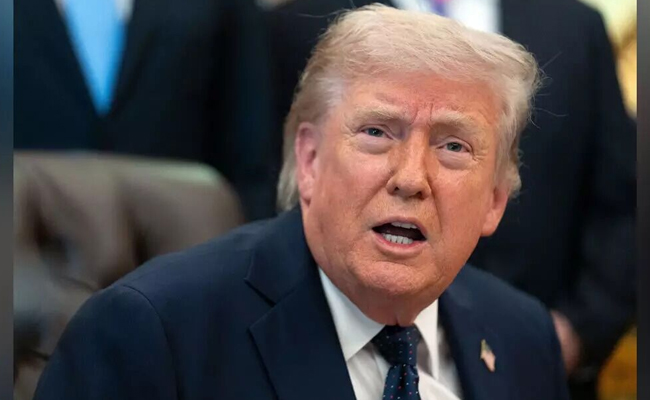
US House votes to curb Trump war power on Iran
Washington: US lawmakers concerned about rushing to war with Iran adopted a measure Thursday aimed at reining in President Donald Trump's ability to take military action against the Islamic republic.
The resolution was introduced by Democrats after Trump's order to kill an Iranian commander and retaliatory missile strikes by Tehran dramatically escalated tensions and raised fears of a devastating war between the two foes.
The mostly symbolic but politically charged vote, 224 to 194, was largely along party lines, with three members of Trump's Republican Party joining Democrats in approving the measure demanding the president not engage in military action against Iran unless authorized by Congress.
Among them was Matt Gaetz, one of Trump's staunchest supporters in Congress who noted in a floor speech that the measure did not criticize Trump, but said that "engaging in another forever war in the Middle East would be the wrong decision."
"If the members of our armed services have the courage to go and fight and die in these wars, as Congress we ought to have the courage to vote for them or against them," Gaetz said.
As lawmakers launched a scalding day-long debate over presidential authority, Trump insisted he needs no one's blessing to launch attacks, essentially scorning existing legal requirements for consulting with Congress.
"I don't have to," Trump said when asked whether he would seek congressional approval for more military action against Iran.
"And you shouldn't have to," he added, "because you have to make split-second decisions sometimes." Trump signaled Wednesday he was stepping back from the brink of war with Iran after a US drone strike that killed commander Qasem Soleimani was followed by Iranian missile volleys against bases housing American forces in Iraq.
But on Thursday he fought back against criticism that he'd ordered the killing, risking all-out conflict, without real justification.
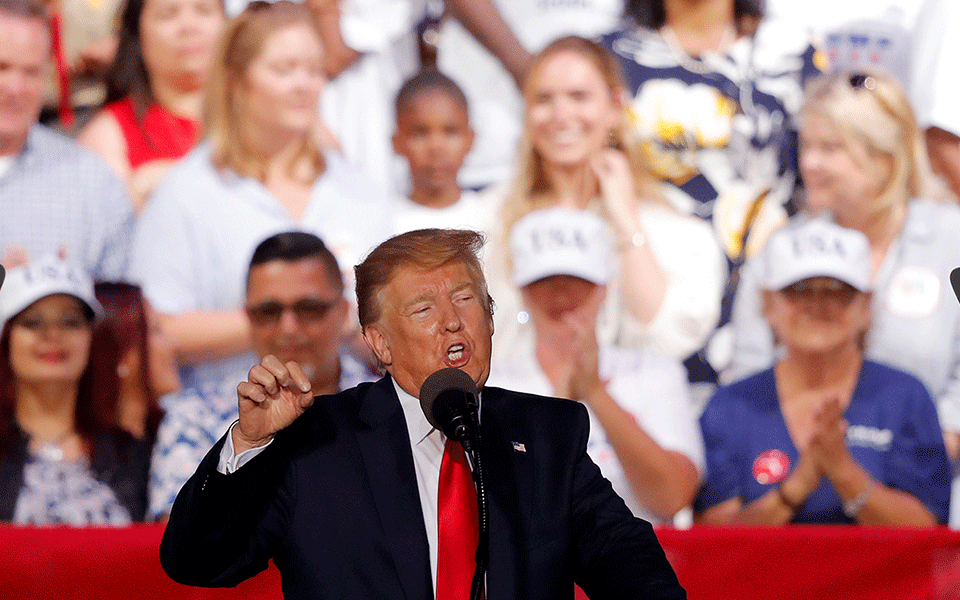
At a reelection campaign rally in Toledo, Ohio, Trump insisted, without providing any evidence, that Soleimani was "actively planning new attacks," including against US embassies, "and we stopped him cold." He ridiculed his Democratic opponents in Congress, calling them insulting names and claimed that if he had consulted with them they would have leaked the secret operation to the "fake news."
"You should get permission from Congress," he said mockingly to mimic the Democratic speaker of the House of Representatives, Nancy Pelosi.
But Democrats, and some Republicans, have expressed deep skepticism about the administration's rationale for Soleimani's killing, and are demanding Congress reassert its power over a commander in chief's use of American military might against another nation.
Citing the War Powers Resolution of 1973 which forbids a president from taking the country to war without congressional approval, the measure "directs the president to terminate the use of United States armed forces to engage in hostilities in or against Iran or any part of its government or military." But the text also provides for key exceptions, allowing use of force to defend against or prevent an "imminent" attack against Americans.
House Speaker Nancy Pelosi, speaking to reporters about the resolution, said Trump "must de-escalate and must prevent further violence. America and the world cannot afford war." The House measure was introduced as a concurrent resolution, a form of legislation that does not carry the weight of law. But as a political instrument it could serve as a rebuke to Trump's foreign policy.
Top House Republican Kevin McCarthy blasted Pelosi's effort as a "show vote" because it cannot become law and will therefore "never limit (Trump's) constitutional authority to defend the American people."
Pelosi said her Democrats were moving forward because their concerns were not addressed in a closed-door briefing to lawmakers Wednesday by Secretary of State Mike Pompeo and other top officials.
Democrats have introduced a similar war powers resolution in the Senate, where it faces a steep climb as Republicans hold a 53-47 majority.
Two Senate Republicans, Mike Lee and Rand Paul, announced support for the Senate version, suggesting the vote, as early as next week, could be razor-thin.
The pair emerged from the top-secret briefing saying administration officials provided no acceptable rationale for killing Soleimani or specific evidence of imminent threats against Americans, and took the "insulting" step of discouraging questions about military policy.
"To come in and tell us that we can't debate and discuss the appropriateness of military intervention against Iran? It's un-American, it's unconstitutional, and it's wrong," Lee told reporters.
During House debate, Democrat Ayanna Pressley rejected what many Republicans described as Trump's inherent military authority, and demanded forthrightness from the administration about reasons for sending US troops into battle.
"We cannot allow our country to be lied into another war," she said.
Let the Truth be known. If you read VB and like VB, please be a VB Supporter and Help us deliver the Truth to one and all.
Mamata visits Bhabanipur EVM strong room, warns against counting irregularities

Kolkata (PTI): West Bengal Chief Minister and TMC supremo Mamata Banerjee early Friday warned against any attempt to tamper with the counting process, hours after she visited an EVM strong room in Bhabanipur, alleging possible malpractice.
Banerjee, who emerged around 12:07 am after spending nearly four hours at the counting centre for her Bhabanipur constituency housed in Sakhawat Memorial School in south Kolkata, said only one person would be allowed inside the designated counting area.
"Either the candidate or one agent can stay upstairs. I have also suggested installation of a CCTV camera for the media," she told reporters.
Stressing the need for transparency, she said, "It is essential to maintain transparency. People’s votes must be protected. I rushed here after receiving complaints. The central forces initially did not allow me to enter."
Sounding a stern note ahead of the May 4 counting, she added, "If there is any plan to tamper with the counting process, it will not be tolerated."
On Thursday evening, Banerjee had reached the Bhabanipur Assembly segment counting centre, which houses the strong room for EVMs used in the April 29 polling, citing suspicion of tampering with the machines.
She entered the premises along with her election agent and remained inside for hours, even as Kolkata Mayor and TMC candidate from the Kolkata Port segment Firhad Hakim reached the spot but could not meet her.
"I reached here upon learning that the chief minister has arrived. But I couldn’t meet her since she was already inside the premises, exercising her right as a candidate to visit strong rooms. I wasn’t allowed there. I will not be able to confirm what exactly is transpiring inside," Hakim said.
The development coincided with protests by TMC candidates Kunal Ghosh and Shashi Panja outside the Khudiram Anushilan Kendra in north Kolkata, where they staged a sit-in alleging irregularities and possible tampering of EVMs stored in strong rooms, leading to face-offs between TMC and BJP supporters.
Earlier in a video message, Banerjee had urged party leaders, workers and polling agents to maintain a 24-hour vigil on EVM strong rooms, alleging that the BJP could attempt to tamper with the machines before counting begins.
Her remarks come amid heightened political tension in the state following a fiercely contested Assembly election, with parties closely monitoring arrangements and raising concerns over transparency.