US lawmakers seek formation of bipartisan commission on origins of COVID-19 virus in China
Washington, Jul 15: A group of Democratic lawmakers in the US has asked the Congressional leadership to establish a bipartisan commission, modelled after the 9/11 panel, on the origins of the COVID-19 virus in China.
The members of the Democratic Blue Dog Coalition, in a letter to House Speaker Nancy Pelosi, House Majority Leader Steny Hoyer, House Minority Leader Kevin McCarthy, Senate Majority Leader Chuck Schumer and Senate Minority Leader Mitch McConnell, said that the commission should be modelled after the 9-11 Commission.
We write to you to express our strong support for the passage of legislation establishing a national commission on the COVID-19 pandemic, modelled on the 2002 legislation creating the National Commission on Terrorist Attacks Upon the United States, also known as the 9-11 Commission, the Democratic Blue Dog Coalition wrote on Tuesday.
The 9-11 Commission was set up on November 27, 2002, "to prepare a full and complete account of the circumstances surrounding the September 11 attacks", including preparedness for and the immediate response to the attacks.
The COVID commission would consist of 10 well-respected individuals, five appointed by Democrats and five appointed by Republicans, and would be supported by a non-partisan staff of subject-matter experts, they proposed.
The commission would examine how COVID-19 emerged and spread in the United States; evaluate the United States' preparedness for and response to the pandemic; and issue a report providing Congress, the President, and the American people with a full accounting of what occurred," the letter said.
It will also recommend concrete steps the US public and private sector can take to prevent, prepare for, respond to, and mitigate the harmful impact of future pandemics, they said.
According to lawmakers, the purpose of the commission would not be to point fingers or assign blame, but rather to make the United States stronger and more resilient if we face another pandemic.
Importantly, as part of its mandate, the commission would build on the work that is currently being conducted by the intelligence community and other components of the federal government to investigate the precise origins of COVID-19 in China.
Understanding exactly how COVID-19 originated and how its initial spread began is critical to creating an accurate historical account of the pandemic and is vital to helping the United States prepare for future pandemics," they wrote.
"The Chinese government will predictably object to this effort to learn the truth. Its objections should be noted and then disregarded, the letter said.
In the wake of both the 9-11 attacks and the 2007-2008 financial crisis, Congress came together on a bipartisan basis to establish independent commissions to learn from the past and prepare for the future," they said.
"It would be unthinkable if Congress were not to follow this sound precedent and establish a commission to investigate a pandemic that has already claimed the lives of more than 600,000 Americans and upended our nation's economy, said the Democratic Blue Dog Coalition.
The origins of the COVID-19 remain a widely debated topic, with some scientists and politicians maintaining that the possibility of a lab leak of the deadly virus exists.
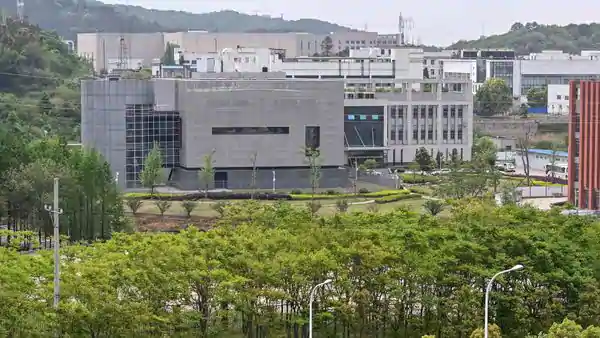
China's Wuhan Institute of Virology (WIV) is near the outbreak's known epicentre of Huanan Seafood Market in Wuhan, where the virus first emerged in late 2019 and became a pandemic.
More than 187 million confirmed cases have since been confirmed worldwide and at least 4.03 million deaths reported.
China has been accused of withholding raw data and access to sites that would aid deeper investigation into how the virus came into being, and how it first spread.
US President Joe Biden in May directed the country's intelligence agencies to report in the next three months on whether COVID-19 emerged from an animal or during a laboratory accident.
However, Beijing has maintained there is no connection between the pandemic origins and the Wuhan lab and sought to dismiss the issue of a possible leak as an absurd story".
China asserts that the COVID-19 broke out in different places in the world and China only reported the virus first.
Let the Truth be known. If you read VB and like VB, please be a VB Supporter and Help us deliver the Truth to one and all.
Two injuries, one DNF, a DQ as India end messy World Relays campaign
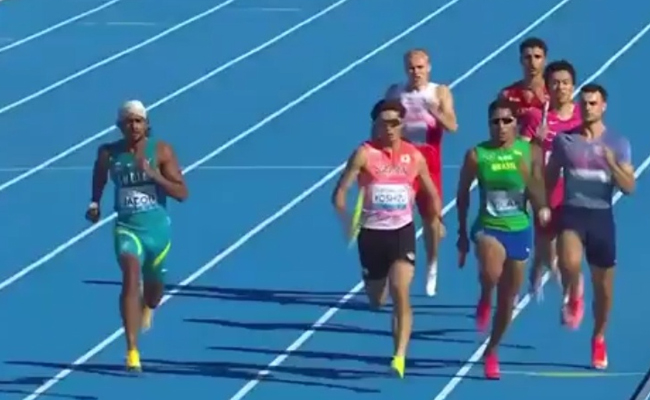
Gaborone (Botswana) (PTI): Amoj Jacob and Ragul Kumar got injured during the men's 4x400m and 4x100 races respectively as India ended their World Athletics Relays campaign in disappointment on the second day of competitions here on Sunday.
The Indian camp had high hopes of making the 2027 World Championships in the men's 4x400m relay but the team did not finish (DNF) the race as Jacob suffered cramps and pulled out of the race after taking the baton from the first leg runner Dharamveer Choudhary. Rajesh Ramesh and Vishal TK were to run in the third and fourth legs.
Those teams which could not qualify for the 2027 Beijing World Championships by reaching the final round of each of the six relay events on Saturday were given another chance in the second qualification round on Sunday.
The top two teams in each of the two heats (in all six relay events) booked the Beijing ticket on Sunday.
India will now have to try and qualify for the World Championships through the Top Lists of the World Athletics, which is a long and tedious process.
In the men's 4x100m race, third leg runner Ragul Kumar fell down the track after failing to hand over the baton inside the exchange zone to fourth leg runner Gurindervir Singh, which clearly showed the lack of coordination among the runners.
Harsh Santosh Raut and Animesh Kujur ran the first two legs.
The Indian quartet was disqualified and Kumar was seen being taken away from the Field of Play with the help of the volunteers.
It was a comedy of errors in the case of the women's 4x100m race, which saw the baton being dropped during an exchange between first leg runner Tamanna and second runner Nithya Gandhe, though the Indians finished the race in 53.09 seconds.
Gandhe started running quite a distance, but after realising that the baton was not in her hand, she turned and ran back to pick it up.
The only silver-lining for the Indian contingent was the national record time in the mixed 4x100m relay race, though the quartet of Ragul Kumar, Nithya Gandhe, Animesh Kujur and Sneha SS finished sixth in heat number two with a time of 41.35 seconds, bettering the previous national mark of 42.30 seconds set in March in Chandigarh.
The mixed 4x400m relay quartet of Theerthesh P Shetty, Kumari Saloni, Nihal William and Rashdeep Kaur ended at fifth in heat number one with a time of 3 minutes and 19.40 seconds.
On Saturday, all the five Indian relay teams had failed to make it to the respective final rounds and thus missed out on the 2027 World Championships berths.