US military operation in Venezuela disrupts Caribbean holiday travel, hundreds of flights cancelled
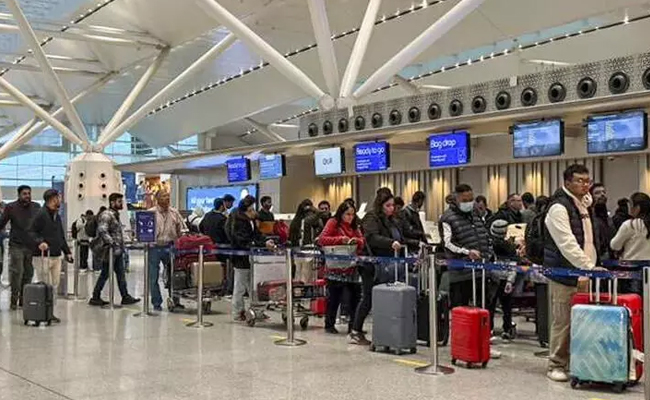
Washington (AP): The US military operation that captured Venezuelan President Nicolás Maduro and flew him out of the country early Saturday also disrupted Caribbean travel at a busy travel time for the region.
No airline flights were crossing over Venezuela that day, according to FlightRadar24.com. And major airlines cancelled hundreds of flights across the eastern Caribbean region and warned passengers that disruptions could continue for days after the Federal Aviation Administration imposed restrictions.
Flights were cancelled to and from Puerto Rico, the Virgin Islands, Aruba and more than a dozen other destinations in the Lesser Antilles island group north of Venezuela. Airlines waived change fees for passengers who had to reschedule flights.
ALSO READ: Congress and NCP (SP) to contest separately in Nagpur civic polls
But US Transportation Secretary Sean Duffy said Saturday night that the restrictions would end at midnight EST and airlines would be able to resume normal operations Sunday.
Southwest Airlines said in a statement that it added six extra round-trip flights to Puerto Rico on Sunday's schedule and another eight round-trips on Monday to help get travellers home from their vacations. It also added two additional Sunday flights to Aruba.
At the Queen Beatrix airport in Aruba, a popular holiday destination for US vacationers just 15 miles (24 kilometres) off Venezuela's coast, officials said they expected a return to normal Sunday after a day of cancelled flights that stranded travellers or blocked them from flying to the island.
In Barbados, Prime Minister Mia Mottley said at a news conference that “the consequences of the conflict have been exceedingly disruptive to both of our ports of entry,” an airport as well as a seaport from which cruise ships sail.
In Puerto Rico, Lou Levine, his wife and their three children were due to return to the Washington, DC, area Saturday morning, but he woke up to his wife saying their flight was cancelled. He found out why when he checked his phone.
They first tried calling JetBlue to reschedule. The airline called back about two hours later, but the agent was not able to help them. Levine and his wife saw others messaging JetBlue on social media and did the same. The airline responded and booked them on a flight Saturday, turning their weeklong New Year's holiday into a two-week sojourn.
Levine, a manager at a software company, said he is fortunate to have a flexible and understanding employer. But his daughter will be missing a week of high school. And then there are the unexpected expenses.
“I love it here. But we have dog-sitting and cat-sitting and car rental. It's fine. It's just really painful on the wallet,” Levine said.
The Levines hoped to book an earlier trip back if possible.
This weekend was already past the peak 13-day holiday period when AAA projected that 122.4 million Americans would travel at least 50 miles (80 kilometres) from home, but there were plenty of travellers still trying to squeeze in some more time on tropical beaches before heading back to colder temperatures.
“The Caribbean is a top destination this time of the year,” AAA spokesperson Aixa Diaz said. “We do have a lot of people who are trying to get back home this weekend ahead of work and school on Monday.”
Diaz said “it's understandable we want to unplug,” but travellers should keep track of what's going on and allow airlines to send them phone alerts.
An announcement by Luis Muñoz Marín International Airport in San Juan, Puerto Rico, that was posted on the social platform X said restrictions were put in place because of the “security situation related to military activity” in Venezuela.
As a result, nearly 60 per cent of all flights to and from that airport were canceled Saturday, according to FlightAware.com.
Foreign airlines and military aircraft were not included in the restriction, the statement said. Air Canada said its flights to the Caribbean were operating normally, though it gave travellers an option to rebook. Another Canadian airline, WestJet, said it cancelled Aruba flights “out of an abundance of caution.”
All major US airlines cancelled flights across the Eastern Caribbean Saturday because of the restrictions and adjusted their schedules.
Nearly two dozen island destinations were affected by the cancellations, including Anguilla, Antigua, Curacao, St. Lucia and the US and British Virgin Islands. But destinations farther to the west like the Dominican Republic and Jamaica were generally not affected.
New York-based JetBlue said it cancelled about 215 flights “due to airspace closures across the Caribbean related to military activity.”
Dutch airline KLM said it too cancelled flights affecting thousands of passengers but planned to resume service Sunday to and from Curacao, Aruba, Bonaire and other islands.
The flight disruptions also affected some travellers booked for Caribbean cruises. Cruise operator Virgin Voyages said airline travellers unable to make it to San Juan in time for an upcoming cruise departure would be able to get a full credit for a future trip.
Let the Truth be known. If you read VB and like VB, please be a VB Supporter and Help us deliver the Truth to one and all.
26-year-old youth from Andhra dies by suicide in US
Kurnool (Andhra Pradesh) (PTI): A 26-year-old youth from this district has died allegedly by suicide in Chicago, US, recently, due to distress over debt, sources said on Saturday.
The family members of the deceased have requested that the identity of their relative be withheld, noting that his parents are senior citizens suffering from medical conditions.
Reacting to the incident, Andhra Pradesh IT Minister Nara Lokesh expressed condolences and assured assistance for the repatriation of the mortal remains of the deceased.
"My heartfelt condolences to the bereaved family. I request Union Aviation Minister K Ram Mohan Naidu to ensure smooth and hassle-free transport of the mortal remains," Lokesh said in a post on X.
An NRI community member from the US posted on social media that one of their members from Kurnool on Optional Practical Training (OPT) passed away in Chicago a few days ago.
He said Telugu Association of North America (TANA) had completed all necessary documentation and formalities to send the mortal remains to India for final rites.
He further requested assistance in expediting the cargo pickup, currently scheduled for Sunday, seeking an earlier arrangement considering the urgency.
(Assistance for overcoming suicidal thoughts is available on the state’s health helpline 104, Tele-MANAS 14416.)