US moves draft resolution in UN to blacklist JeM chief Masood Azhar
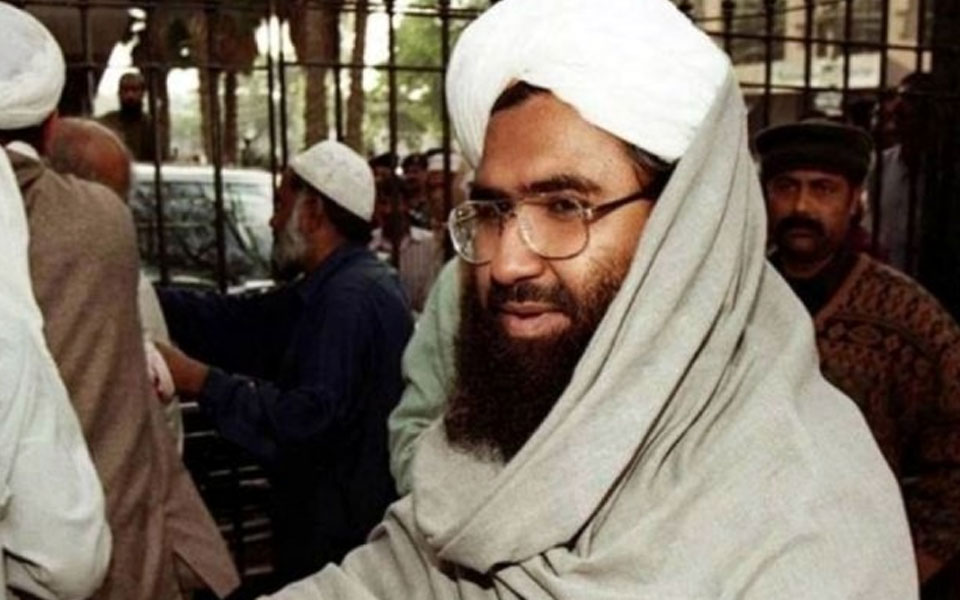
United Nations: Stepping up the international pressure to designate Jaish-e-Mohammed chief Masood Azhar as a global terrorist, the US, supported by France and the UK, has moved a draft resolution in the UN Security Council to blacklist the Pakistan-based terror group's chief.
Two weeks after China put a hold on a proposal to list Azhar under the 1267 Al Qaeda Sanctions Committee of the Council, the US on Wednesday circulated the draft resolution to the powerful 15-nation Council to blacklist the leader of the Pakistan-based terror group and subject him to a travel ban, an assets freeze and an arms embargo.
UN sources told PTI that this is the "first time" the US, the UK and France have moved a draft resolution directly in the Security Council to designate Azhar. The previous have been listing proposals in the Sanctions Committee of the Council to designate Azhar.
Unlike a listing proposal, which is generally under a 10- day no objection period, the draft resolution is not under any no-objection provision.
Sources said that the draft resolution will be discussed informally and then it goes to the Council.
However, it's not yet decided by when a vote would be held on the draft resolution, during when it could again face a veto by China, which has in the past blocked bids to blacklist Azhar.
Sources said the draft resolution would condemn "in the strongest terms the heinous and cowardly suicide bombing" on February 14 in Jammu and Kashmir's Pulwama district that killed 40 CRPF personnel.
An annex to the draft resolution says Azhar is associated with the Islamic State terror group, Al-Qaida for "participating in the financing, planning, facilitating, preparing, or perpetrating" or "supplying, selling or transferring arms and related material" or supporting acts of Jaish-e-Mohammed (JeM).
It says that Azhar founded JeM after his release from prison in India in 1999 in exchange for 155 hostages held on an Indian Airlines flight that had been hijacked to Kandahar, Afghanistan.
It adds that Azhar was previously the leader of the terrorist group Harakat al Mujahadin, also known as Harakat ul-Ansar, and that most of these groups' members subsequently joined Jaish under Azhar's leadership.
In 2008, JeM recruitment posters contained a call from Azhar for volunteers to join the fight in Afghanistan against Western forces.
The Sanctions Committee makes its decisions by consensus of its members. However, for a resolution in the Security Council to pass, it needs nine votes in favour and no vetoes from any of its five permanent members - China, Russia, the United States, France and the UK.
France, the UK and the US on February 27 moved a proposal to designate Azhar under the 1267 Al Qaeda Sanctions Committee.
It was under the no-objection period and Committee members had a period of 10 working days to raise any objections to the proposal.
More than a dozen member states had co-sponsored the proposal. About an hour before the no-objection deadline was to expire on March 13 at 3 PM, China blocked the proposal by putting a hold on it.
India expressed disappointment by the outcome, saying in a statement "this has prevented action by the international community to designate the leader of JeM, a proscribed and active terrorist organisation which has claimed responsibility for the terrorist attack in Jammu and Kashmir on 14 February 2019".
Meanwhile, US Secretary of State Mike Pompeo made an apparent reference to China blocking the proposal to designate Azhar as a global terrorist at the UN Security Council when he said Wednesday that China abuses over a million Muslims at home, but "protects" violent Islamic terror groups from UN sanctions.
"The world cannot afford China's shameful hypocrisy toward Muslims. On one hand, China abuses more than a million Muslims at home, but on the other it protects violent Islamic terrorist groups from sanctions at the UN," Pompeo said in a tweet, without mentioning the JeM or the outfit's chief.
The February proposal was the fourth such bid at the UN in the last 10 years to list Azhar as a global terrorist.
In 2009, India moved a proposal by itself to designate Azhar. In 2016 again India moved the proposal with the P3 - the US, the UK and France in the UN's 1267 Sanctions Committee to ban Azhar, also the mastermind of the attack on the air base in Pathankot in January, 2016.
In 2017, the P3 nations moved a similar proposal again. However, on all occasions China, a veto-wielding permanent member of the Security Council, blocked the proposals from being adopted by the Sanctions Committee.
A UNSC designation will subject Azhar to an assets freeze, travel ban and an arms embargo. An assets freeze under the Sanctions Committee requires that all states freeze without delay the funds and other financial assets or economic resources of designated individuals and entities.
The travel ban entails preventing the entry into or transit by all states through their territories by designated individuals.
Under the arms embargo, all states are required to prevent the direct or indirect supply, sale and transfer from their territories or by their nationals outside their territories, or using their flag vessels or aircraft, of arms and related materiel of all types, spare parts and technical advice, assistance or training related to military activities, to designated individuals and entities.
Let the Truth be known. If you read VB and like VB, please be a VB Supporter and Help us deliver the Truth to one and all.
Ladakh a living land of dharma for centuries: Amit Shah
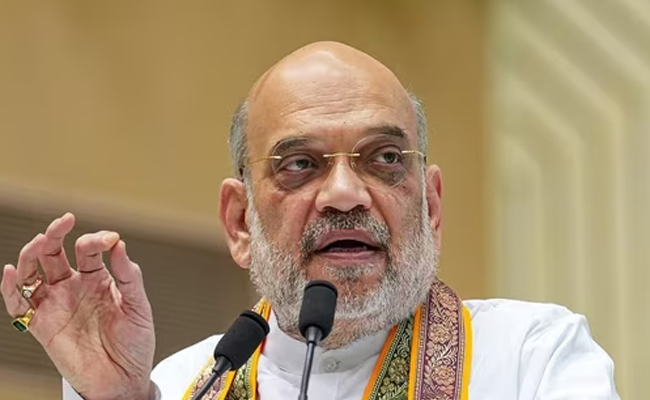
Leh/Jammu (PTI): Union Home Minister Amit Shah on Friday described the return of sacred relics of Lord Buddha to Ladakh after 75 years as a "historic reunion" and said that the Union Territory has remained a "living land of dharma", preserving and nurturing Buddhist knowledge for centuries.
Stressing the relevance of Buddha's teachings in modern times, Shah said the message of peace, compassion and the middle path was even more important today than it was 2,500 years ago.
"Ladakh has been a living land of dharma for centuries. When the Dalai Lama comes here, he says this land is not merely a geographical land but a living laboratory of Buddhist culture and compassion," Shah said, speaking after the inauguration of the sacred holy relics exposition of Tathagata Buddha and the 2569th Buddha Purnima celebrations at Jivetsal in Leh during his two-day visit to Ladakh.
Calling Ladakh a land of compassion, he said this land has preserved and nurtured knowledge. "Whenever Buddhism faced crises, this land worked to protect the teachings of Buddha. And when peace returned, it helped to expand and carry forward that preserved wisdom," he added.
"Unless one internalises knowledge and makes it a part of oneself, liberation is not possible. Knowledge is incomplete without spiritual practice, while spiritual practice without knowledge is blind. Therefore, the union of spiritual practice and knowledge is the right path. Even after all this, if there is no moral discipline, one cannot lead a truly wise life. The basis of a life of wisdom is moral discipline," he said.
Shah said it was through Ladakh and adjoining routes that the teachings of Tathagata Buddha, which originated in India, spread to China and several other countries.
"The message that emerged from the land of Ladakh has become a guiding force for many people around the world to take their lives forward. The presence of these sacred relics in Ladakh reminds us that India's civilisation has, for thousands of years, given the message of peace and coexistence," he said.
He said that in a diverse region like Ladakh and Kargil, this message becomes even more relevant. "This heritage still tells us today that amidst conflict and unrest, only the path of peace and compassion can provide solutions."
He said the return of the relics on Buddha Purnima had enhanced the significance of the festival for the people of Ladakh.
"These sacred relics have come to Ladakh after 75 years. It is as if Buddha himself is present here today," Shah said, adding that followers of Buddhism and people of other faiths in Ladakh and Kargil would draw spiritual energy from the relics.
Highlighting Ladakh's role in the spread of Buddhism, Shah said Kashmir was once an ancient centre of Buddhist studies, Mahayana philosophy and Buddhist art, from where Ladakh first came into close contact with Buddhism.
He said Emperor Ashoka's envoys laid the foundation of Buddhist influence in Ladakh through Kashmir and Gandhara, while Mahayana Buddhism expanded in the region during the Kushan period between the first and third centuries CE.
The Silk Route linking Kashmir, Leh, Yarkand, Khotan and Tibet became a channel not only for trade but also for ideas, monks, manuscripts and artistic traditions, Shah said.
He added that later, Tibetan influence between the seventh and tenth centuries further enriched Ladakh through Mahayana and Vajrayana traditions.
Stressing the relevance of Buddha's teachings in modern times, Shah said the message of peace, compassion and the middle path was even more important today than it was 2,500 years ago.
"Amid conflict and unrest, only the path of peace and compassion can provide solutions," he said.
Shah also appealed to the Ladakh administration to ensure complete arrangements so that followers of all faiths, especially Buddhists, could visit and pay obeisance to the relics.
#WATCH लेह, लद्दाख: केंद्रीय गृह मंत्री अमित शाह ने कहा, "जब दलाई लामा यहां आते हैं तो वे कहते हैं कि यह भूमि केवल भौगोलिक भूमि नहीं है। यह भूमि बौद्ध संस्कृति और करुणा की जीवंत प्रयोगशाला है। इस भूमि पर ज्ञान का संरक्षण हुआ है... भारत की सभ्यता हजारों वर्षों से शांति का संदेश… https://t.co/2nwG0w2CE6 pic.twitter.com/W13itRBqeX
— ANI_HindiNews (@AHindinews) May 1, 2026