US paid Pakistan billions, they never said bin Laden was living there: Trump
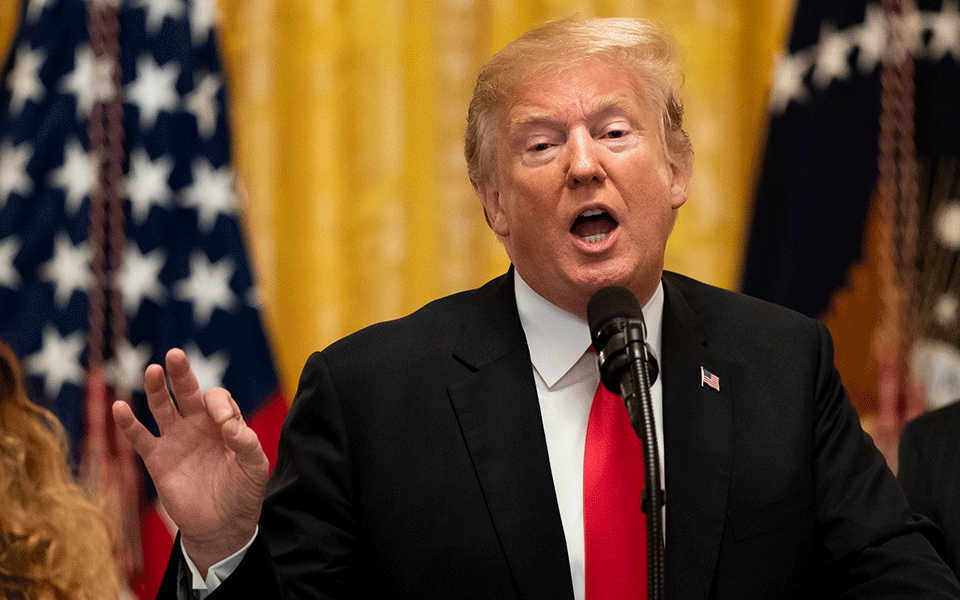
Washington, Nov 19: Continuing his tirade against Pakistan, President Donald Trump on Monday said the US has paid Islamabad billions of dollars but it never told the Americans that the Al Qaeda leader Osama bin Laden was living in that country.
In an interview to a television news channel on Sunday, Trump had defended his administration's decision to stop hundreds of millions of dollars in military aid to Pakistan for not doing enough to curb terrorism and criticised Islamabad for offering a hideout to Al Qaeda chief Osama bin Laden in the garrison city of Abbottabad.
"We paid Pakistan Billions of Dollars and they never told us he was living there. Fools!..," Trump said in a tweet, a day after he told Fox News in an interview that Laden should have been captured long before.
"We no longer pay Pakistan the $Billions because they would take our money and do nothing for us, Bin Laden being a prime example, Afghanistan being another," Trump said.
"They were just one of many countries that take from the United States without giving anything in return. That's ENDING!" he said.
Beginning with a tweet on January 1, the US President has announced stop giving military and security assistance to Pakistan.
Trump believes that the Pakistan has been a reluctant partner of the US in the war against terrorism and that it has misused the US money.
Trump insisted that Bin laden should have been captured long time back before he was killed in a daring raid in Abbottabad.
"Of course we should have captured Osama Bin Laden long before we did. I pointed him out in my book just BEFORE the attack on the World Trade Centre. President Clinton famously missed his shot," Trump said.
Let the Truth be known. If you read VB and like VB, please be a VB Supporter and Help us deliver the Truth to one and all.
NIA court to complete framing of charges against 2010 hand-chopping case accused on May 15
Kochi (PTI): A special court here will complete proceedings for framing charges against the prime accused in the 2010 hand-chopping case involving professor T J Joseph, in which PFI activists were accused of attacking him at Muvattupuzha.
Ernakulam Special Court for NIA cases judge P K Mohandas, on April 30, heard the arguments of counsel for accused Savad and Shafeer C and decided to proceed with framing charges against the duo.
A group chopped off Thodupuzha Newman College professor Joseph's right hand in July 2010, accusing him of religious blasphemy in a question paper he had prepared.
The case, later taken over by the National Investigation Agency (NIA), resulted in the conviction of 19 accused.
The first accused, Savad, who allegedly chopped off Joseph’s palm, was arrested in Berram in Mattannur, Kannur, in January 2024, where he had allegedly been hiding under the pseudonym Shajahan.
The NIA also arrested Shafeer, who allegedly arranged shelter and provided logistical support to Savad at Chakkad and Mattannur in Kannur since 2020.
On April 30, the court heard the counsel for the accused and the NIA prosecutor on framing charges against the duo.
"On going through the documents and evidence in the case and on hearing the counsel for the accused and the prosecutor, I am of the opinion that there are grounds for presuming that the first accused has committed offences punishable under provisions of the IPC, the Explosive Substances Act and the Unlawful Activities (Prevention) Act, and that the second accused has committed offences punishable under the IPC and the UAPA, and there are materials for framing charges under these provisions against the accused," the court said.
The court directed that Savad be produced and Shafeer, who is on bail, appear before it on May 15 for recording their pleas as part of the charge-framing process.
After framing the charges, the court will schedule the trial in the case.