US presidential panel discusses issuing work permits to those waiting for Green Card for over 5 yrs

Washington (PTI): A presidential advisory commission has discussed the possibility of issuing employment authorisation cards in the early stages of Green Card application, a move if approved by the Biden administration would end the agonising wait for the Permanent Resident Card for highly skilled foreign-born workers, including Indians.
A Green Card is a document issued to immigrants to the US as evidence that the bearer has been granted the privilege of residing permanently.
The recommendation proposes that the Department of Homeland Security's US Citizenship and Immigration Services (DHS-USCIS) grant employment authorisation documents (EADs) and travel documents to individuals who have approved I-140 employment-based visa petitions in the EB-1, EB-2, EB-3 categories.
And also who have been waiting in the visa backlog for five or more years regardless of whether they have filed applications for adjustment of status.
Members of the President's Advisory Commissioner for Asian American Native Hawaiian and Pacific Islander commission on Tuesday held a detailed discussion on the proposal moved by an eminent Indian-American community leader and its member Ajay Jain Bhutoria, who in his presentation highlighted the challenges faced by H-1B visa holders in the United States.
The H-1B visa is a non-immigrant visa that allows US companies to employ foreign workers in speciality occupations that require theoretical or technical expertise.
Technology companies depend on it to hire tens of thousands of employees each year from countries like India and China.
During the meeting, which was webcast live, members of the commission sought further information on this recommendation and decided to bring it up in the next full commission meeting.
Bhutoria said such a move would benefit the US by ensuring that the country can continue to attract and retain global talent in science, technology, engineering, and mathematics (STEM) and by improving the lives of many foreign-born scientists, engineers, and physicians.
The recommendation comes at a time when highly skilled foreign-born workers, including Indians, face long waits for their immigrant visas to be processed during which they may lose out on job opportunities or be forced to leave the country because their prior non-immigrant visas have expired.
By granting EADs to these individuals, the US can continue to benefit from their skills and expertise while the immigrant visas are being finalised, he noted.
The policy would also improve the lives of many foreign-born scientists, engineers, and physicians who often face significant uncertainty and stress as they wait for their visas to be approved.
Granting EADs would provide them and their families with greater stability and security.
The proposal would be a win-win for the United States, benefiting both the country and the talented foreign-born individuals seeking to contribute to it.
In his recommendations, Bhutoria also highlighted the challenges faced by the H-1B visa holders, including visa restrictions, limited career growth opportunities, discrimination, uncertainty, lengthy processing times, limited job and travel opportunities, and family separation.
The recommendation to grant EADs to these individuals would provide them with increased job opportunities, improved job security, the ability to start a business, flexibility on being home, invest and build a life in the US, travel freely without worry of visa stamping or appointment, mental peace, better health, and the ability to stay connected with family members.
Let the Truth be known. If you read VB and like VB, please be a VB Supporter and Help us deliver the Truth to one and all.
Allahabad HC orders probe into 'reinstatement' of teacher in UP's Barabanki
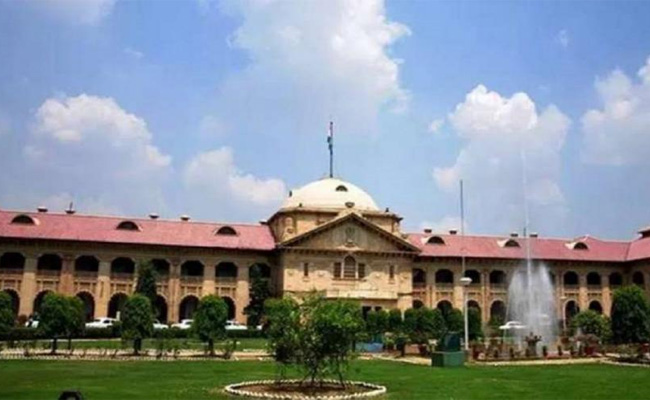
Lucknow (PTI): The Lucknow Bench of the Allahabad High Court on Friday ordered a probe by the special task force (STF) into alleged irregularities in the rejoining of a teacher at City Intermediate College in Barabanki, observing that the reinstatement appeared to be prima facie illegal.
The court also directed the recovery of the salary paid to the teacher during the disputed period.
A bench of Justice Rajeev Singh passed the order on a petition filed by the college management committee. The court expressed doubts over the roles of the District Inspector of Schools (DIOS), Barabanki, the college principal and the teacher concerned and hence, directed a detailed inquiry into the matter.
Taking note of alleged manipulation of records and misleading submissions, the court ordered the immediate transfer of the Barabanki DIOS to ensure a fair probe. It also directed the initiation of disciplinary proceedings against the then joint director of education of the Ayodhya division.
In its order, the court found that the teacher, Abhay Kumar, was initially appointed as an assistant teacher in 2018 but joined an Eklavya Model Residential School in Chhattisgarh as a lecturer in June 2024 without obtaining permission from the management. His subsequent request to retain the lien was rejected.
Despite this, he was allowed to rejoin the Barabanki College in September 2025 on the directions of the joint director of education and the DIOS, and was even paid the salary for October 2025. The court termed the rejoining "wholly illegal" and lacking any legal basis.
The bench also expressed concern over lapses in communication within the education department and directed the Uttar Pradesh chief secretary to ensure that official orders are communicated through email and WhatsApp as well, to prevent disputes.
The matter is next listed for hearing on May 28 when a compliance report is sought.