US ready to help India's defence but buying S-400 from Russia would limit cooperation: Trump admin
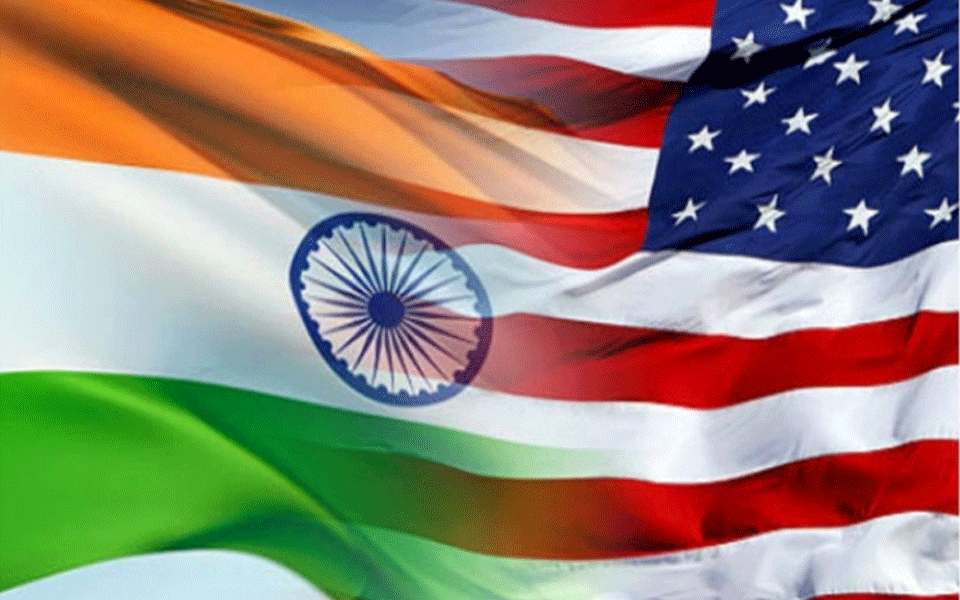
Washington: The US is ready to help India's defence needs with the latest technologies and equipment, but New Delhi purchasing long-range S-400 missile defence system from Russia would limit cooperation, the Trump administration has cautioned.
The statement came weeks after an identical warning from a senior State Department official who had said that New Delhi's deal to procure the lethal missile system from Moscow will have "serious implications" on India-US defence ties.
The S-400 is known as Russia's most advanced long-range surface-to-air missile defence system. China was the first foreign buyer to seal a government-to-government deal with Russia in 2014 for the system.
India and Russia signed a USD 5 billion S-400 air defence system deal in October last year after wide-ranging talks between Prime Minister Narendra Modi and Russian President Vladimir Putin.
Senior State Department official (South and Central Asian Affairs) Alice G Wells told House Foreign Affairs Subcommittee for Asia, the Pacific and Nonproliferation on Thursday that the US now does more military exercises with India than any other country.
"Under the Trump administration, we've been very clear that we're ready to help meet India's defence needs and we are seeking a very different kind of defence partnership building on the 'Major Defence Partner' designation that India has received from Congress," Wells said.
She was replying to the Congressional sub-committee on India buying S-400 from Russia and how to make India-US ties as robust and as meaningful as possible.
Just a few weeks ago, India, the United States, the Philippines and Japan did a sail by in the South China Sea, she said.
"In both our bilateral, trilateral, quadrilateral formats, we're working together in ways that we didn't even conceive of 10 years ago. And so we'd like all aspects of our military relationship to catch up to this new partnership," Wells said.
Noting that India has a historical dependence on Russian arms, she said what causes concern with the S-400 is that it effectively could limit India's ability "to increase our own interoperability".
At a certain point, she argued, a strategic choice has to be made by India about partnerships and a strategic choice about what weapon systems and platforms it is going to adopt.
"It is the case that 10 years ago we did not offer the range of military equipment to India that we're prepared to offer today. We're very much engaged in a conversation with India over how we can broaden our defence relationship," Wells said in response to a question.
Signing of COMCASA agreement between the two countries, she said, was a key step forward which allows for the classified sharing of information, which is one of the basic foundational agreements that foster military interoperability.
"So we're making significant strides forward in our military relationship," she said.
"There is no a blanket waiver or country waiver when it comes to an S-400. We have serious concern about a possible S-400 purchase (by India) and we're continuing our conversations on what the United States or other defence providers could assist India," Wells said.
Over the last 10 years, she said India-US defence trade has increased from zero to USD 18 billion, as New Delhi has started to diversify its weapons sources.
"We expect continued progress and expanding that defence relationship. But it's still the case that about 65 or 70 per cent of India's military hardware is Russian origin," she said.
And when Russian President Putin visited India last October, there were additional announcements of big ticket military items that were potentially under consideration, she said.
Responding to another question, Wells alleged that India has the highest tariff barriers of a G-20 country.
"Historically it has been a protected market. So, our failure to negotiate an agreement over the course of the last year and a half led to the decision to suspend the GSP benefits," she said.
However, GSP or asking India to stop purchasing oil from Iran is unlikely to push India into the China camp, she said when asked about it from a lawmaker.
"I don't think so. We are India's largest and best market. Twenty per cent of India's goods come here. There is Indian Foreign Direct Investment in the US. There's a huge interest by US firms in India. As Prime Minister Modi begins his second term. he's preoccupied with job creation and attracting Foreign Direct Investment is going to be a key part of that strategy.
"Properly conducted trade can be a huge strength to the relationship and that's certainly our focus as we begin our engagement with Prime Minister Modi in his second term as how do we fix this part of the relationship," Wells added.
Let the Truth be known. If you read VB and like VB, please be a VB Supporter and Help us deliver the Truth to one and all.
Rahul Gandhi joins Haryana Congress leader's 'Sadbhav Yatra' in Gurugram
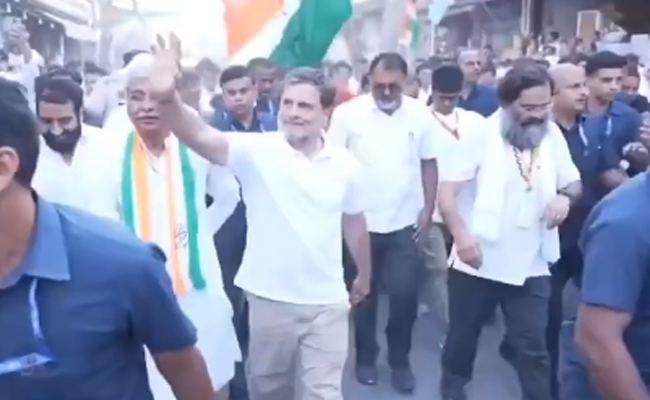
Gurugram (PTI): Congress leader Rahul Gandhi on Friday joined the 'Sadbhav Yatra' of Haryana Congress leader Brijendra Singh here.
Gandhi, who is the Leader of Opposition in the Lok Sabha, reached Gurugram in the evening and joined the yatra. He also walked some distance with Brijendra, state Congress chief Rao Narender Singh and other leaders.
Huge crowds had turned up for the occasion.
Later, Gandhi proceeded to the venue where he addressed a public gathering.
Leader of Opposition in Haryana Bhupinder Singh Hooda and other Congress leaders, including Randeep Singh Surjewala, B K Hariprasad, state Congress chief Rao Narender Singh, were also present.
Brijendra Singh had on Thursday said it is a matter of joy for them that Gandhi was joining the 'Sadbhav Yatra' in Gurugram-Badshahpur, "thereby strengthening the Indian National Congress' campaign for brotherhood and harmony".
The 'Sadbhav Yatra' began from Danoda village at Narwana in Jind on October 5, 2025, and has covered 85 of the 90 assembly segments in the state.
The foot march was started by Brijendra Singh, son of Congress veteran Birender Singh, to highlight several national and regional issues.
State Congress chief Rao Narender Singh had asked all party leaders to take part in Friday's event.
Days before his yatra began in October, Brijendra Singh, who narrowly lost the 2024 assembly polls from Jind's Uchana Kalan, accused the ruling BJP of playing "divisive politics" and said that "sadbhav" (harmony) has come under stress in the last decade.
Brijendra Singh was a sitting MP from Hisar for the BJP when he resigned ahead of the 2024 general election and switched over to the Congress. He also alleged that the saffron party creates a wedge in society to achieve its political purpose.
The 'padyatra' has so far covered 85 assembly constituencies in Haryana, traversing more than 2,700 kilometres.
Addressing the public gathering, Brijendra Singh said the yatra is inspired by Rahul Gandhi's Bharat Jodo Yatra, where he took the party's vision and values directly to the people of the country.
Singh said the yatra has highlighted issues like "Vote Chori" (vote theft), unemployment, poor law and order situation, agrarian distress, and issues related to government employees, labourers and traders.
"Sadbhav (harmony) and bhaichara (brotherhood), which the BJP is attempting to weaken, are the messages of this yatra," he said, adding that its slogan is "Congress ka haath bhaichara ka saath".
"This yatra is a natural extension of the Bharat Jodo Yatra," Brijendra Singh said.